Robert Baird, Phil Brett, Ray Chelstowski, Tom Fine

Revinylization #48: When Duke met the Bean

Saturday, August 18, 1962, was quite a day in music. In England, Ringo Starr made his first appearance as a full member of the Beatles, at a Horticultural Society dance at Port Sunlight, Merseyside. In Englewood Cliffs, New Jersey, two jazz giants met in a recording studio for the first time. Duke Ellington showed up with a streamlined, potent ensemble: Johnny Hodges, Harry Carney, Ray Nance, Lawrence Brown, Aaron Bell, and Sam Woodyard. Then tenor sax legend Coleman Hawkins arrived.

Ellington and Hawkins had never recorded together, so there was an atmosphere of energy and something grand and long overdue. Producer Bob Thiele and engineer Rudy Van Gelder stayed out of the way and let the music unfold while making sure not to miss anything. The result was a spectacular, loose, joyous, perfectly played album: Duke Ellington Meets Coleman Hawkins (Impulse! Records, AS-26, A-26 in mono).

Continue Reading »

The Last Beatles Song (and Other News)

The news zipped across the interwebs like lightning just after 9AM Eastern Time today (it went live here first). "Now & Then," a new-old song by The Beatles made with modern technology, bringing the band back together once more across time and space, will be released November 2. The evening prior, at 7PM London time, the BBC will broadcast "Now And Then – The Last Beatles Song," a short documentary directed by Oliver Murray, describing how the song was made. It will appear on the Beatles' YouTube channel at 8:30PM London time November 1, 3:30PM Eastern US time. There will also be a radio documentary about the song, produced by Beatles historian Kevin Howlett. The BBC today released the first 5 episodes of "Eras - The Beatles," a podcast hosted by actor Martin Freeman; episode 6 will drop November 2 (see https://www.bbc.co.uk/sounds/play/m001rzhw).

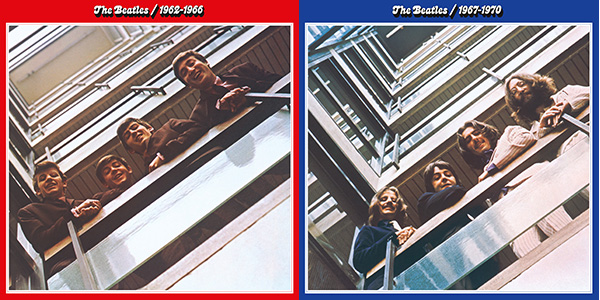
There's more: New 50th Anniversary expanded versions of 1962-1966 ("The Red Album") and 1967-1970 ("The Blue Album") will be released November 10.

Continue Reading »

JBL 4329P active loudspeaker

Hi-fi is at a crossroads. One road takes us toward modernized versions of the gear we grew up with, stuff that has been around since the 1950s. The other road faces the future. While sometimes accommodating physical media, including vinyl records, that's not where that road leads. On that road, streaming is the norm, and equipment may be hooked up with traditional signal cables or with no cables at all, just GHz-range electromagnetic radiation, the digital kind. In the more extreme cases, the music may remain digital all the way to the amplifiers, which themselves are likely to be class-D.

I keep a foot on both paths, hoping they don't diverge so much that they split me in two. I've got a substantial collection of physical discs, black and silver, and I play them often. But I love the convenience of my network-attached storage (NAS) appliance, Qobuz, even lossy Spotify, especially when I want my world filled with music for hours with no thought or action on my part.

Continue Reading »

Mytek Digital Brooklyn Bridge II Roon Core preamplifier

The concept of streaming digital music files over distances great (as with internet-streaming services like Spotify, Qobuz, Tidal, etc.) and small (from a home-PC hard drive, NAS, or networked music server) became mainstream only recently. But it was already brewing during the late 20th century, with people illegally downloading low-bitrate MP3 files made from CD rips and coming close to killing the recorded-music industry.

That wasn't streaming exactly, or not in the current sense, because the files needed to be downloaded, stored locally, then either played out of a computer or loaded onto a portable player, but from that point forward it was a steady march to the streaming-dominated present.

Never mind Napster—the first subscription audio "streaming" service was one you probably wouldn't think of: Audible, the audio book service now owned by Amazon, which started up in 1995. I did beta testing and editing work for early-days Audible, and around that time, I started loading up home-ripped MP3 files on a pocket-sized Rio MP3 player (which by then had replaced Audible's proprietary player), using it in place of a portable CD player. This led to experiments with a PC music library/player running Linux, controlled by a Handspring PalmOS device connected to the stereo system via a Sound Blaster 16 card.

Continue Reading »

Bob Ludwig—The Mastering Master Bids Farewell (Part 2)

The wall of Gold and Platinum Disc Awards, as displayed at the Gateway Mastering website.

In Part 1 of this interview, which announced that famed mastering engineer Bob Ludwig was retiring, Ludwig discussed his early days as a music-loving student, as a trumpet player, his graduation from Eastman College with a Master's degree in music performance, and how working with legendary engineer and producer Phil Ramone at A&R Studio awakened his interest in how records are made. In this second part, Ludwig talks about how he moved to Sterling Sound, then to Masterdisk, and finally how and why he set up his own studio, Gateway Mastering Studios in Portland, Maine.

Continue Reading »

Bob Ludwig—The Mastering Master Bids Farewell (Part 1)

Photo: Peter Luehr

If album sales, longevity of career, position on the leading edge of audio technology, reputation in the music business, and involvement in many of the most important albums in history are the measurements, Bob Ludwig is the GOAT (Greatest Of All Time) of music mastering.

"I'm an old goat, anyway," he joked during our multiday, many-hours conversation, centered around his recent retirement announcement and his five-plus decades as a mastering engineer.

If Bob Ludwig is the Michael Jordan of music mastering—and the case can definitely be made—then this is big news. I'll repeat it for emphasis: Bob Ludwig is retiring. Ludwig stopped taking new work on June 30, 2023.

Continue Reading »

Revinylization #44: Little Feat's evolution in two classic albums

Little Feat's beginning was a slow burn, bolstered by the faith of record company execs as the band found its groove. Once it found its, um, feat, the band thrived through deaths and other turmoil. In fact, they're still at it. This fall, according to Rhino Records, the band will be performing "on back-to-back nights ... at selected venues" the two albums that document the time they found their way: 1972's Sailin' Shoes and 1973's Dixie Chicken.

In conjunction with that 50th anniversary mini-tour, Rhino has issued deluxe remasters of both albums on 3 LPs or 2 CDs, with plenty of bonus material and a previously unissued live show with each album. On the LP sets, the two original albums were remastered by Bernie Grundman "from the flat master tapes," according to Steve Woolard, Rhino's head of A&R. Plating and pressing was done at Precision Record Pressing in Ontario, Canada. Rhino was kind enough to send me both the LP and CD sets so that I could compare the sound and presentation.

Continue Reading »
Advertisement
Advertisement
Advertisement