Cable Reviews

Sort By:  Post Date TitlePublish Date

Kimber Kable Carbon Series speaker cable and interconnect, PK10 Palladian power cable

Ray Kimber founded his enterprise in the late 1970s, and for the last half-century has withstood the ravages of this difficult market. He first got involved in cable technology while addressing the problems of induced interference in audio connections where high-power installation lighting was involved, especially early thyristor-controlled systems.

An AudioQuest Cable Loom: Vodka network, Pegasus interconnects, Robin Hood speaker cables, Blizzard power cables

I began the test series I discussed in Colloms on Cables with the first company to respond to our request for review samples: AudioQuest. Their loom comprised a pair of Robin Hood Zero loudspeaker cables; Pegasus I/C interconnects, both unbalanced RCA and balanced XLR; Blizzard AC power cables; and Vodka Ethernet cables. AudioQuest has decades of experience with audio cables, supplying a huge range from high-quality "industrial" cables—some available in bulk for custom-install applications and manufacturing—to more familiar audiophile constructions. Their designs are highly finessed and exquisitely terminated, some executed in exotic materials, particularly solid silver. An established bedrock of engineering underlies AudioQuest's cables. They're based on high-quality, nontwisted conductors, low-loss insulation materials, well-known construction geometries, and a nuanced approach to subtler aspects including conductor purity and cable-draw finish.

Brilliant Corners #26: Racks, Cleaners, Cables, Resonators

Some years ago, I visited the home of a well-known American author who happened to be an audiophile. His cramped, dimly lit listening room contained a tube amp, a DAC, and a pair of inexpensive floorstanding speakers surrounded by what looked like a museum of audio tweaks. I recall a scarecrow-like contraption with swiveling wood-and-metal arms that rearranged magnetic fields, assorted boxes and panels that promoted "quantum proton alignment," mysterious dots covering the walls like a rash, and nearly a dozen things dangling from the speakers' binding posts that were supposed to do something I can't remember. The author had an almost mystical belief in the power of these objects to bend the laws of physics and told me that he'd spent more on them than on the rest of the system, because in his opinion they were more important to the overall sound.

The thing that surprised me most is that despite the tweaks—or maybe because of them—his hi-fi sounded pretty terrific.

Gramophone Dreams #87: Deejay Coolosities, AudioQuest Yosemite tonearm cable, Nagaoka MP-110 phono cartridge

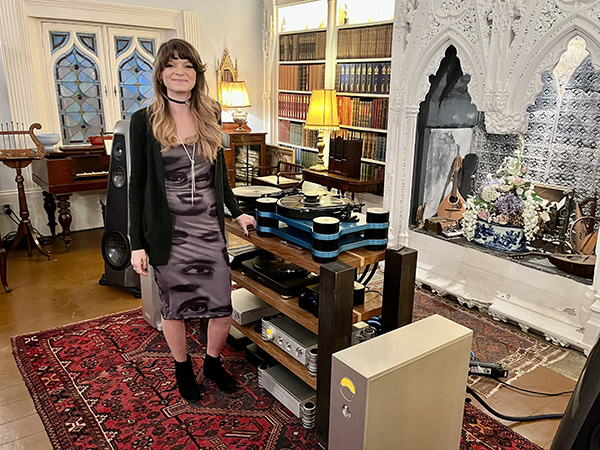
SME’s Kathryn "Kat" Ourlian deejays a turntable shootout. Photo by Michael Trei.

One August night in 1965, I parked in the driveway of my best friend Derf Marko's house and let myself in the back door. As I entered, I could see to the bottom of the basement stairs, where I observed a loud pulsing darkness with plumes of agreeably acrid smoke floating up through the stairwell. Back in the darkness, I heard Derf/Fred and another person making declarative statements in loud unintelligible bursts. When I reached the bottom of the stairs, Marko's basement rec room looked like a trashed-out tiki bar illuminated by a single red Christmas light hanging just above a Dual turntable. The room was dark to a point where it was impossible to walk without stepping on records or to make out who was there and what was going on. I slouched on a couch, closed my eyes, and let my mind follow the sounds of rock drummers wailing like angry cats.

Soon it was obvious: Marko was frantically playing one drum solo after another while some crazy old dude kept hollering for the next solo before the last one finished. The revved-up stranger kept slapping his knees, muttering, and drumming along with each different drummer. Stacks of unsleeved LPs littered the linoleum floor and pink wool couch I was slumping on. But unbelievably, Marko adeptly—without cursing, fumbling, or hesitation—located every solo he wanted.

I found out later that the crazed "old guy" was Ginger Baker!

Analog Corner #244: TARA Labs cables, Synergistic Research accessories, Stillpoints ESS rack

Does everything produce an improvement?"

My skeptical visitor, to whom I'd just pointed out some of the acoustic treatments and other accessories in my listening room, wasn't trying to push my buttons. He just wanted my opinion.

"No," I said. "Some things make the sound worse—way worse—but after all these years, I'm convinced that just about everything that can be done to a room or a system produces an audible difference, for better or worse."

Analog Corner # 247: Dr. Feickert Firebird turntable, Viva Fono MC phono preamplifier, AcroLink and Fono Acustica interconnects

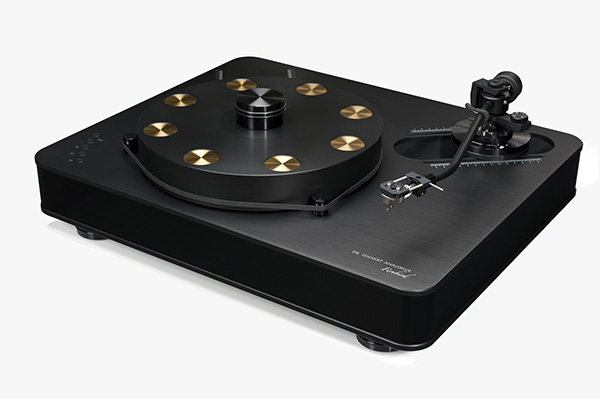
Dr. Feickert Analogue's top-of-the line turntable, the Firebird ($12,500), is a generously sized record player designed to easily accommodate two 12" tonearms. Its three brushless, three-phase DC motors, arranged around the platter in an equilateral triangle, are connected to a proprietary controller in a phase-locked loop (PLL); according to the Firebird's designer, Dr. Christian Feickert, a reference signal from just one of the motors drives all three—thus one motor is the master while the other two are slaves. (Man, today that is politically incorrect, however descriptively accurate.)

Gramophone Dreams #82: IKIGAI Kangai-level cables, dCS Lina headphone amplifier

Decades ago, when I was peddling million-dollar sound systems, an astute potential customer asked me: "If I buy your very expensive system, what will I get that I'm not getting with my less expensive system?" Smiling my best fatherly smile, I whispered to his ear, "Goosebumps, tears, and laughter."

With a slightly worried look, he asked, "How much did you say those silver cables cost?"

Thirty years later
Changing audio cables always changes the sound of my system, sometimes a lot but usually just a little. Typically, the sonic effects of cable changes are modest shifts in focus, tone, or transparency. But sometimes during blue moons I've seen a new set of cables turn a blah, dull, fuzzy system into a macrodynamic, microdetailed one. Or turn a cool, mechanical-sounding system into something fierce and mammalian.

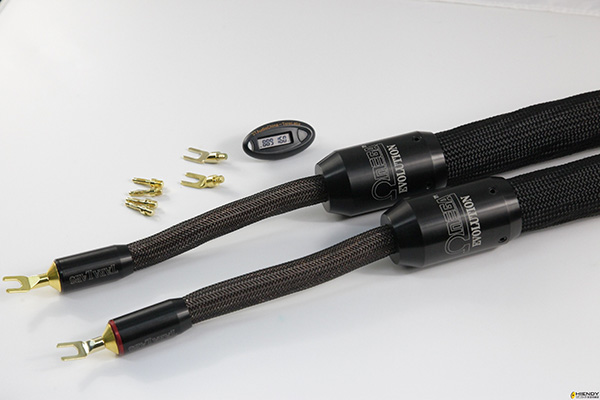
Analog Corner #257: AJ Conti, Audio Research Reference Phono 3, TARA Labs Air Evolution cables

As I began writing this column, the terrible news arrived that Armando "AJ" Conti, founder of Basis Audio, had died of a heart attack at 59. A talented designer of turntables and tonearms, AJ was one of the warmest and more thoughtful people in the High End. Whenever I entered the Basis room at a Consumer Electronics Show, I had to be prepared to spend the next hour or more talking with AJ—not only about audio, but about coffee, motorcycling, metallurgy, or any other of his many passions . . .
Advertisement
Advertisement
Advertisement