CES 2010

Sort By: Post DateTitle Publish Date

Vivid Giya G2 Loudspeaker
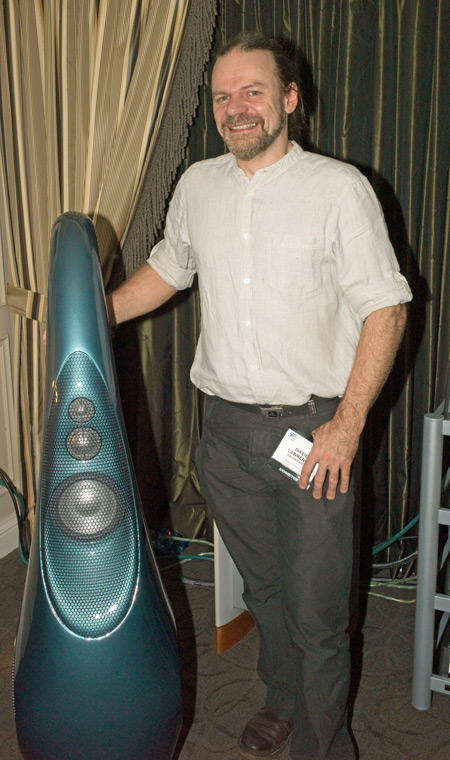
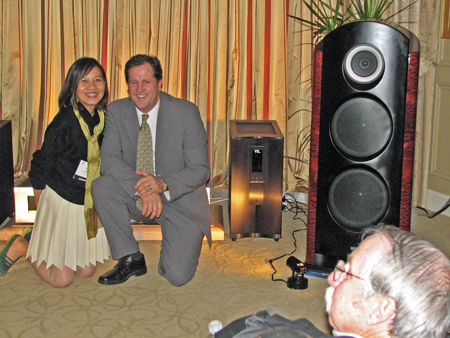
John Atkinson introduced me to English engineer Laurence Dickie, who was sharing our ride up the elevators to the 34th floor of the Venetian Hotel. Mr. Dickie is a well-known loudspeaker designer, responsible for the original B&W 800 and B&W Nautilus loudspeaker designs, and as well as the cute little Blue Room Minipods, and is now creating new products for South African company Vivid from his design studio in Brighton, England. "Dick," as he is known to his friends, designed the G1 flagship for Vivid, which retails now for $65,000/pair and was being demonstrated in the Convergence Audio suite with, among other things, the piano recordings John Atkinson made and wrote about in the February issue’s “As We See It.” Laurence is shown here with the smaller G2, which was being demmed">http://blog.stereophile.com/ces2010/halcro_and_vivid/">demmed in the Halcro room and so impressed Erick Lichte.
TAD Heaven

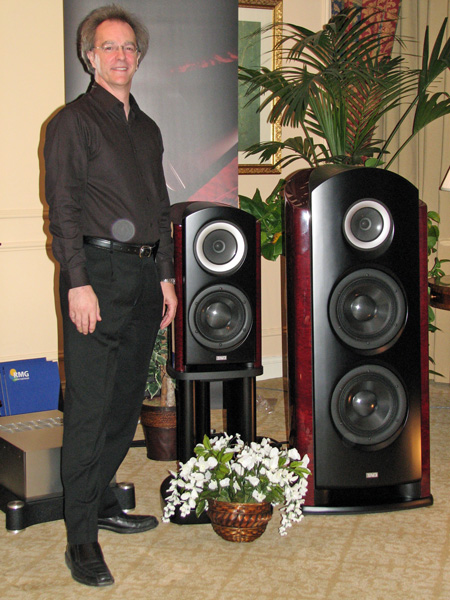
I felt as though I had entered sacred space. As I walked into the huge TAD suite, designer Andrew Jones was playing Aaron Neville's recording of "Amazing Grace." Everything about the sound, the speaker layout, and the rapt silence of the full house felt like a holy shrine.

Audience at THE Show

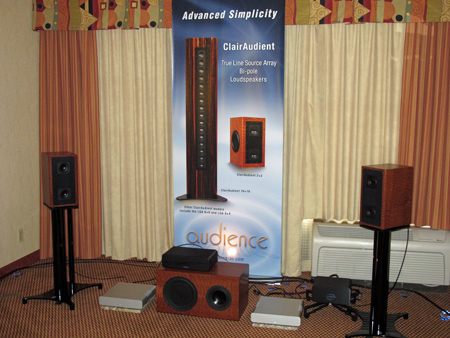
My penultimate stop at THE Show, held for the first time this year at the Flamingo, was the Audience room, where they were playing a system full of new gear. Their line stage combines a relay-controlled autotransformer volume control and zero-gain active buffer. The unit has four inputs, all single-ended, and very clever switching to keep noise to an absolute minimum. Oh—it also includes a headphone amp and all of Audience's power and signal-transfer technology, in a sleek, compact package.


Trial By Stereophile

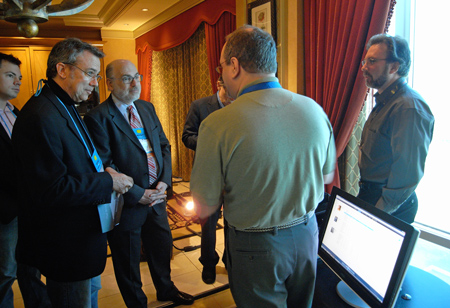
Most of the time at CES, Stereophile's writers prowl the corridors in solitary fashion. But occasionally we find ourselves in the same room at the same time, which was the case in the Blue Smoke suite at the

Mirage, where we had gathered to check out the company's new server that Jon Iverson blogs about elsewhere">http://blog.stereophile.com/ces2010/blue_smoke_black_box_music_server/"… in this report. Seen in this photo are (from left to right): Erick Lichte, Jon Iverson, Kalman Rubinson, Larry Greenhill (partially hidden), Blue Smoke's Peter Sills (back to the camera), and someone whose name tag I couldn't see. It gives you an idea of the inquisitorial mode we are in at Shows, desperate for detail but eventually satiated with sound.


Audio Research's "Magnepan" Amplifier

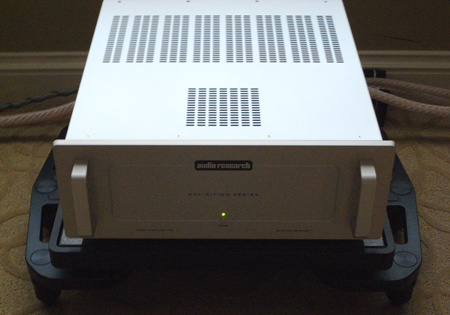
My last stop of the day, and of the show, was the Audio Research room. Dave Gordon showed me their new DS-650 (I'm not sure that the designator was DS) stereo amp and laughed that it was their "Magnepan amp." Yup, I agree. As I discovered when I paired a pair of MG-3.6s with Classé CAM-350s, while any competent 20Wpc amp will drive a pair of MG-3.6s adequately...any top-notch 300–400W amp will actually drive them well. Then Dave casually noted that the 650 was a class-D amp and told me to put my hand on its top. Sure enough, it was cool as a cucumber in spite of having been on and making music for several days. "The entire amp is ours, from the bottom up," Dave noted, "there's nothing standard or off the shelf in there."


Vital VTL

What a relief to revisit VTL electronics, and breathe in the mellow midrange of jazz vocalist Johnny Hartmann singing on the Original Recordings Group reissue of I Just Dropped by to Say Hello. There's a beauty and timbral truth to VTL electronics that you do not hear from many tube products that cost more than the $50,000/pair Siegfried monoblocks, and far more than the wonderful VTL MB450 Signature Series II monoblocks ($15,000/pair).


Sonic Studio Amarra

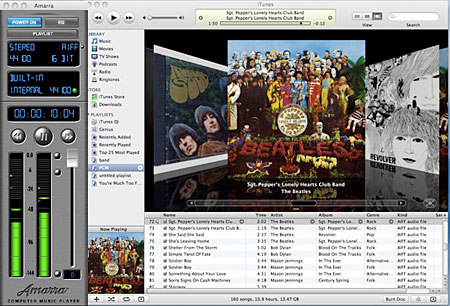
Those who follow computer audio forums have probably heard the name Amarra a few times. If you have an Apple computer running iTunes and want to get the most out of high resolution audio, Sonic Studio's Amarra software offers a way around some of the inherent problems when switching resolutions and the way the Apple OS handles audio.


Advertisement
Advertisement
Advertisement