CES 2010

Sort By: Post DateTitle Publish Date

The Mag Amp—World’s First Switching Amp

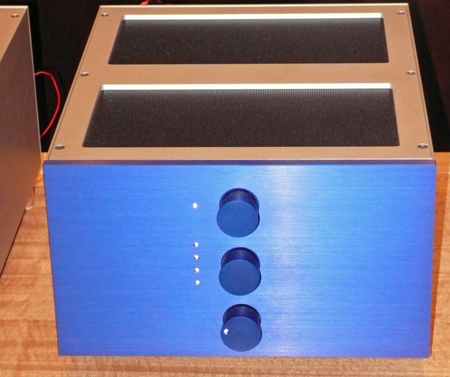
John Devore was using this diminutive integrated amplifier, the German-manufactured Acoustic Plan Mag Amp, to drive his new high-sensitivity loudspeakers. According to Jonathan Halpern, the US importer, the Mag Amp uses a tubed voltage-gain stage and an output stage comprised of two small transformers with dual primaries. He described it as the "world's first switching integrated amplifier, and added that it was designed by Lars Lundahl in the 1960s. The 19 kg stereo chassis offers 15Wpc into 8 ohms and will cost $18,500. It played both a 1980s recording of Ella Fitzgerald and one of Stravinsky's Pulcinella Suite with great dynamics, speed, and detail. This is the kind of odd and fascinating gem one can uncover at the end of a day when one is too tired to rush out of an exhibit room, and instead collapses on the couch to listen.


John Devore and his Orangutans

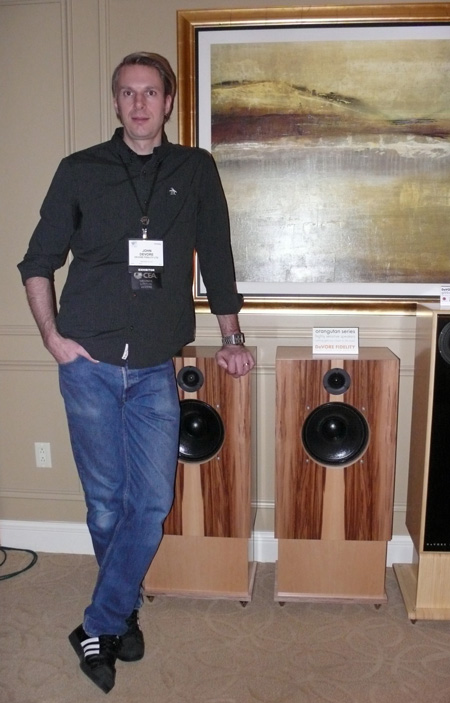
I was highly impressed with the dynamics, speed, and pace of a new $8000/pair loudspeaker from John DeVore, a speaker maker from my area of the country, Brooklyn, New York. I had first read about John in the New York Times when it featured new and brave entrepreneurs making their way in Brooklyn during the recent recession. I was interested, because of my medical research background, that the very tall Mr. DeVore had been positively influenced in his younger years by an uncle who was a leading primatologist, and had take him to Africa to view various monkeys living in their natural habitat. As a result, John names his loudspeaker lines for various species, including the Gibbon, Silverback, and now Orangutan. This floorstanding, two-way, high-sensitivity ([95]dB/2.83V/m) loudspeaker features a 1" silk-dome tweeter and a reflex-loaded, 10" treated-paper woofer (rear port) in a cabinet with a lace walnut finish. I was struck by the similarity between John's energy and enthusiasm and the dynamics and pace of the music the Orangutan generated driven by the 15Wpc Mag Amp.


Vandersteen's Model Seven in Production

Vandersteen's $45,000/pair, time- and phase-correct, four-way, floorstanding, Model Seven loudspeaker made its debut at the 2009 CES but is now in production. I sat with Richard Vandersteen in his suite at the Venetian, and listened intently to his description of how he designed the Model Seven. He started by saying, "I didn't really understand the advantages of carbon-fiber as a material that could help speaker design until I built my own airplane." From there, he described how he developed a patent-pending sandwich of high-Young’s Modulus carbon-fiber skins bonded to a balsa-wood core for the mid-bass, midrange, and tweeter diaphragms, which combines very high stiffness for proper pistonic operation, with high self-damping. Carbon-fiber construction for the enclosure also allowed him to restrict the cabinet resonance to very high frequencies, where they will have no effect on sound quality. The drive-units use Vandersteen’s patented method of avoiding rear reflections from the magnet structure. The powered 12" subwoofer fires down at the floor. All this was evident when he played a vinyl recording of Holst's The Planets. The Model Seven, driven by Aesthetix amplification, played with unusual clarity and definition, and I could easily follow different motifs in this orchestral selection that I had not been aware of at home. From what I heard at the Show, I anticipate the Model Seven doing very well in the review scheduled to run in the March, 2010 issue of Stereophile.


Tenor Amps and Hansen Speakers

It was a case of Johnny Hartmann the third time over. In the room shared by Hansen and Tenor Audio, my third encounter with Hartmann's vocalism at CES 2010 came via a CD transfer of a 1964 recording. Happily, the CD retained much of the vocal richness of the two Hartmann LPs I had heard earlier in the show.


Tidal Speakers and Ypsilon Amps

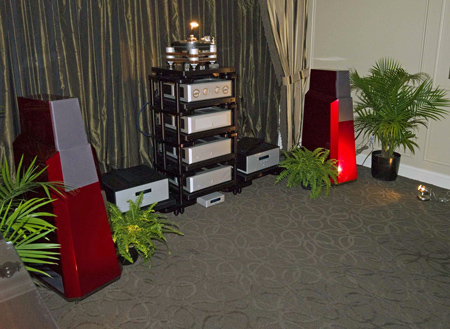
Visiting one of Aaudio Imports' rooms gave me another opportunity to hear Tidal loudspeakers from Germany. I initially encountered an extremely imposing pair of these speakers on the first day of the show, paired with BAlabo electronics and Echole cabling. Now before me was a smaller pair of the Tidal speakers, either the Contriva Diacera SE ($73,500/pair) or Piano Cera ($28,400/pair). (The equipment sheet listed both models).


Avalon Stops the Clock

Beckoning like the mythical paradise for which the Coloradon company is named, the Avalon Acoustics Time loudspeakers ($47,995/pair) stood in a large suite on the 34th floor. Surrounded by a large complement of room-tuning devices that only partially controlled their low end, the beauty and clarity of the Time's diamond tweeter transmitted the beauty of Renaud Capuüon's violin as few other speakers I have heard.

Dynaudio's Little Dynamo

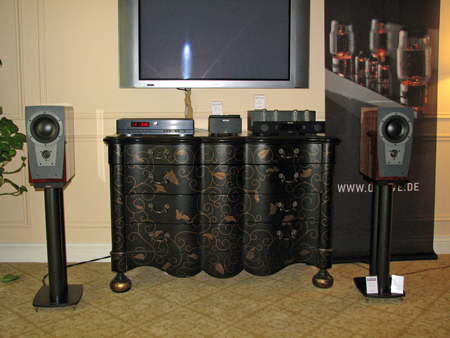
Dynaudio had something for almost everyone with an exhibit that ranged from affordable to cost-no-object. At one of the room stood the imposing Consequence SE, whose bass was so powerful that it would interact with the spongy wall behind it unless the mighty Michael Manousselis braced himself against the corner. But on the other end of the long room sat a marvelous little system composed of the Contour S 1.4 ($3500/pair, with optional stands costing an additional $450), Octave V40SE 40Wpc integrated amp ($4900), and an optional capacitance Black Box ($1200) that increased the capacitance of the integrated amp's power supply. Interconnects were from Tara Labs, and speaker cables the Ocos Pro ($900/3 meter pair).


The Fabulous Acapella-Einstein Duo

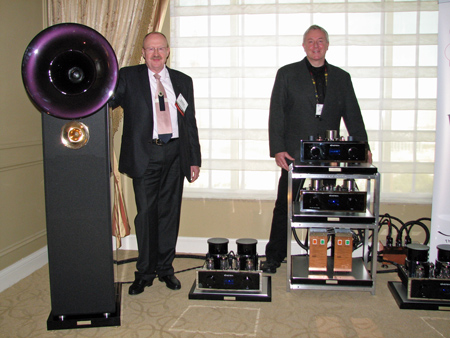
I have heard Acapella horn loudspeakers and Einstein electronics on other occasions, but they have never sounded as glorious as they did paired together in one of the Aaudio Imports room at CES 2010. I only wish Erick Lichte and John Atkinson had been present as I played John's 2008 recording of Cantus' While You Are Alive, which Erick produced. (Erick was also Cantus' Artistic Director at the time). The sound was big—huge, in fact—maximally transparent, and thanks to the Einstein electronics' euphonic presentation, absolutely luscious.


Old Times, Good TImes

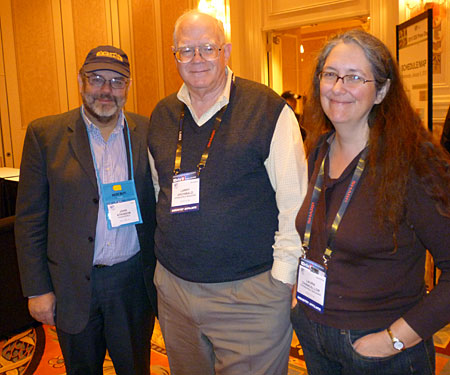
CES is where you can see the new but it is also where you can catch up with old acquaintances. Caught here in the CES Press Room in Jon Iverson's photo, I'm standing on the left with my partner in Stereophile Inc. for 12 years, Larry Archibald, who is both enjoying his retirement from the high-end audio industry and missing it, and Larry's wife, Laura Chancellor. It was on the 700-mile drive back to Santa Fe, New Mexico, from the CES in January 1986 that Larry, Laura, and I mapped out the future of Stereophile.


Advertisement
Advertisement
Advertisement