Turntable Reviews

Sort By: Post DateTitle Publish Date

Listening #108

I set out on a fishing trip but returned less than an hour later, empty-handed. You asked me, reasonably enough, "What happened?"


"I spent a half-hour digging in the garden for worms, but couldn't find any."


"You could have driven to Mr. Zetterstrum's farm, knocked on his door, asked his permission, and spent a few hours overturning the cowflops in his pasture. I'm sure you would have found one or two worms that way."


"You're right. I guess I didn't want to go fishing that badly."

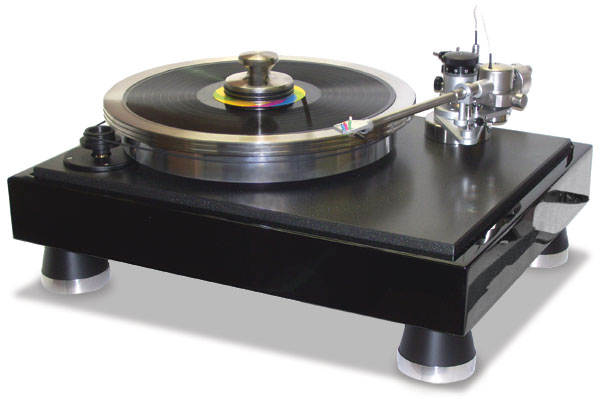
VPI Classic 3 turntable & Classic-JMW tonearm

Trends in turntable design shift back and forth over time, each "advance" turning out to be a mostly sideways move. Over its long history, VPI's founder and designer, Harry Weisfeld, has moved the analog goalposts back and forth as he's refined his thinking. His early turntables were mostly standard spring-suspension designs of normal size. By the time Weisfeld produced his fully tricked-out TNT model, which was originally designed to stably hold the heavy moving mass of Eminent Technology's ET2 air-bearing arm, he'd moved to a massive, oversized, sandwiched plinth with isolating feet at the corners. He first used springs and, later, air bladders originally designed to cushion a tractor-trailer's load, and which he'd found in a trucker's supply catalog. Via an O-ring, the TNT's outboard motor drove one of three pulleys that protruded from holes in the plinth, and attached to a T-shaped subchassis that, in turn, drove the other two pulleys via two additional O-rings.

Listening #106


In 2010, sales of motorcycles equipped with sidecars accounted for only 4% of total motorcycle sales in the US. But that was a significant increase over 2009, which was itself an increase over 2008. While numbers remain low overall, sales of sidecar motorcycles are going up at a decent rate, while sales of most other motorcycles are in the toilet.

Clearaudio Concept record player

Enticing more music lovers to try vinyl requires a foolproof, plug'n'play solution. Asking a member of the digital generation to install a cartridge in a tonearm and then set up the VTA, SRA, VTF, etc. is asking too much. It's easier to make such a request of someone already bitten by the analog bug, but with turntables, wishing someone beginner's luck will not guarantee success.

Brinkmann Audio Bardo turntable

I won't debate here how to make a turntable's platter go around. Choose your favorite: belt vs direct drive, idler wheel vs belt, spring-windup vs wind power, whatever. As far as I'm concerned, there's nothing to debate. Each of these technologies has its pluses and minuses, but none can produce CD's accuracy of speed and inherent freedom from wow and flutter.

Rega RP-1 record player

I tried to name a high-end audio product that's been recommended more often than the Rega Planar 3 turntable. I failed.


The closest I could come was Rega's own RB300 tonearm, surely the best-selling perfectionist tonearm of all time. After that came the Rega Planar 2 turntable, a sample of which I owned and loved in the early 1980s. Next on my list was the original Rega Elys, a moving-magnet cartridge that sounded as chunky and direct as it was cheap and magenta.

Spiral Groove SG2 turntable

Photograph: TONEAudio Magazine


High-end audio exists at the intersection of art and science. Either discipline can produce a good product, but it takes both to create the very best. The Sonic Frontiers gear I auditioned many years ago, for example, was technically sound, nicely built, and sounded good—just never as sublime as products from, say, Audio Research or VTL. On the other hand, an experienced, insightful designer such as Quicksilver's Michael Sanders can create wonderful products from humble circuits and parts, but be ultimately limited by the underlying technology. But when brilliant design, uncompromised execution, long experience, and artistry all come together, the results can be staggering.

Bauer Audio dps turntable

Although LPs remain, for me, the high-end medium of choice, I'm not terribly interested in today's high-end record players. Most of them, from the 1980s through the present, have been soulless, uninspired, me-too products that utterly fail to communicate the presence, momentum, and punch of recorded music. And in certain ways—expense, complexity, size, cosmetics—some have been, quite simply, ridiculous.


Oracle Delphi Mk.VI turntable

Thirty years have not diminished the beauty and elegance of Oracle's Delphi turntable. In my opinion, it still ranks among the best-looking turntables ever made. I bought an original Mk.I, used, in 1982, and very positively reviewed the Delphi Mk.V in the December 1997 Stereophile.


In its three decades the Delphi has undergone many upgrades both technical and aesthetic. Not surprisingly, so has the price. The Mk.II Delphi sold for $1250 in 1986; the Delphi Mk.VI with Turbo power supply and dedicated power cord now sells for $8500, which, in today's market, I think is reasonable for what you get. The review sample came with an Oracle/SME 345 tonearm ($3100) and a Benz-Micro Thalia high-output MC cartridge ($1700), for a total cost of $13,300—or $11,600 for just 'table and arm.

Pro-Ject Debut III record player

In the January 2010 issue of Stereophile I gushed">http://www.stereophile.com/integratedamps/marantz_pm5003_integrated_amp… effusively about the $450 Marantz PM5003 integrated amplifier. Not only was I impressed with the sound, build quality, and features of this very affordable component, but, intrigued by how it might be combined with other gear to build a complete entry-level system for about a thousand bucks, I began to ponder other entry-level components that might nicely complement it. My goal here, of course, is to inspire a new generation of young audiophiles. I felt a turntable would be a good place to start.


Advertisement
Advertisement
Advertisement