Audacious Audio

Sort By: Post DateTitle Publish Date

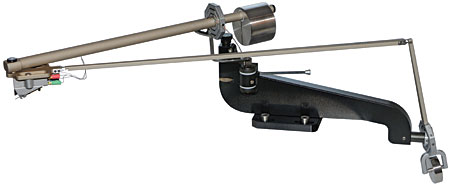
HiFiction Thales AV tonearm

Ideally, LPs should be played with the pickup stylus remaining tangential (ie, at a 90° angle) to the groove—just as the lacquer from which the LP was ultimately stamped was cut in the first place. Over the years, many attempts have been made to accomplish this. Back in 1877, Thomas A. Edison's original machines tangentially tracked his cylinders, but Emil Berliner's invention of the flat disc put an end to cylinders altogether. In the 1950s, a number of companies marketed so-called "tangential" trackers that used dual arms, based on conventional pivoting arrangements, to change the angle at which the headshell was mounted as it moved across the LP side. In 1963, Marantz introduced the SLT-12, which used a plastic pantograph to move the stylus across the record surface. Garrard's Zero 100 pivoting arm controlled its independently pivoting headshell with a bar that extended from the main bearing of the tonearm.


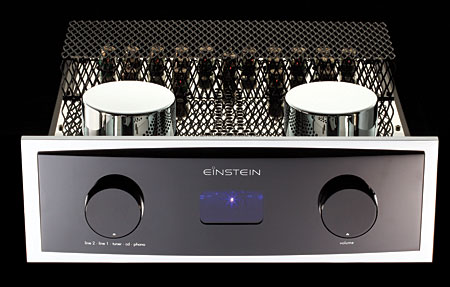
Einstein Audio Components The Tube Mk.II preamplifier

It doesn't take a genius to appreciate the audacity of naming a company after Albert Einstein, the iconic science and math whiz. Clearly, company founder and owner Volker Bohlmeier knew what he was doing—this German brand of boutique electronics has enjoyed worldwide critical and marketplace success since its founding more than 20 years ago.


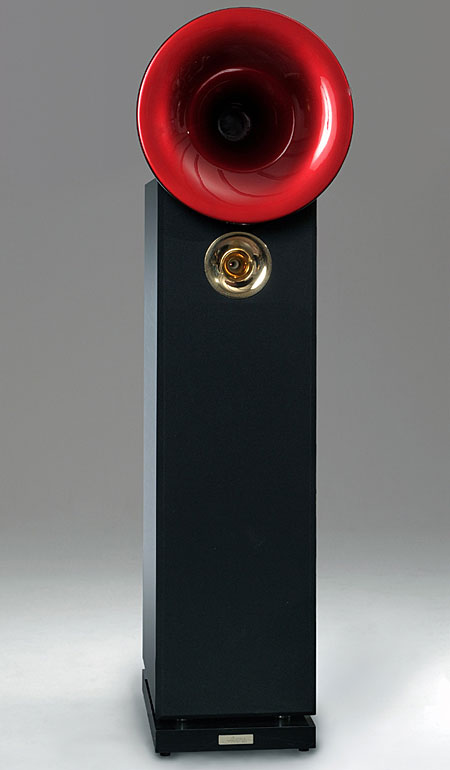
Acapella High Violoncello II loudspeaker

Stereophile's founder, the late J. Gordon Holt, always had a thing for horn loudspeakers, feeling that these archaic beasts offered a "jump factor" that could never be rivaled by conventional, direct-radiating designs. A horn drastically increases the efficiency with which electrical power is converted into acoustic power, which means that for a given sound-pressure level, a smaller amplifier can be used compared with a direct-radiator, and that all distortions, both electrical and mechanical, can theoretically be much lower. Yet outside of a small circle of enthusiasts, horns never got much of a following in high-end audio, and as high amplifier power became plentiful and relatively cheap, horns largely disappeared from domestic audio use (except in Japan).


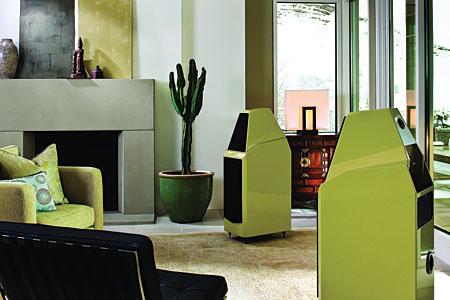
Wilson Audio Sasha W/P loudspeaker

Before last year, I had no more than a professional interest in the products of Wilson Audio Specialties. But before last year I hadn't experienced Wilson's">http://www.stereophile.com/artdudleylistening/listening_86">Wilson's Sophia Series 2 loudspeaker ($16,700/pair)—which, like the wines I tend to order when my wife and I go out to dinner, is the second-cheapest item on their menu. Within weeks of the Sophias' arrival, respect had turned to rapture, like to love, and an entirely new appreciation for Wilson Audio was mine (footnote 1).


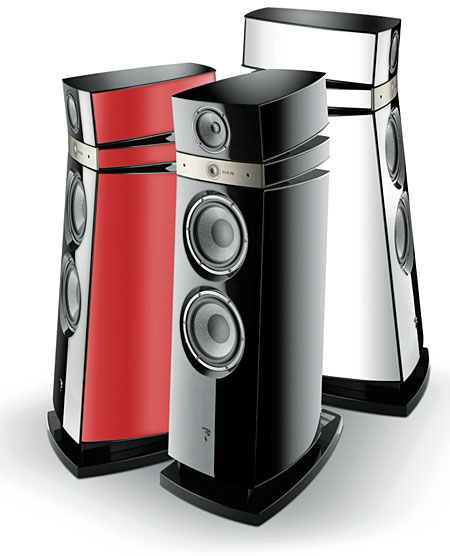
Focal Maestro Utopia III loudspeaker

Considering that the crates they're shipped in are each as large as a Manhattan studio apartment, once they'd been set up in my listening room, Focal's Maestro Utopia III speakers weren't as visually overpowering as I'd anticipated. The elegant dark-gloss front baffles, the gloss-gray side panels, and the fact that the speaker's three subenclosures are vertically arrayed so that the top, midrange section is angled down, significantly reduced their apparent size.


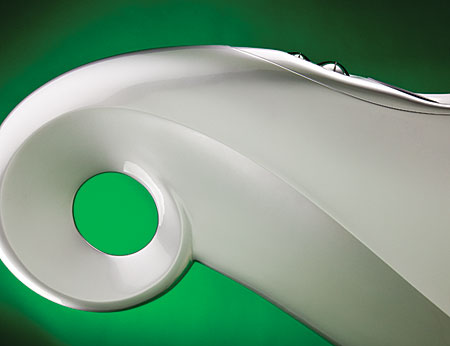
Vivid Audio G1Giya loudspeaker

Over the years that I've been reviewing hi-fi, I've had my share of loudspeakers that drew comments from everyone who visited during the audition period. Some of those comments were about the speakers' appearance—most often about their size—and some were about how good they sounded. Vivid's G1Giya loudspeaker ($65,000/pair), its narrow-baffled, swirling cochlear shape molded from fiber-reinforced composite, elicited more comments of both types than has any other speaker I've reviewed.


Advertisement
Advertisement
Advertisement