CD Player/Transport Reviews

Sort By: Post DateTitle Publish Date

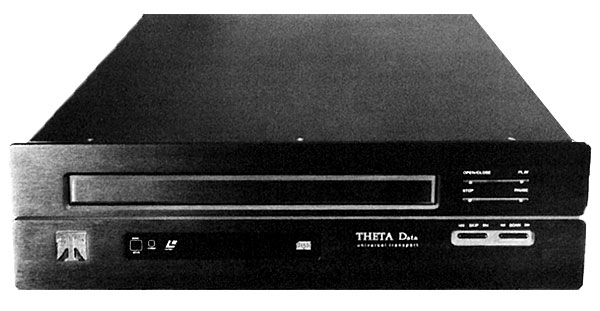
Theta Data universal disc transport

"In the fields of observation, chance favors only the mind that is prepared."


When Louis Pasteur uttered these words more than a hundred years ago, he must have speculated that they would apply equally well to future circumstances as to the events of his day. What he couldn't anticipate, however, was the technology to which his insight now seems so appropriate.

Meridian 602 CD transport

"I don't like Mondays!" sang Bob Geldof some years back, and I'm beginning to hate Mondays too. No, not for the obvious reason. You see, Monday is "hate-mail" day. Every day I get letters from Stereophile's readers. But for some reason known only to the mavens (or should that be Clavens?) of the US Postal Service, the ones pointing out my stupidity, dishonesty, and sheer incompetence as a human being arrive on Mondays.
For example: "Bits are bits, and it is therefore dishonest for Stereophile's writers to continue to insist that they can hear any differences between CD players or digital processors!" recently wrote an angry reader, canceling his subscription. (They always tell me they're going to cancel their subscription.) "Yeah, right!" thought I, having just sat through a comparative audition of, would you believe, digital data interconnects in Robert Harley's listening room. Some of the differences I heard were not trivial. They might even be audible in a blind listening test.

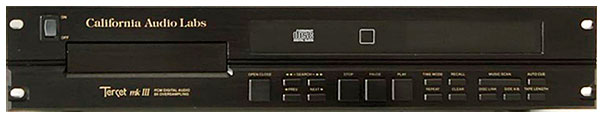
California Audio Labs Tercet Mk.III CD player

At $1295, the Tercet Mk.III represents a step up from CAL's $750 Icon, which I enthusiastically recommended back in April 1990 (Vol.13 No 4, footnote 1). Externally, with the exception of a wider and slightly thicker front panel, it appears to be a carbon copy of that unit. Like the other products in California Audio Lab's stable, the Tercet Mk.III is designed from the ground up in-house.

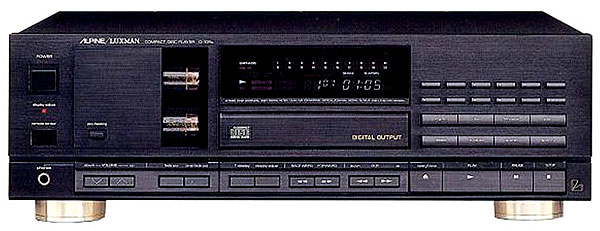
Luxman D-105u CD player

The $1200 D-105u, the top of Luxman's CD-player line, is novel in its twin-triode vacuum-tube amplification in the analog output stage. This configuration is said to provide high linearity with low distortion and that hard-to-quantify musicality found in tubed products. In addition, the D-105u incorporates an anti-vibration laser pick-up mechanism and a high-mass magnetic disc clamper, the latter feature said to mass-load the disc center to minimize spindle-motor microvibration, thus improving tracking accuracy for lowest error rate.

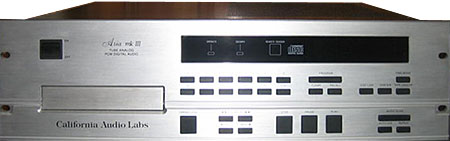
California Audio Laboratories Aria Mk.III CD player

The face was different, but the look was familiar. It should have been. The $2395 Aria Mk.III is a close cousin to the Aria II that I'd hung around with for about two years. Same sense of style, same heart of tubes. CAL Audio apparently made it what it is today, from the ground up. They even designed its transport and transport-drive circuitry in-house (footnote 1). In a high-end world which has gone increasingly to separate digital processors, CAL has been, up till now, a conspicuous holdout. They've only recently introduced their first outboard converter, and have in the past argued in favor of the all-in-one player. Something about reduced jitter from all the timing circuits being under one roof.


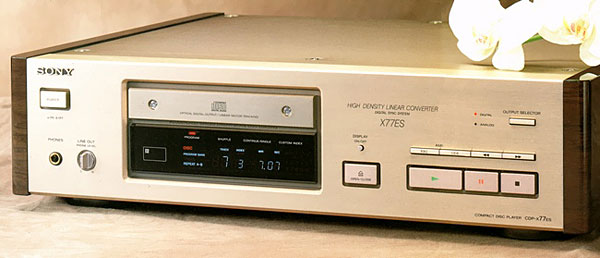
Sony CDP-X77ES CD player

With Sony's latest flagship single-box player ($1700), we find yet another variant on 1-bit D/A technology—High Density Linear Converter, or HDLC. At the heart of this Pulse Length Modulation (footnote 1) D/A technique is Sony's CXD-2552 Pulse D/A converter (two per channel in complementary mode in the CDP-X77ES). This complex LSI chip incorporates a third-order noise shaper, the PLM converter, and a digital sync circuit receiving its input from the system clock.

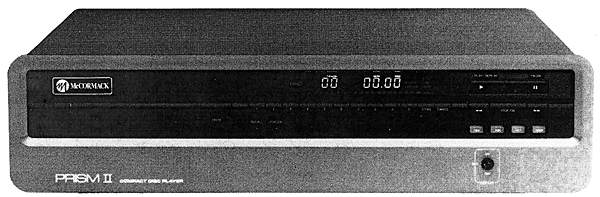
The Mod Squad Prism II CD player

Like its Prism I predecessor, which I reviewed in May 1988, the Mod Squad Prism II is based on a Philips player: the same 16-bit, 4x-oversampling converter, the same general control layout. But The Mod Squad does their own extensive remanufacture, both on the internal circuitry and on the cosmetics—the latter involving a handsomely sculptured case and metal front trim-panel surrounding Philips's command center.

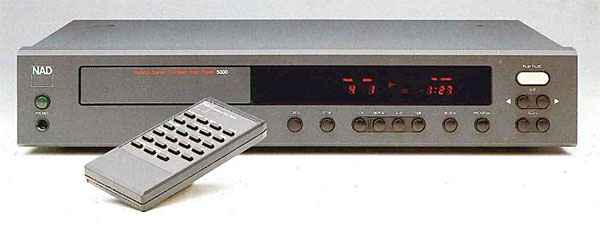
NAD 5000 CD player

The $499 NAD 5000 looks nothing like most inexpensive CD players. Its plastic trim doesn't look cheap. It doesn't look expensive either, but it certainly won't be embarrassed to show its face in polite company. The front panel is neatly arranged and easy to interpret and use. It's the smallest and lightest of the present company of players—the only obvious physical reflections of its low-budget heritage. Inside, however, NAD has done a lot to put your money where it counts.

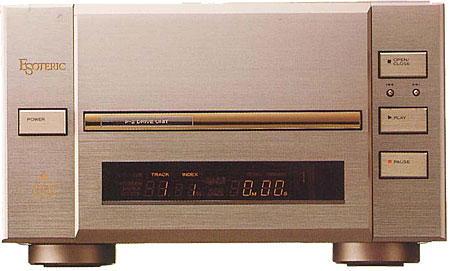
Esoteric P-2 CD transport

The whole idea that different CD transports have different sonic characteristics when driving the same digital-to-analog converter is a vexing problem. It is easy to prove that even the cheapest CD players recover the data stored on most CDs with bit-for-bit accuracy, thus disproving the widespread and erroneous belief that errors in the digital code are commonplace and affect presentation aspects such as imaging, soundstage depth, textural liquidity, etc (footnote 1). If the datastream driving the digital converter is comprised of the same sequence of ones and zeros, regardless of the transport, what other factors could account for the sonic differences between CD drives reported by many listeners?


Advertisement
Advertisement
Advertisement