Tube Power Amp Reviews

Sort By: Post DateTitle Publish Date

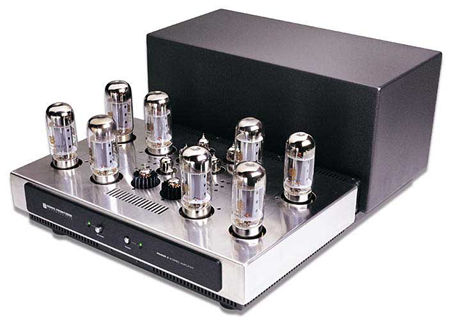
Conrad-Johnson Premier Twelve monoblock amplifier

Conrad-Johnson is one of audio's "marquee" companies, and charges accordingly. The Premier Twelve tube monoblock power amplifier, rated at 140W, sells for a rather steep $3495 each, meaning that unless you listen in mono, be prepared to lay out almost $7000 just for the amplification link in your audio chain. Apparently, many audiophiles feel the money is well spent: according to Conrad-Johnson, the Twelve has been a consistently strong seller during its approximately five-year production history.


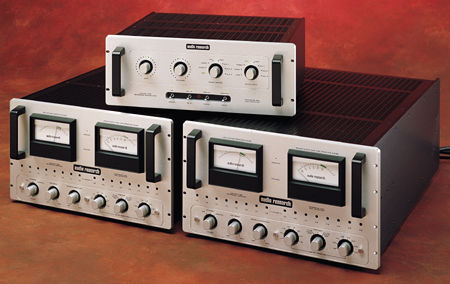
Audio Research Reference 1 preamplifier & VT200 power amplifier

They say you never forget your first time. For me, it was an Audio Research SP-6B that had been heavily modified by Analogique in NYC—which meant, among other things, that yellow capacitors shunted other yellow capacitors all the way up to the top plate. That first taste of the High End—prior to that, you might say my face had been pressed against the window—was definitely love at first listen. That SP-6B was warm yet detailed, and I ended up building a system around it that at least one friend described as a huge musical wet kiss.


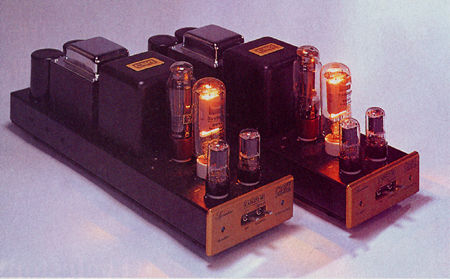
Cary Audio Design CAD-572SE monoblock power amplifier

In conversation with Cary">http://www.stereophile.com/interviews/399">Cary founder Dennis Had at a recent audio convention breakfast, I learned that he had a long career in electronics, specializing in military/industrial high-power radio-frequency amplification and transmitters. However, his dream was always the re-creation of single-ended tube amplifiers, especially zero-feedback designs.


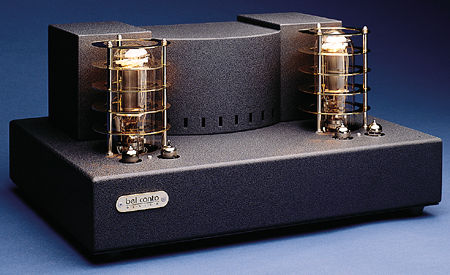
Bel Canto SET 80 monoblock power amplifier

Although I retain a firm hold on the established audio world, and recognize and value all that it has achieved, I feel inexorably driven to make some space in my life for single-ended amplifiers—more especially, those that eschew negative feedback (footnote 1). A classic if costly example of the art is the Cary">http://www.stereophile.com/tubepoweramps/740">Cary CAD-805C, which, to my ears, has earned the right to teach audiophiles what negative feedback really sounds like, and what damage it can do to the musical message when poorly handled. This shouldn't be taken as an out-of-hand dismissal of those many great pieces of electronics and amplification that use negative feedback—it is simply an acknowledgment, or even an assertion that negative feedback generates a sound of its own.


VTL MB750 monoblock power amplifier

How much power do you really need? What does it do for you, anyway? Even before the single-ended renaissance, the prevailing wisdom was that you really didn't need that much power. When I had a pair of Met 7 speakers, even the "1 watt" indicator LED was hardly ever lit. Ditto for my time with a Threshold Stasis Two—all those cool power-indicator LEDs just sat there dark. Besides, everyone knows that power can be had only at tremendous cost, both monetary and in terms of other performance attributes.


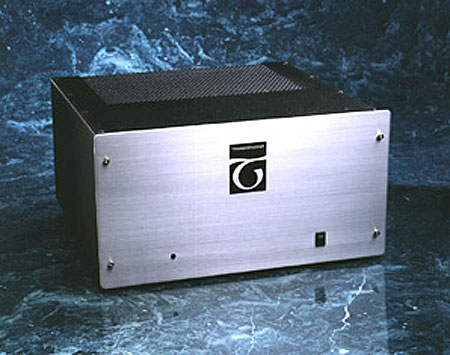
Transcendent T8 OTL monoblock power amplifier

Just who does Bruce Rozenblit think he is? And why is he saying those things about the late Julius Futterman? Rozenblit, relying heavily for guidance on his Electrical Engineering degree, has crafted an OTL (output-transformerless) amplifier that flies in the face of contemporary design dogma. To hear Bruce tell it, he's tamed the breed—this is how OTLs should have been done to start with, Futterman notwithstanding.


Graaf GM 200 OTL power amplifier

I'm always eager to fulfill my prime Stereophile directive: "To go where no audiophile has gone before," as JA often quips. As it happens, I've long suffered an itch to audition OTL (output-transformer–less) amplifiers, wondering how eliminating the output transformer might affect the sound. Enter the Graaf GM 200, with nothing but wire between its power tubes and the crossover.


Advertisement
Advertisement
Advertisement