Tube Power Amp Reviews

Sort By: Post DateTitle Publish Date

Balanced Audio Technology VK-5 preamplifier & VK-60/75 power amplifiers

How important is the use of balanced circuit typology in the design of preamplifiers and power amplifiers? Ask the top audio designers (I didn't, but just play along, okay?) and you'll get a wide variety of opinions. Some reject the balanced approach outright, arguing that it represents a needless duplication of circuit components, and that better results can be achieved if the same attention and resources are devoted to perfecting a single-ended circuit. In his provocatively titled article "Balance:">http://www.stereophile.com//features/335/">Balance: Benefit or Bluff?" (Stereophile, November 1994, p.77), Martin Colloms questioned the advantages of balanced designs, suggesting that while the results may be better in certain respects (eg, noise level), the reproduced sound may suffer in other, perhaps more important ways (eg, rhythm and dynamics).
Manley Laboratories 175 monoblock power amplifier

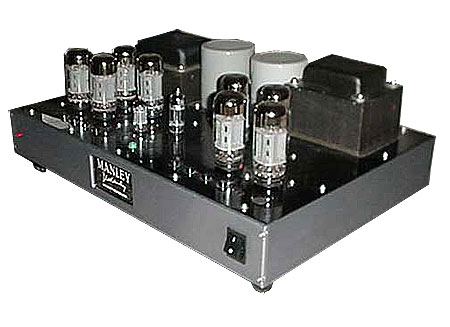
Neither its rather pedestrian name nor Manley Labs' own literaturehttp://www.manleylabs.com/containerpages/100200.html">literature; gives much of a clue as to the 175 monoblock's special pedigree. Where are the bands, the fanfare?! After all, the rolling-out of a 6L6–based high-power audiophile-grade tube amplifier definitely qualifies in my book as a momentous occasion. Deplorably, such happenings are rare indeed; the 6L6 has been unjustly neglected in high-end circles.


Conrad-Johnson Premier Eleven power amplifier

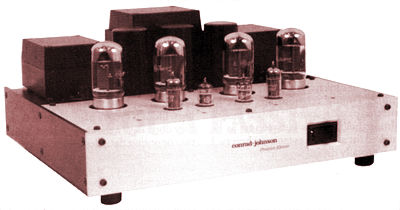
I love being seduced. I'm shocked to learn that not everyone does. The very qualities in live music that excite and intoxicate me are denigrated by many audiophiles as "colorations." It would seem they prefer the lean, chilly sound that they've dubbed "accurate." While I concede that almost all of their preferred audio components have ever-more-extended high frequencies, I'm not certain that that's the same thing as having greater accuracy. It sounds to me—to use Stravinsky's description of electronic music—"spayed for overtone removal." The overtones that I miss are those stripped from the middle ranges—the ones the clinical crowd (footnote 1) disparagingly refers to as the "warmth" region.


Audio Research VT-150 monoblock power amplifier

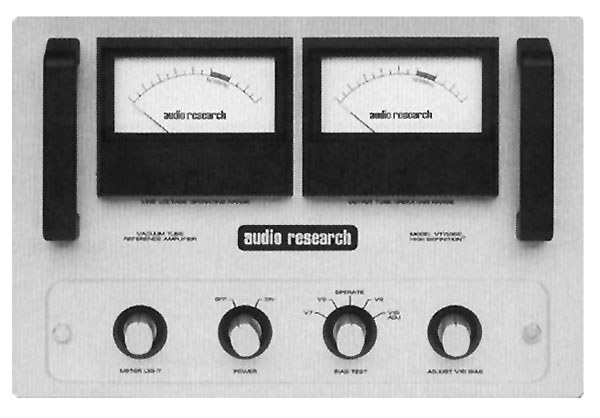
At the 1992 Winter Consumer Electronics Show in Las Vegas, Audio Research showed a line of reference products that represented the pinnacle of founder William Z. Johnson's life work as an amplifier designer. Although the all-tubed, fully balanced preamplifier and tubed monoblock power amplifiers were shown as works-in-progress, it was clear that these were products aimed at advancing the state of the amplifier art with no consideration for cost.

Woodside MA50 Renaissance monoblock power amplifier

Brian Tucker, the US Quad importer, introduced me to the Woodside MA50 tube amplifiers and their manufacturer, John Widgery, during the 1992 Summer CES. Tucker's combination of Woodside MA50 tube amplifiers and Quad">http://www.stereophile.com/floorloudspeakers/416">Quad ESL-63 USA Monitors sounded unusually neutral, dynamic, and detailed. This was good news; back in 1987, Dick Olsher (Vol.10 No.6, pp.104–5) was unable to recommend an earlier Woodside-manufactured amplifier, the Radford STA 25 Renaissance. Brian mentioned that the MA50's design is a much-improved version of that earlier Radford model. Time for another review.


Cary Audio Design CAD-805 monoblock power amplifier

Lee de Forest filed for a US patent on his "Audion"—the first triode—on October 25, 1906, but never could explain why it worked (footnote 1). It was up to Armstrong and Langmuir, in their pioneering work, to place the hard-vacuum triode on firm scientific ground. When the US entered World War I in April 1917, the Army had to rely on French tubes. Six months later, Western Electric was mass-producing the VT-1 receiving tube and the VT-2 transmitting tube. However, it was only in the decade following World War I, as designers became conversant with the triode amplifier, that many of the crucial elements of tube amplification were nailed down. Technical issues such as coupling two gain stages and selection of optimal coupling impedance were already resolved by the mid-1920s. The triode ruled supreme until the tetrode came along in 1926, followed in 1929 by the pentode from Philips's research laboratories in Holland.


Jadis Defy-7 Mk.II power amplifier

Owning a powerful tube amplifier is like owning a classic automobile. Great pleasure may be had, but ownership involves a little more care and maintenance than usual.

Jadis, an audiophile company specializing in all-tube amplifiers and operating out of a small French town, has enjoyed a good reputation for some years, even if some of its models have suffered from the reliability problems that occasionally afflict the largest tube amps. Another problem area is that of power consumption and heat output. In common with class-A amplifiers and high-bias A/B types, including solid-state models, larger tube amps give off substantial heat. The Defy-7's 240W idling consumption may or may not be welcome, according to your location and the season.

McIntosh Laboratories MC275 power amplifier

Tubes, tubes, tubes.


The amps (and preamps) keep coming.


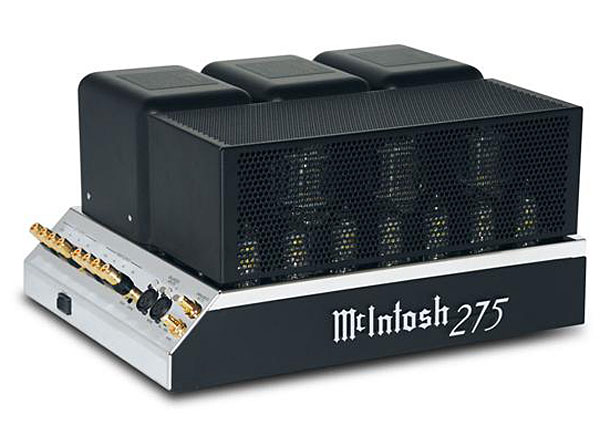
McIntosh Laboratories is back in the act with a limited-edition revival of the MC275 tube amplifier, the original of which was produced from May 1961 through July 1973—one of the longest model runs in hi-fi history.


New companies devoted to tube gear keep cropping up—in recent years, America's VAC and Cary and Canada's Sonic Frontiers. The same thing appears to be going on in the UK. The pages of British magazines are filled with new tube gear.

Berning EA-2101 power amplifier

It was back in the mid-'70s that David Berning made a name for himself in the Baltimore-Washington area as an avant-garde designer—someone with a truckload of fresh ideas about tubes. At the time, though Audio Research was starting to crank out pretty decent amplifiers, tube design was pretty much reduced to a rehash of the Williamson circuit and the Dynaco mod of the month.


Advertisement
Advertisement
Advertisement