Solid State Preamp Reviews

Sort By: Post DateTitle Publish Date

Burmester 011 preamplifier

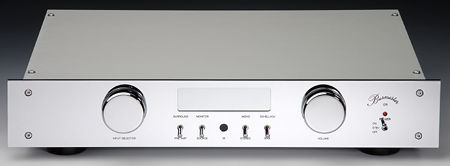
Back in 2003, while auditioning the Burmester 001 CD player ($14,000, reviewedhttp://www.stereophile.com/digitalsourcereviews/1203burmester">reviewed…; in the December 2003 Stereophile, Vol.26 No.12), I discovered that my system sounded much better if I bypassed my preamplifier and ran the 001 directly into the power amps. I concluded by suggesting that potential customers consider building a system around the 001 itself and forgo a preamp altogether. The response from Burmester fans was immediate and unambiguous: As good as the 001 was on its own, it sounded even better run through its stablemate, Burmester's 011 preamplifier ($15,999). The pair had, they claimed, a significant synergy that I absolutely had to hear. It's hard to argue with determined German logic, and I'd begun shopping for a new preamp anyway. So here we are.

HeadRoom Total BitHead headphone amplifier

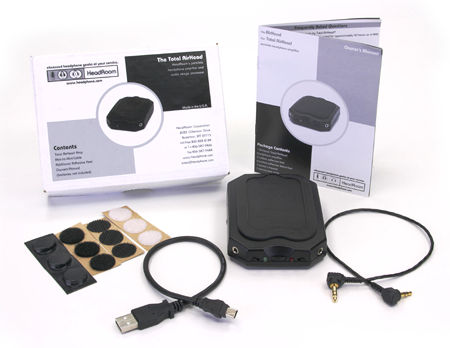
When, on his long-running TV variety show, Jackie Gleason used to order up some "traveling music" from music director Ray Bloch, he got a live orchestra's worth. But when Gleason, a composer and conductor in his own right (he wrote his show's unforgettable theme song, "Melancholy Serenade"), actually traveled, his listening options were severely limited compared to ours. By the time the comedian died in 1987, Sony had introduced the Walkman cassette player, but Apple's iPod was still more than a decade in the future.


McIntosh C200 preamplifier

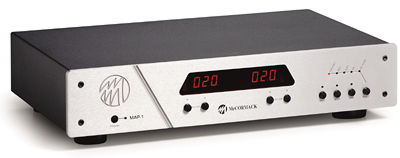
In August, I reviewedhttp://www.stereophile.com/amplificationreviews/804mcintosh">reviewed; McIntosh's MC501 monoblock power amplifier. In terms of what I'd thought was possible from Mac, this was a revelation. Once memories and lurking preconceptions had been set aside and the amps installed in my system, the MC501 easily established itself as among the finest overall performers I have ever reviewed.


Placette Audio Remote Volume Control passive preamplifier

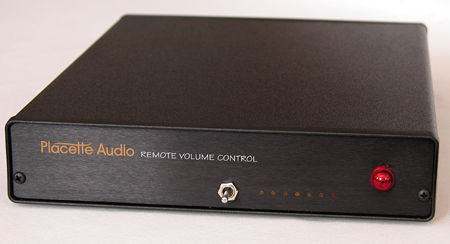
The Placette Audio Remote Volume Control is simplicity itself: a paperback-sized black box with one set of unbalanced inputs and outputs, a toggle switch (and a remote) to change the level, and a row of LEDs that light up to indicate the relative volume level. The signal path, too, is simple, with only a stepped attenuator between input and output. But this is not just any attenuator—it's a 125-step model built entirely with super-premium Vishay S-102 foil resistors.


Halcro dm10 preamplifier

My last visit to Planet Halcro transformed my audio life. All but the newest readers will recall that the Australian dm58">http://www.stereophile.com/amplificationreviews/683">dm58 power amplifier was Stereophile's Amplification">http://www.stereophile.com/features/724/index2.html">Amplification Component of the Year and overall Component">http://www.stereophile.com/features/724/index8.html">Component of the Year for 2002. To this day, I have yet to hear any amplifier that equals the dm58's combination of complete neutrality, harmonic generosity, lightning reflexes, and a sense of boundless power that is difficult to describe. Though some others have come close, the dm58 shines as a singular beacon of excellence among power amplifiers.


Music in the Round #2

It doesn't take much to read between the lines of Sony's discontinuation of the TA-P9000ES">http://www.stereophile.com//amplificationreviews/700/">TA-P9000ES analog preamplifier and their introduction of the SCD-XA9000ES SACD player with IEEE1394 digital output at Home">http://www.stereophile.com/news/11662/">Home Entertainment 2003. (A similar feature from the DVD-Audio camp has been promised.) Surely, we will at long last be able to have external digital processing and DACs in our preamp or control units. In addition to the freedom to mix and match components, this opens the door to having a single digital component manage bass and channel balance for all sources, and room/speaker correction without redundant redigitization.


Naim NAC 552 preamplifier

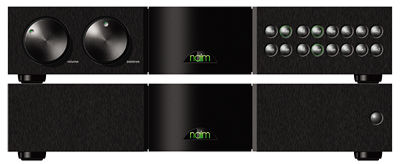
There's nothing groundbreaking about the technology included in Naim's new $22,400, two-box, remote-controllable, top-of-the-line NAC 552 preamplifier. Still, the inclusion of two sets of RCA input jacks is a departure from Naim's tradition of DIN jacks, and the NAC 552's programmability is unusual for a high-end two-channel audio product. And you can order RCA output jacks at no extra cost, which is how my review sample was configured.


Linn Klimax Kontrol preamplifier & Klimax Twin power amplifier

I've spent six-odd years in a sort of hi-fi counterculture, playing with things like mono cartridges, one-box CD players, and cheap, homemade cables—and, of course, owning and listening to single-ended triode (SET) amplifiers and horn loudspeakers. But before all that, I owned components that, while more mainstream, did the job just as well in certain ways. That category included solid-state electronics (Naim, BEL, Spectral), dynamic loudspeakers of middling efficiency (ProAc, Epos, Magneplanar), electrostatic loudspeakers of very low efficiency (Stax), and even "high-end" accessories like Tiptoes and Shun">http://www.stereophile.com//features/69/">Shun Mook Mpingo discs (which I still have, although my five-year-old daughter has more or less permanently co-opted the latter for playtime use).


Final Laboratory Music-4 phono preamplifier, Music-5 line preamplifier, & Music-6 power amplifier

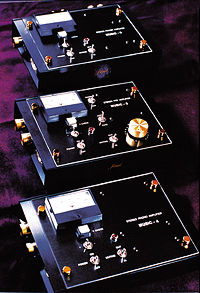
Modern hi-fi is little more than a way of getting electricity to pretend that it's music. Of course, good source components remain all-important, and even if loudspeakers are imperfect, most of us can find one or two that suit our tastes, if not our rooms and the rest of our gear.


Advertisement
Advertisement
Advertisement