Solid State Power Amp Reviews

Sort By: Post DateTitle Publish Date

Bricasti Design M28 monoblock power amplifier
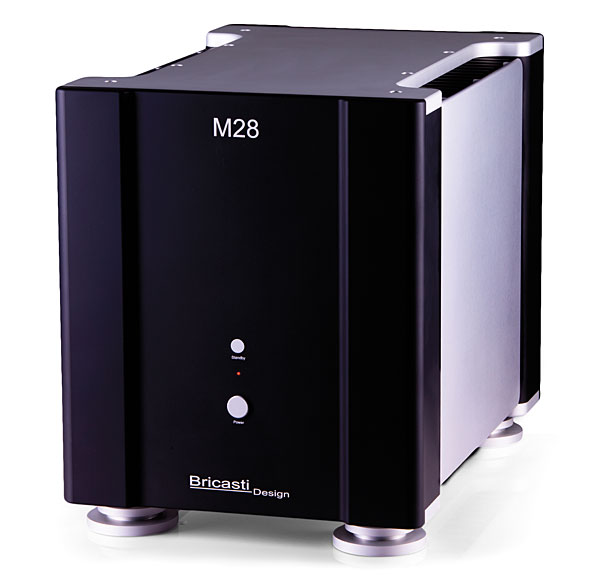
Google Bricasti and all that comes up are sites relating to Bricasti Design products. The name must be fanciful—it sounds Italian, but cofounders Brian Zolner and Casey Dowdell most likely are not, and the company's headquarters are not in Milan or Turin but in Massachusetts.


While its name might be whimsical, nothing else about Bricasti is. As John Marks reported in his review of Bricasti's M1 DAC in the August 2011 issue, both founders previously worked at Lexicon: Dowdell as a DSP-software engineer, Zolner as international sales manager. Bricasti develops its products in conjunction with Aeyee Labs, formed by a group of ex-employees of Madrigal Audio Laboratories and based in New Haven, Connecticut.

Theta Digital Prometheus monoblock power amplifier

Several seconds after I began listening to it, I knew that Theta Digital's Prometheus monoblock amplifier ($12,000/pair) was different from other amplifiers. The violins and brass were more dynamic, and had more pace. The orchestra sounded more three-dimensional, depicted in relief by a degree of hall ambience I hadn't heard when I played the same recording through my reference solid-state stereo amplifier, a Mark Levinson No.334.

Music in the Round #68

Power amplifiers are unglamorous but essential. In theory, they have only one task. But, according to audio sage Yogi Berra, "in theory, theory and practice are the same. In practice, they are not." Amplifiers must take a voltage input signal and provide an output of somewhat higher voltage but of substantially higher current, the product of which is power. The task is complex in that this output must be applied to electrical interfaces whose characteristics vary widely from speaker to speaker—across the audioband and, for some, even at different power levels. There are no control mechanisms or feedback signals to help. The power amp must just stand and deliver.

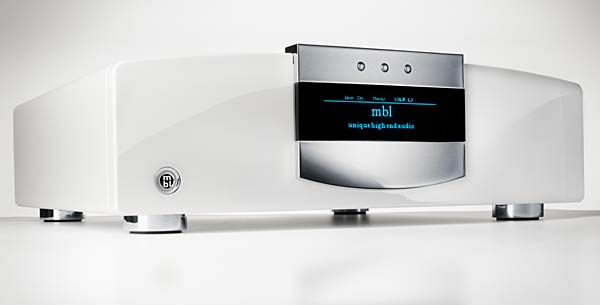
MBL Corona C15 monoblock power amplifier

A year or so ago, in my review of the Pass Labs XP-30 preamplifier, I wrote that the heart of an audio system is the preamplifier, in that it sets the overall quality of the system's sound. But it is the power amplifier that is responsible for determining the character of the system's sound, because it is the amplifier that must directly interface with the loudspeakers. The relationship between amplifier and loudspeaker is complex, and the nature of that relationship literally sets the tone of the sound quality.

Pass Labs XA60.5 monoblock power amplifier

Whereas the Pass Labs preamplifiers are designed by Wayne Colburn, the power amplifiers are the work of company founder and high-end audio veteran Nelson Pass, who even lays out his own circuit boards. The X-model amplifiers, beginning with the X1000 in 1998, were the first implementation of Nelson Pass's patented Supersymmetry topology (see "Nelson Pass on the Patents of Pass"). The XA series, which debuted in 2002, combined Supersymmetry with the single-ended class-A operation of the Aleph series. The XA.5 models offer detail improvements over the XAs.

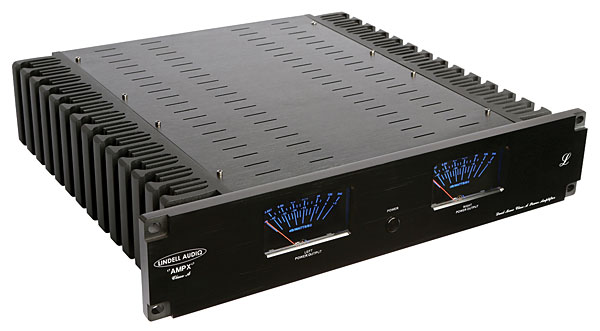
Lindell AMPX power amplifier

Lindell Audio, a Swedish professional-audio company, was founded in 2010 by recording engineer Tobias Lindell, and claims to offer equipment "by engineers, for engineers." Tobias Lindell specifies the features and functions that he wants each product to incorporate; the actual circuit designs are by others. Although Lindell's corporate headquarters are in Sweden, the products are manufactured in China, and are competitively priced.

Constellation Audio Performance Centaur Mono monoblock power amplifier

High-performance audio has always been and will probably remain a cottage industry perpetuated by talented and visionary individuals whose products reflect their singular visions and whose companies often bear their names, though of course there are notable exceptions. One of them is Constellation Audio. No single star dominates the appropriately named Constellation Audio, which arrived on the scene at the 2010 Consumer Electronics Show with a seemingly impossible debut roster of products: stereo and monoblock amplifiers, preamplifiers, digital file player/DACs, and phono preamplifiers, each category of component represented by members of two distinct lines: no compromise and some compromise.

Simaudio Moon Evolution 880M monoblock power amplifier

In the September 2005 issue (Vol.28 No.9), I reviewed Simaudio's first reference-quality power amplifier: the 1000W, 220-lb Moon Rock monoblock ($37,000/pair). At the time, the Rock was a dramatic departure for Simaudio, then primarily known as a maker of midpriced gear that was good for the money. I found a lot to like about the Rock, concluding that while it wasn't quite up to the standard of the best superamps of the time, it was very good—and, for Simaudio, an admirable first shot at the state of the art.

Anthem Statement M1 monoblock power amplifier

When I first saw Anthem Statement's M1 at the 2011 CEDIA Expo, it was a bolt from the blue. Happening on this flat, black slab of an amplifier lying on a display table or bolted to a wall, reminded me of the appearance of the iconic monolith in Stanley Kubrick and Arthur C. Clarke's 2001: A Space Odyssey. The M1's dimensional ratios are not 12:22:32, and there are many other one-rack-unit amps—yet, like the monolith on the moon, the M1 was in such striking contrast to everything else in its environment that it demanded attention and reflection.
Advertisement
Advertisement
Advertisement