Floor Loudspeaker Reviews

Sort By: Post DateTitle Publish Date

Snell XA90ps loudspeaker
The patter of the snare drum began softly and I leaned forward in my seat. Avery Fisher Hall fell silent as Riccardo Muti led the New York Philharmonic in Ravel's Boléro. Ravel once described this masterpiece as "lasting 17 minutes and consisting wholly of orchestral texture without music—of one long, very gradual crescendo." Though the hall was silent and expectant, the stage was packed with musicians waiting for...what? To gradually join in, one by one and layer by layer, to drive that gentle but relentlessly mounting crescendo. Ravel accomplished this by "having solo instruments play the melody...[then progressing] to groups" and finally "arranging the scoring so that the dynamics are self-regulating" (footnote 1). When the final, thunderous E-major chord stopped the piece by locking "all its harmonic gears," the hall erupted in ecstatic applause, and we all leapt to our feet.
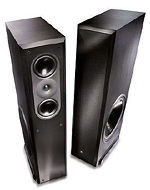
JMlab Mezzo Utopia loudspeaker

Loudspeakers are all about balancing conflicting variables: accepting that you can't have electrostatic transparency and horn dynamics; finding something to suit the size of your room and credit rating; and picking the best all-around compromise to suit your particular taste. Goldilocks had the right attitude for loudspeaker reviewing. All that too-soft/too-hard, too-hot/too-cold merely sets the scene; "just right" goes straight to the heart of the matter.


Aerial Acoustics Model 7B loudspeaker

Although the component that actually produces the sound is obviously the loudspeaker, audiophiles know that everything in the system—digital or analog source, preamplifier, amplifier, cables, room acoustics—has an influence on sound quality. No matter how good the speaker, its performance depends on the quality of the signal, the speaker's acoustical environment, and how the speaker is set up in that environment. I've heard speakers that I knew to be topnotch performers sound dreadful at audio shows and in dealers' listening rooms.


Sonus Faber Amati Homage loudspeaker

After establishing a reputation for building small, magnificent-looking, very expensive, stand-mounted loudspeakers, the Italian manufacturer Sonus Faber has hit the ground running. First came the moderately priced ($3500/pair) floorstanding Concerto Grand Pianos, and now the company's "statement" loudspeaker, the Amati Homage--a $20,000/pair visual stunner that earns its keep almost by looks and touch alone.


Acoustic Research AR-1 loudspeaker

Experienced reviewers know that shows are the wrong environments for critical audiophile listening. Convention centers—especially the one at Las Vegas—are huge, cavernous airplane hangers, not the intimate listening rooms reviewers thrive in. Extraneous sounds from subwoofer blasts and the constantly milling crowds leak in to sully the music. Booths set up by manufacturers on the show floor have very thin, flexible walls, and no bass treatment.


Hales Design Group Transcendence Five loudspeaker

Paul">http://www.stereophile.com/interviews/117">Paul Hales has been a busy guy lately. In little over a year, he has designed and brought to production four new speakers in his Revelation series (footnote 1); his cost-no-object flagship, the Alexandra, which had been seen but not heard at a number of shows, was finally demonstrated at the 1999 CES; and he has introduced the new Transcendence series, which replaces the Concept series. (He's also produced a brand-new baby girl during this period, although I believe his wife made a significant contribution to that project.)


Coincident Speaker Technology Super Conquest Series II loudspeaker

Usually, I review a component after it has impressed me at a show or in a store. Though this approach reduces the possibility of a bad review—I pre-select based on real experience—it does not minimize the possibility of disappointment. This makes me a sort of stand-in for the consumer who would like to take something home for a real shakeout, and only then decide to buy it or send it back.


Genesis Technologies 500 loudspeaker

In Stereophile's "Recommended Components," most full-range Class A speakers—and even some in Class B—are behemoths. Some are tall, some are wide, some are deep, and some are just plain big. Most of us would find such no-compromise devices physically imposing and visually distracting in our listening rooms. Putting aside the infamous "Spousal Acceptance Factor," how can you ignore such speakers' presence and concentrate on the music?


Wilson Audio Specialties MAXX loudspeaker

It's been five years since David Wilson's X-1/Grand SLAMM speaker system invaded our audio consciousness with its 500W power capacity and very high (95dB/W) sensitivity (footnote 1). Capable of an earsplitting 123dB at 1m, with a bandwidth to match, this was one speaker system that refused to be ignored. The X-1 has since evolved to $70,000/pair Mk.II form. It now provides some flexibility of tonal balance for different room acoustics, and is distinguished by greater subtlety in its differentiation of timbre. Beneath the X-1 in Wilson's range comes the WATT/Puppy ensemble, now in its 5.1 iteration (footnote 2). The WATT/Puppy has survived for over 10 years, and sets a benchmark for the Wilson line at its $17,270 system price.


Advertisement
Advertisement
Advertisement