Floor Loudspeaker Reviews

Sort By: Post DateTitle Publish Date

Listening #37

There was once an Englishman named H.A. Hartley, who was a contemporary of H.G. Baerwald, P.G. Voigt, P.K. Turner, and other men whose first two names are lost to us. Hartley was a capable designer and audio theorist, not to mention a gifted lecturer and writer—his literary achievements include a book on astrology (footnote 1), of all things—and he's often credited with coining the expression high fidelity. Most important of all, in 1928 H.A. Hartley teamed up with the aforementioned P.K. Turner to create an audio manufacturing company known as Hartley Products, Ltd. The Hartley company made electronics and loudspeakers, the latter of which included full-range coaxial drivers using energized field coils and, later on, quite powerful permanent magnets—just like their countrymen at Lowther Loudspeakers, Ltd.
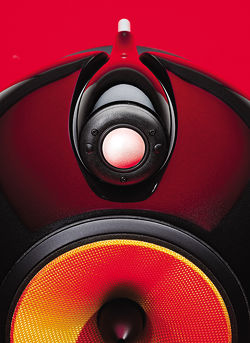
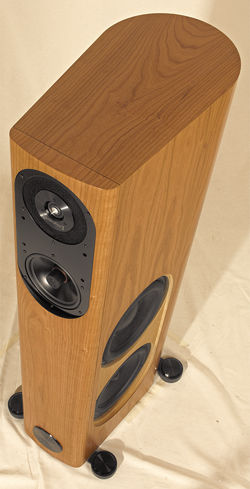
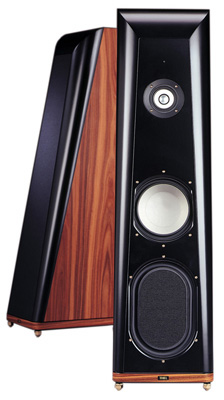
B&W 802D loudspeaker

Back in the 1970s, I used to hang out at an audio store on Northern Boulevard's Miracle Mile. After business hours—and sometimes during them—a group of us audiophiles would put every new product through the wringer. One of the most anticipated was the original B&W 801, which appeared in 1979. The 801 was simply unflappable. Fed enough power, a pair of them played louder and cleaner than anything we had ever heard, including the mammoth, multimodule Fultons that were the pride of that shop. But—and this was a big but—the 801 lacked immediacy and engagement, and I soon fell back to preferring an earlier B&W model, the DM6, which seemed more coherent and to offer the music out to the listener. The 801 was more objective and detached, but boy, could it knock you over with the right source material.


Audio Physic Caldera III loudspeaker

More, I think, than any other link in the audio chain, loudspeaker designs tend to reflect the personal preferences, opinions, and philosophies of their creators—think Henry Kloss, Paul Klipsch, Rudy Bozak, David">http://www.stereophile.com/interviews/478">David Wilson, Jon Dahlquist, Arnie Nudell, and Amar Bose (just kidding). Consider, if you remember, where Ken">http://www.stereophile.com/interviews/232">Ken Kantor took Acoustic Research when he took over AR's design reins. Might as well have called AR NHT, for all that the new designs followed the old.


Thiel CS2.4 loudspeaker

Jim Thiel sounded almost bored. "Almost everything about the CS2.4 is pretty standard stuff—short-coil, long-gap, low-distortion drivers, aluminum diaphragms, polystyrene capacitors, spatial coherence, time coherence, reduced diffraction baffles, reduced cabinet vibration, etc., etc. Of course, I think the execution of the 2.4 is more successful than our previous models, but in terms of what's really different, that mechanical crossover is what's special."


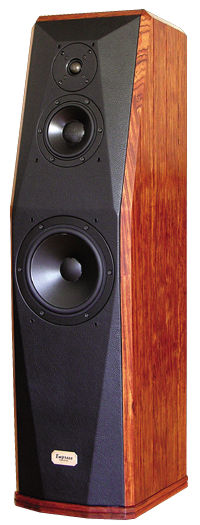
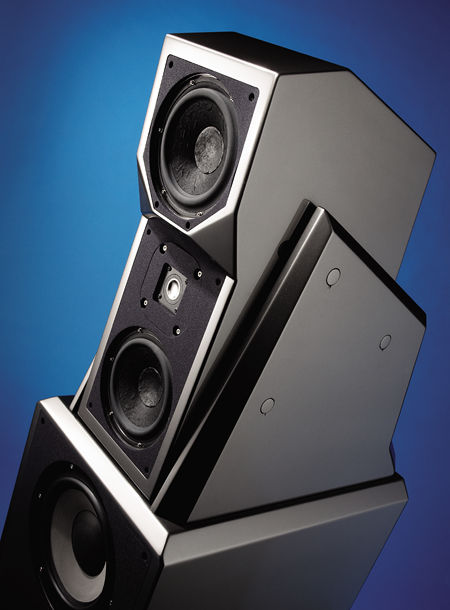
Peak Consult Empress loudspeaker

I'd heard rumors about Peak Consult. John Marks was all a-burble, having reviewed the InCognito in "The">http://www.stereophile.com/amplificationreviews/932/index2.html">The Fifth Element" in the September 2003 Stereophile, but I'd never actually heard anything designed by PC's Per Kristoffersen. Therefore, when US distributor Chris Sommovigo proposed that I audition the $25,000/pair Empress, I was intrigued. Well, who wouldn't be?


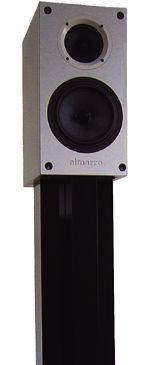
Almarro M0A loudspeaker

One of my favorite parts of attending Stereophile's Home Entertainment shows—aside from seeking out the sexy new gear and pressing the flesh of readers—is the "Ask the Editors" panel discussions. What begins as a Q&A session usually turns into a free-for-all, as the outspoken and opinionated likes of Sam Tellig, Michael Fremer, Ken Kessler, and John Marks barely give room for wallflowers such as Art Dudley and yours truly to express our opinions—except when editor John Atkinson asks each of us, in turn, to cast our votes for the "most interesting rooms to visit." At both the HE2004 and HE2005 "Ask the Editors" panels, one company was recommended by a number of Stereophile writers, me included: Almarro Products.


Mordaunt-Short Performance 6 loudspeaker

Wood is not an engineering material. It might look pretty, but it's inconsistent and therefore unpredictable. So we smash cheap wood into sawdust and then glue it all together again to create something that can be machined. This is called medium-density fiberboard, or MDF. We then thinly slice some classy hardwood—hopefully harvested from sustainable sources—and use it to cover the ugly MDF. This might have made sense back when Chippendale was making furniture, but it seems strangely old-fashioned in our age of plastics and composites. I haven't seen wood trim on a TV set for more than a decade. Why is it still the norm for loudspeakers?


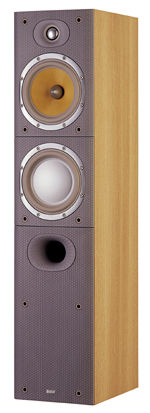
B&W DM603 S3 loudspeaker

It occurred to me recently that, after nearly a decade of specializing in reviewing affordable speakers, and with the exceptions of two entry-level Mission models, I'd never taken a look at recent designs from the large mainstream British speaker manufacturers. So with this review I embark on a Bob Reina "British Invasion" tour to seek out the most innovative and value-conscious designs from companies that have been household names in British stereo shoppes for decades.


Advertisement
Advertisement
Advertisement