Floor Loudspeaker Reviews

Sort By: Post DateTitle Publish Date

DeVore Fidelity Silverback Reference loudspeaker
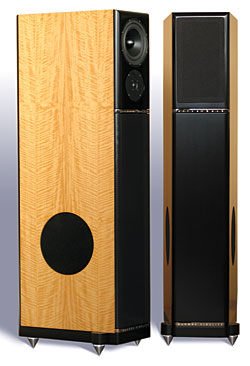
It was my hunt for new and interesting-looking turntables at the 2004 Consumer Electronics Show that introduced me to the loudspeakers from DeVore Fidelity. In the Glass Amplifier room I spied a Teres turntable with a Darth Vader-ish look and sat down to listen. From a pair of nondescript, two-way, floorstanding speakers so small they were almost lost in the room, came surprisingly present, full-bodied, and notably coherent music. Their sound so far exceeded my low expectations that I exclaimed, "What are those?! Whoever designed them sure knows what he's doing!"
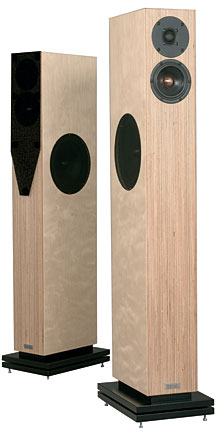
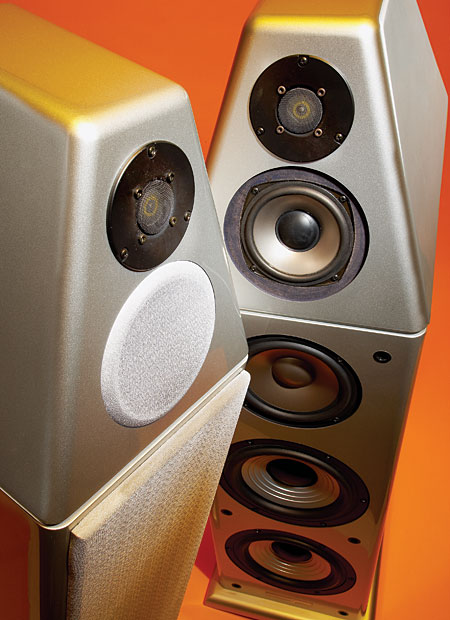
KEF iQ9 loudspeaker

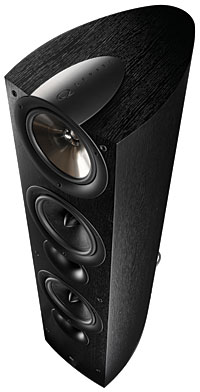
The penultimate stop on Bob Reina's British Invasion Tour of Affordable Loudspeakers (footnote 1) brings us to the doors of KEF. Although KEF is a large and well-established British firm, I've noticed that their product lines have not been as visible in the US as those of, say, B&W, Wharfedale, or Mission. In fact, the last time I heard a KEF speaker, it was the company's then-flagship design, at a Consumer Electronics Show nearly 20 years ago! Before that, when I lived in London, KEFs were ubiquitous, down to the older, entry-level designs tacked to the walls of the ethnic restaurants I frequented. My strongest KEF memory is a cumulative one: Every KEF speaker I've ever heard, regardless of price, venue, or setup, has always produced good, convincing sound.


Penaudio Serenade loudspeaker

Audiophiles sure don't have it easy. We put in a hard day sweating to hear those diminishing-return differences, and when we're finally ready to pontificate, no one at the party will obligingly ask us what we think. They've made that mistake before, you see, then spent the next 45 minutes frantically looking around the room for someone to rescue them.


Genesis Advanced Technologies 5.2 loudspeaker

Genesis Advanced Technologies was formed in 1991 to manufacture loudspeakers designed by industry veteran Arnie Nudell, who was responsible, with Cary Christie, for some of high-end audio's highest-performing models when both were at Infinity Systems. The company was acquired a few years back by Gary Leonard Koh and some of his friends, but Nudell remains with the company as Chief Scientist and the company has offices and a production facility in Seattle.


B&W 802D loudspeaker

Back in the 1970s, I used to hang out at an audio store on Northern Boulevard's Miracle Mile. After business hours—and sometimes during them—a group of us audiophiles would put every new product through the wringer. One of the most anticipated was the original B&W 801, which appeared in 1979. The 801 was simply unflappable. Fed enough power, a pair of them played louder and cleaner than anything we had ever heard, including the mammoth, multimodule Fultons that were the pride of that shop. But—and this was a big but—the 801 lacked immediacy and engagement, and I soon fell back to preferring an earlier B&W model, the DM6, which seemed more coherent and to offer the music out to the listener. The 801 was more objective and detached, but boy, could it knock you over with the right source material.


Audio Physic Caldera III loudspeaker

More, I think, than any other link in the audio chain, loudspeaker designs tend to reflect the personal preferences, opinions, and philosophies of their creators—think Henry Kloss, Paul Klipsch, Rudy Bozak, David">http://www.stereophile.com/interviews/478">David Wilson, Jon Dahlquist, Arnie Nudell, and Amar Bose (just kidding). Consider, if you remember, where Ken">http://www.stereophile.com/interviews/232">Ken Kantor took Acoustic Research when he took over AR's design reins. Might as well have called AR NHT, for all that the new designs followed the old.


Thiel CS2.4 loudspeaker

Jim Thiel sounded almost bored. "Almost everything about the CS2.4 is pretty standard stuff—short-coil, long-gap, low-distortion drivers, aluminum diaphragms, polystyrene capacitors, spatial coherence, time coherence, reduced diffraction baffles, reduced cabinet vibration, etc., etc. Of course, I think the execution of the 2.4 is more successful than our previous models, but in terms of what's really different, that mechanical crossover is what's special."


Peak Consult Empress loudspeaker

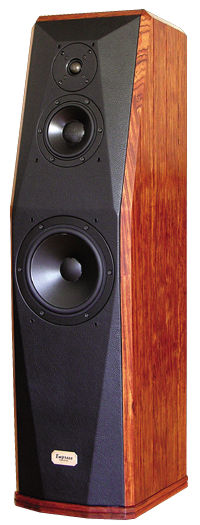
I'd heard rumors about Peak Consult. John Marks was all a-burble, having reviewed the InCognito in "The">http://www.stereophile.com/amplificationreviews/932/index2.html">The Fifth Element" in the September 2003 Stereophile, but I'd never actually heard anything designed by PC's Per Kristoffersen. Therefore, when US distributor Chris Sommovigo proposed that I audition the $25,000/pair Empress, I was intrigued. Well, who wouldn't be?


Mordaunt-Short Performance 6 loudspeaker

Wood is not an engineering material. It might look pretty, but it's inconsistent and therefore unpredictable. So we smash cheap wood into sawdust and then glue it all together again to create something that can be machined. This is called medium-density fiberboard, or MDF. We then thinly slice some classy hardwood—hopefully harvested from sustainable sources—and use it to cover the ugly MDF. This might have made sense back when Chippendale was making furniture, but it seems strangely old-fashioned in our age of plastics and composites. I haven't seen wood trim on a TV set for more than a decade. Why is it still the norm for loudspeakers?


Advertisement
Advertisement
Advertisement