

The Future is Back
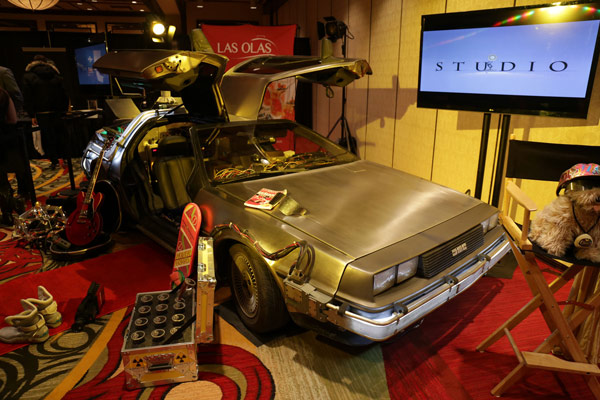
What is this replica of the DeLorean used in the Back to the Future movies doing at an audio/video show? It's to advertise a company called Le Studio Secret, which organizes office parties with a cinema theme. But this is obviously not just a business; the Back to the Future DeLorean was a labor of love for Thierry Lacombe, with some extra gadgetry that Doc Brown and Marty McFly would have appreciated. You have to admit that it looks cool.
The magic Chord
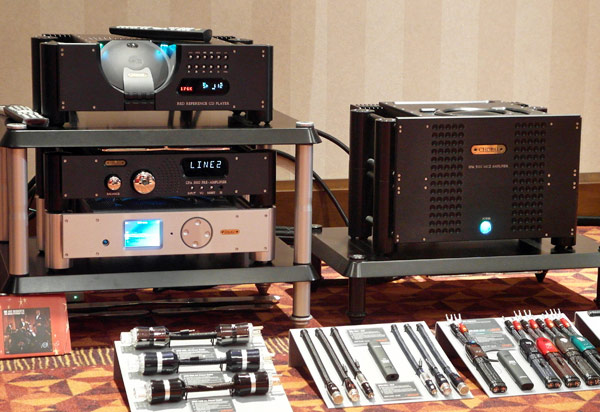
In addition to AudioQuest cabling, the demo system put together by Montreal retailer Audioville comprised a pair of KEF Blade loudspeakers ($30,000), stirred into action by Chord electronics: the SPM5000 amplifier ($25,000), CPA3000 preamplifier ($10,000), and DSX1000 DAC/streamer ($13,000). The sound, as noted in Steve Silberman's demonstration, was explicit without being relentless about it: Music flowed naturally, and with decent color and very good impact, especially at the louder end of the spectrum.
The Nordost experience

I have experienced my first cable demo in French. The very animated and enthusiastic Bruno Delorimier conducted a Nordost interconnect comparison for an appreciative audience of Quebec audiophiles, using a pair of Dynaudio Confidence C1 loudspeakers ($8500/pair, plus $600 for stands), and all SimAudio Moon electronics. Going from Nordost's Blue Heaven ($350/1 meter pair) to their monofilament-technology Heimdall (ca $800/1 meter pair), the differences in rhythmic nuance and sheer touchin favor of the Heimdallwere apparent, regardless of language.
The restaurant at the beginning of the universe
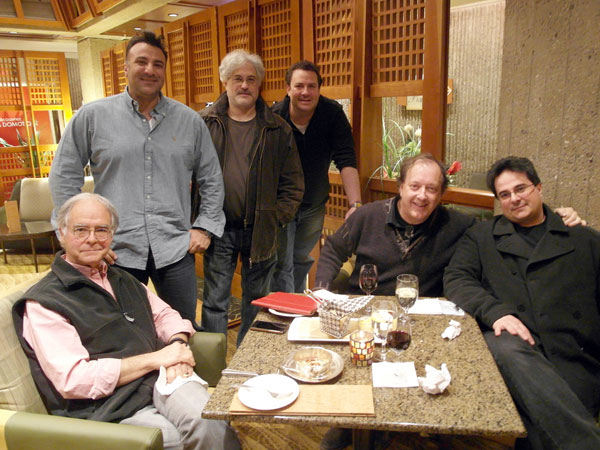
I’ve reported from Salon Son et Image almost every year since joining Stereophile in 2003, and as much as I enjoy the show itself, my favorite part remains the evening before the opening day. That’s when, in accordance with an informal tradition, members of the industry and the press gather together at the Hilton Bonaventure’s hotel barwhich also happens to serve the best food of any hotel bar in my experienceto shake the dust of the town from our boots, as it were. Pictured here, from left to right, are Peter McGrath (Wilson Audio), Mike Manousselis (Dynaudio), Lionel Goodfield (Simaudio), Keith Pray (publisher, Stereophile), Philip O’Hanlon (On a Higher Note), and Costa Koulisakis (Simaudio).
The Totem in the Pavillon

The photography used in the display materials associated with Totem loudspeakers are of consistently very high quality. That said, during my stroll through the Pavillon du Canada at this year's SSI, I finally noticed something about the people in those photos: They are exclusively female, and they are almost always barefoot. As a male who is as ignorant of the principles of the psychology of marketing as he is hesitant to go barefoot anywhere but the beach, the bath, and the bed, I am puzzled (but not troubled).
Tri-Art Audio

I admit some confusion: According to the product sheets found near this static display, almost every one of Tri -Art Audio's 20 products is named either Pebbles or Bam Bam. That said, here is the Ontario-based company's $1150/pair mini-monitor. It is named Bam Bam. Bob Deutsch was similarly puzzled by the company's dem room.
Triangle and Hegel
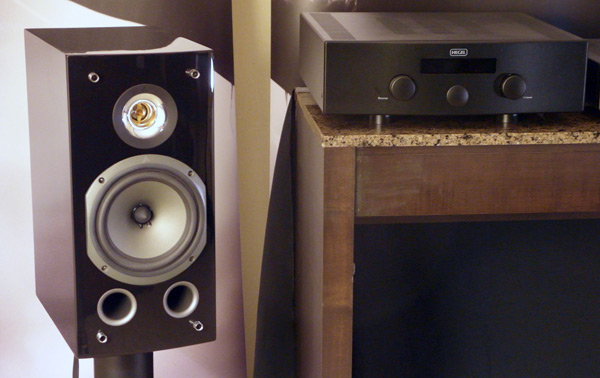
I have found that, under show conditions, some of the sweetest sounds often come from the smallest systems; so it was in the room sponsored by distributor VMAX, where a Hegel H80 integrated amplifier with onboard D/A and five digital inputs, including USB ($2000) drove a lovely pair of Triangle 30th Anniversary Comete loudspeakers ($1800/pair), with a Hegel CDP-2A CD player ($2600) used as a transport.
What I saw in the VMAX room
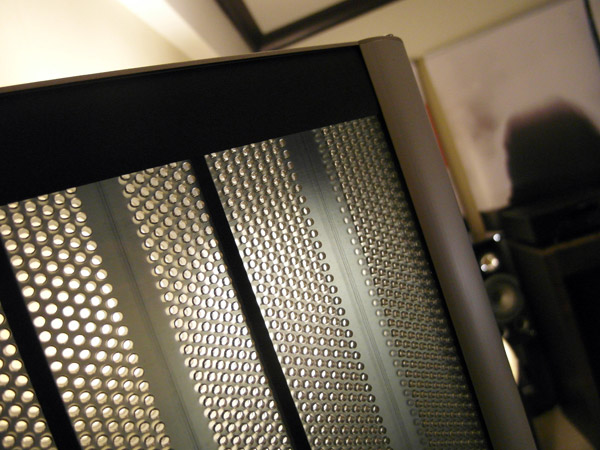
Seen in the same room as the Hegel-Triangle system was a frustratingly silent display: one of a pair of brand-new, full-range electrostatic loudspeakers from the Dutch company Essence. Apparently its mate suffered a bit of rough handling, and the people of VMAX decided, commendably, not to trust its high-voltage circuitry before giving the speaker a thorough check-up. In the meantime, keep your eyes peeled for this $4000/pair beauty, the stators of which are created from acrylic using a 3D printer.
Wilson’s Mk.2 Sasha
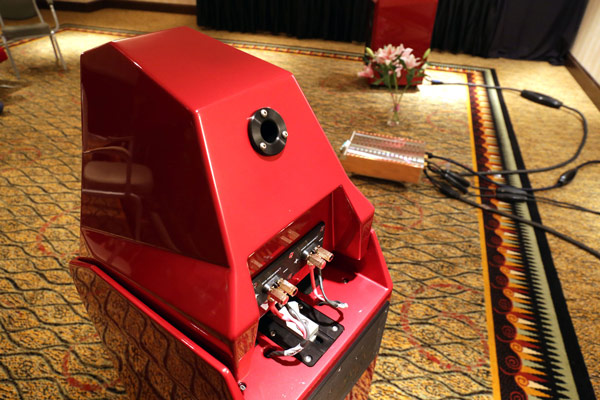
The revision of the Sasha to Mark II status involves a number of improvements, the cumulative effect of which, according to Peter McGrath, is quite significant. The Sasha II has the same midrange and woofer as the original Sasha, but the tweeter is all newa convex rather than a concave dome as used previously. The tweeter and midrange baffle materials are different from those in the original Sasha, and the effect is a 34% reduction in resonant modes. The mechanism allowing the mid/tweeter module to be tilted, to "focus" the sound, has been revised so that the focusing can be more precise.
Woo Audio's Tubes

I think of Woo Audio as a manufacturer of fairly modestly-priced tube headphone amplifiers, so I was surprised to see in the Woo Audio exhibit something that was clearly more upscale. The WA5 is described as an "SET class-A transformer-coupled speaker and headphone amp." It's available as a base model at $3400, but the version with all upgrades (special tubes, etc.) brings the price up to $6400. The power output is 8Wpc, so your speakers had better have high sensitivity.