

Steinway–Lyngdorf
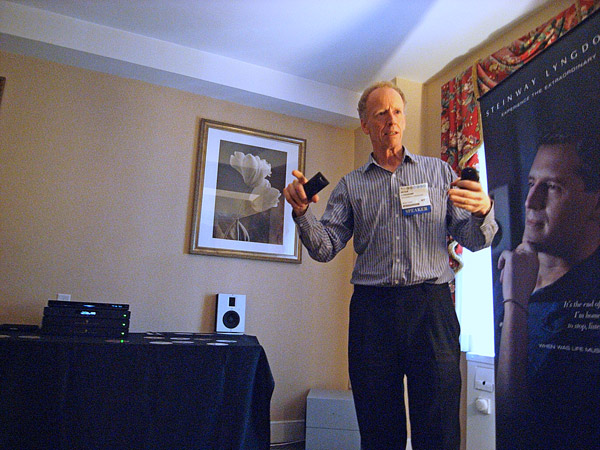
After Peter Lyngdorf left Tact, he went into partnership with the Steinway piano company to make a line of expensive speakers aimed not at audiophiles but at well-heeled music lovers. I was impressed by what I heard of the first of this line, which incorporates Lyngdorf's RoomPerfect acoustic correction, when I auditioned it in Manhattan a couple of years back, so I wasn't surprised when Steve Guttenberg button-holed me and told to go listen in the SteinwayLyngdorf room at Axpona.
The S-Series subwoofer-satellite system ($22,100) was producing a big sound with the tiny satellites stood on a credenza against the wall behind them. Incorporating RoomPerfect correction, the speakers also use digital signal processing to produce a flat response, which Peter Lyngdorf explained allowed him to optimize the drive-units for maximum sensitivity. The two small subwoofers were placed in the room corners, with a crossover frequency (depending on the room correction necessary) around 200Hz
TAD—JA's Best Sound At Axpona
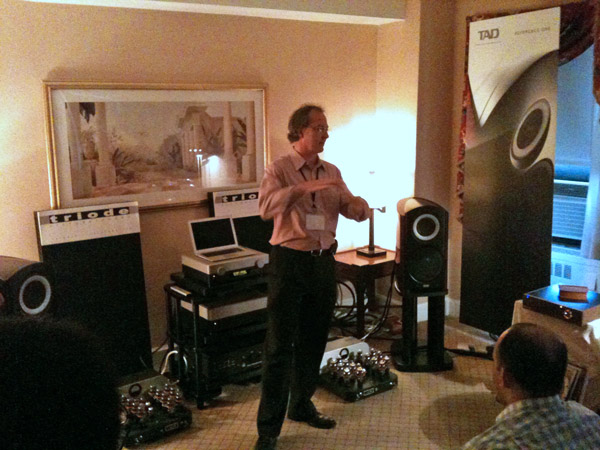
Best sound apart from violinist Arturo Delmoni, that is. I am reviewing TAD's Compact Reference CR-1 three-way stand-mounts ($37,500/pair plus $1800/pair for stands) for a Fall issue of the magazine so I was interested in seeing what kind of sound TAD's chief engineer Andrew Jones was getting from the CR-1s in the room TAD was sharing with its New York dealer, Triode Picture+Sound. Though there were a pair of Atma-Sphere tube monoblocks in the room, the speakers were being driven by TAD's solid-state amplifier with the source Andrew's MacBook Air running Decibel and feeding data to a TAD DAC via USB. I listened to several hi-rez recordings at 176.4kHz and 192kHz from Chesky and ex-Sheffield Labs engineer Bill Schnee, whose recording for Bravura Records of a band led by drummer Simon Phillips had one of the best recorded drum sounds I have heard. Even in the cramped and crowded hotel room, it was obvious that these speakers, with their coaxial, beryllium-diaphragm midrange/tweeter and reflex-loaded 8" woofer with a 4" voice-coil, were doing something out of the ordinary with respect to freedom from compression.
The Mark Neumann loudspeaker

A challenge for the journalist who can’t read his own notes (that would be me): The need for information regarding the Mark Neumann loudspeaker shown above led me to the world-wide web, but a Google search on the words Mark Neumann returned mostly hits that had nothing to do with audio and everything to do with politics. (It was a little like reading one of my old columns. But just a little.) I returned to my senses and visited the website of Miami’s High End Palace, the Axpona exhibitor that brought the mighty Coliseum XLS loudspeaker (approximately $40,000/pair) to New York, and learned that this open-baffle speaker’s design was inspired by a concert grand pianoand that only 12 are made each year. Fed by a Stahl-Tek CD player and driven by Tact and BAT electronics, the Coliseum XLS sounded impressive in a number of ways, although its considerable bass response tended to overwhelm the smallish room.
The Wharfedale Neo Airedales
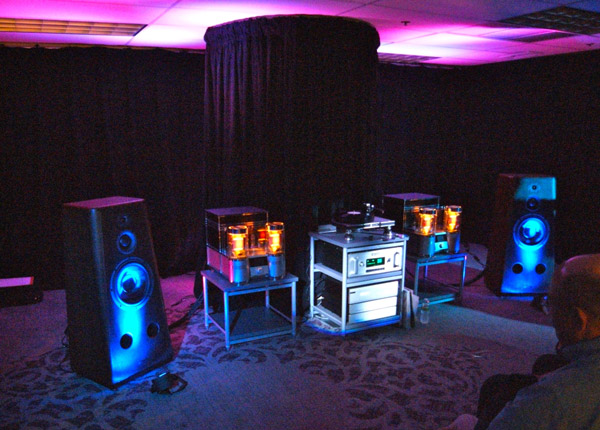
Art Dudley mentioned earlier in this show report the Audio Power Laboratories tube monoblocks driving Wharfedale's new Neo Airedale flagship loudspeakers ($25,000/pair). Source was a Musical Fidelity CD player, preamp an Audio Research, and the sound in this room was indeed one of the best at Axpona: extended lows, clean highs, and impressive dynamic range.
Woodbridge Audio

The show started before the show started: Julia and I were having morning tea in our room on the 7th floor when we heard a familiar and compelling voice: not Amanda McBroom or Jacintha but Lhasa de Sela a real recording artist! The music turned out to be coming from one of two exhibit rooms sponsored by New Jersey retailer Woodbridge Audio, whose proprietor also had the audacity to play such non-audiophile fare as the Andrews Sisters and Michael Hedges. Think of it! The system in Woodbridge's tonier room had an estimated total value of $125k and included a VPI TNT HRX record player with Koetsu Urushi Black cartridge, Mark Levinson electronics (including the majestic No.53 amplifiers), and a pair of Revel Ultima Salon2 loudspeakers, with MIT cabling, Richard Gray power accessories, and ASC Tube Traps.