

Joseph—Bel Canto

Like many exhibitors at Axpona, Joseph Audio was playing files from a laptop for their dems. In this case, Jeff Joseph was using Pure Music on his MacBook Pro and feeding a short USB link to Bel Canto's LightLink converter (reviewed by Erick Lichte in the June issue), which in turn fed the audio data via a low-jitter ST optical link to the Bel Canto DAC3.5VB, which also acted as the system preamp. Power amplifiers were a pair of Bel Canto Ref.500 monoblocks and speakers were Joseph's own stand-mounted Pulsars ($7000/pair). The sound of Jeff's rip of Louis Armstrong's "St. James Infirmary," a long-term staple in Joseph dems, was visceral. (Another iPhone photoforgive the grainy quality, due to the lack of light.)
Linkwitz Orion-4 Speakers
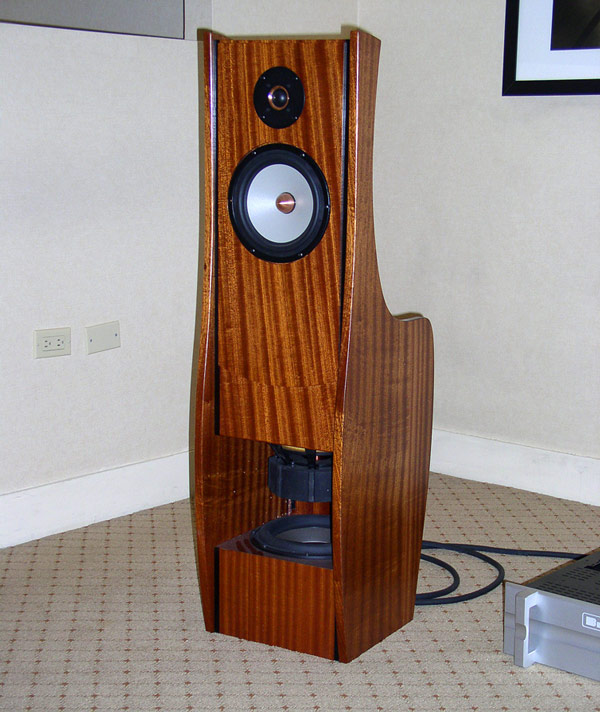
One might argue that there are more research-driven engineering innovations in the Linkwitz Lab Orion-4 than in most other high-end loudspeakers which is remarkable, considering that it sells for less than $15,000/pairbut at the Axpona show I found it easy to forget all of that and simply enjoy the speaker's musical prowess. Driven by Bryston amplifiers and fed by an Auraliti L1000 digital music player and MSB D/A processor, the Linkwitz loudspeakers disappeared into their own wide, deep, and mildly recessed (as opposed to in-your-face) soundfield. In addition to being spatially convincing, the Orion-4s sounded open, clear, and appropriately colorful: one of the finest demonstrations at the show.
Live vs Recorded

John Marks also arranged, courtesy of Audio Power Laboratories and Wharfedale, to present Arturo Delmoni performing the slow movement from Karl Goldmark’s Concerto for Violin in their room. Arturo played live, but Steve Martorella playing his transcription for pipe organ of the orchestral part was recorded by John Marks in the First Baptist Church in America and played back from CD over the Wharfedale Neo Airedale speakers. The result was impressive, both on the grounds of the system’s sound quality, with extended low frequencies demanded by the organ, but also for Dr. Delmoni’s lyrical virtuosity. This wasn't so much Live vs Recorded and Live with Recorded.
We all owe John Marks a big "thank you" for bringing live music to Axpona New York.
Marks—Garcia
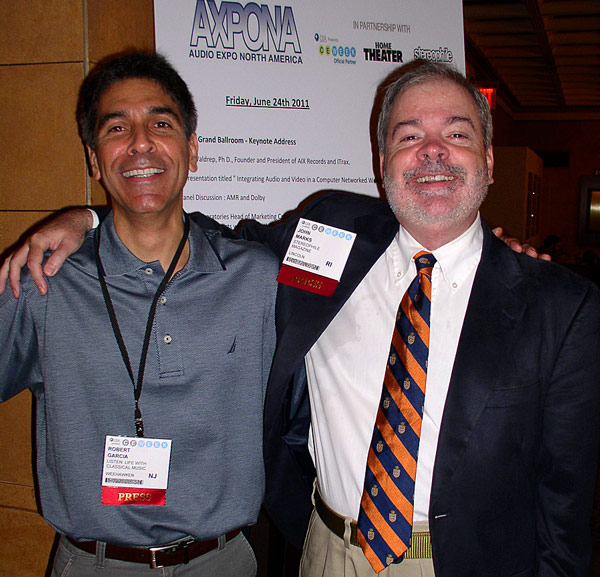
Speaking of the devil: Here's JM himself (right), posing with Arkiv Music's Robert Garcia, who is also associated with that company's classical music quarterly Listen.
May Audio
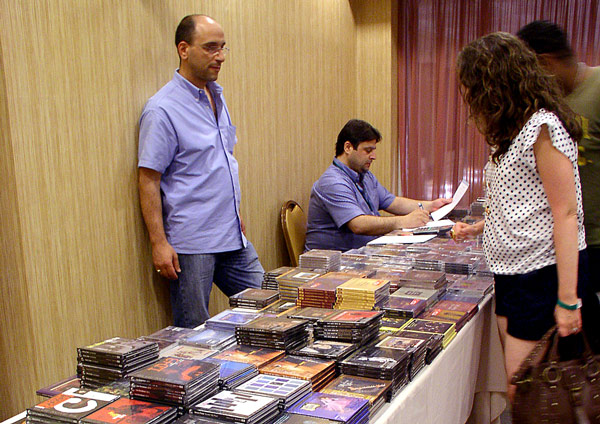
May Audio Marketing's Nabil Akhrass (seated) was even busier than usual at this show, given the absence of his sister, Julia: She recently gave birth to her and her husband's first child (congratulations!), and decided to sit this one out. When I visited the May Audio exhibit on Saturday morning, they were already enjoying brisk sales of CDs and vinyl.
MBL in Gloss White
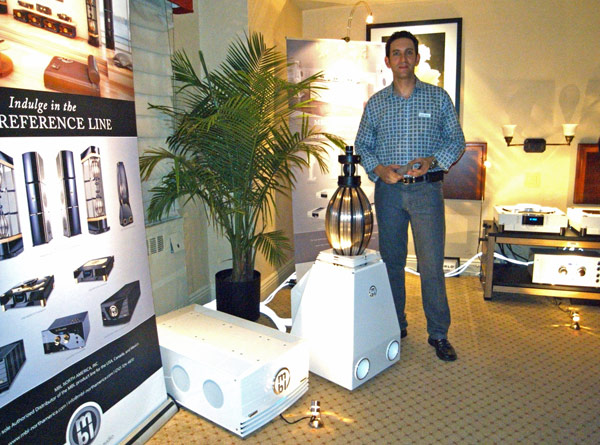
It was déjà vu all over again when I went into the MBL room at Axpona (after a wait in the corridor outside, this room being packed throughout the Show). The system was the same used at SSI in Montreal and Axpona in Atlanta last April101E Mk.2 omnidirectional speakers driven by gigantic 9011 monoblock amplifiers, a 6010D preamp, a 1621A CD transport, and a 1611F D/A converterbut this time with everything finished in a superb gloss white. I listened to "Fit Song" from Cornelius's Sensuous CD, "The Boy in the Bubble" from Peter Gabriel's Scratch My Back CD, and the hi-rez solo piano recording made by MBL's long-time chief engineer Jürgen Reis, "Walchensee, Mondnacht," performed by Martin Vatter, from the album Klangbilder. All the music was being played from a Linux music server put together by MBL's Jeremy Bryan and fed via an asynchronous USB link to the MBL DAC.
The room was a little on the small side for the speakers, with their extended LF response and omnidirectional highs, but that aside, the sound rocked, with an enormous and well-defined soundstage drawing me into the music.
Napa
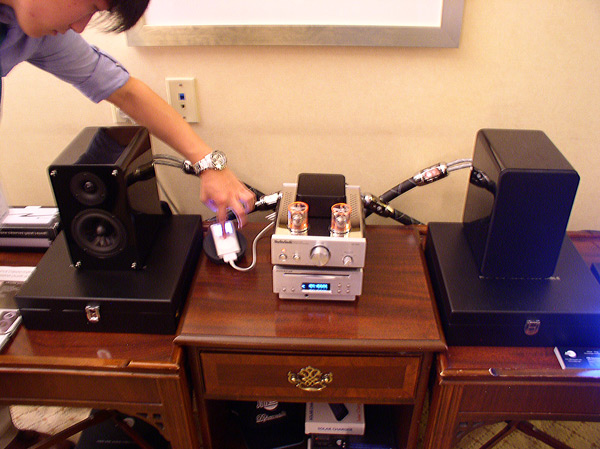
The sign on the door said JIB Germany, leading me to expect…well, something very different from what I found. (As the late Vivian Stanshall declared in a Bonzo Dog Band number titled “Shirt”: ‘24-Hour Cleaners’? That’s just the name of the shop, dearie!) That said, the exhibitors in this room demonstrated a pleasant-sounding mini-system, comprised of a Napa Acoustics NA-208A hybrid tube integrated amplifier ($399) and NA-208S two-way loudspeakers ($199/pair), fed by a first-generation iPod playing Abba songs. Hand not included.
Pure Music Does DSD
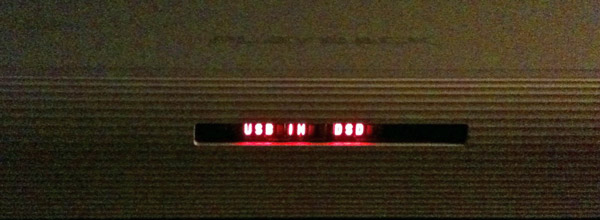
In Channel D's own room at Axpona, Rob Robinson demmed the latest version of his Pure Vinyl LP ripping program and Pure Music audio file player program for me. One of the new features of Pure Music v1.8 is the ability to play DSD files as well as hi-rez PCM, and to emphasize that fact, I photographed the display of Rob's Playback Designs MPD-3 D/A converter ($6500) to show that it was receiving DSD data via USB2.0.
Despite the small room, the musicDavid Elias's "Freedom on the Freeway"sounded excellent, with an analog-like ease to the presentation. The rest of the system comprised Joseph Pulsar speakers ($7000/pair) driven by a Hegel H20 amplifier. Blue Coast and 2L are already offering DSD files for download, and I understand that there are many live concerts available from tapes via bit torrent sites.
Rogue—EgglestonWorks
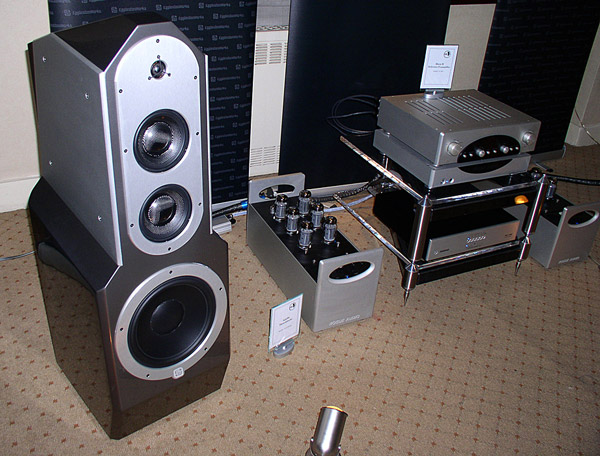
It’s okay to like R.E.M. again, and not just because their latest single (“Uberlin”) is the band’s best in over a decade: In the exhibit sponsored by EgglestonWorks and Rogue Audio, R.E.M.’s “How the West Was Won and Where it Got Us” sounded so good and so clear and so utterly fresh that I literally did not, at first, recognize the music. The combination of Rogue Hera II preamplifier ($7995) and Apollo monoblock amplifiers ($10,995/pair) plus Eggleston Andra III loudspeakers (ca $24,000 per pair) contributed to my wondering if the album from which that single sprung1997’s New Adventures in Hi-Fimight be better than I thought. I guess I’ll give the LP version another try (although I maintain that NAIHF represented the very nadir of the group’s covert-art pretentiousness). The Axpona experience renewed, in particular, my admiration for Rogue Audio’s persistence in making superb tube electronics at sane, fair prices.
Steinway Lyngdorf—Small Speaker—Big Sound
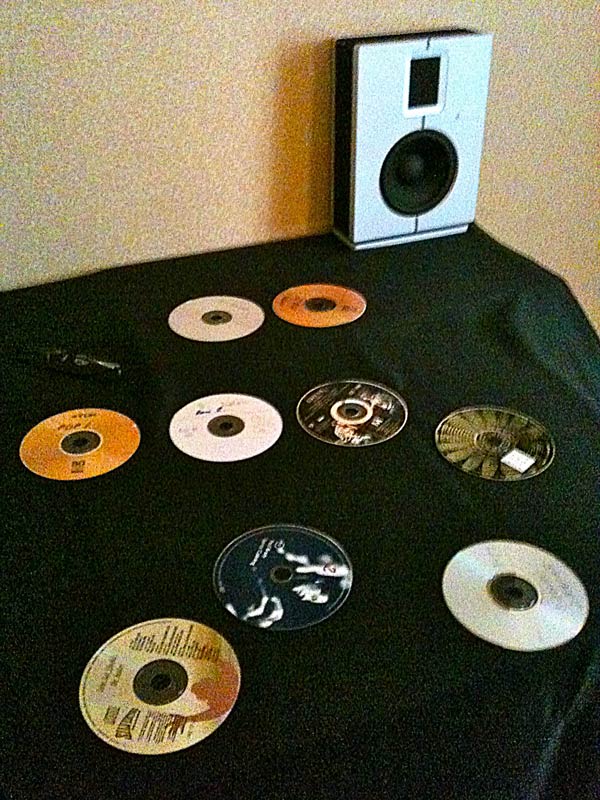
Steinway-Lyngdorf's S-Series loudspeaker is tiny, at just 10.2" H by 7.8" W and 3.1" D. (My apologies for the grainy photo but the battery in my camera gave out and I had to resort to my iPhone 3GS for this shot.)