

Listening #76
"Glory to the genius of Edison!"—Nikolai Rimsky-Korsakov
London (Decca) Jubilee/Reference phono cartridge
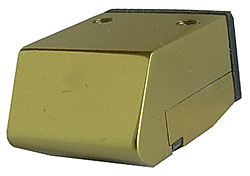 London phono cartridges still carry the famous Decca name (even if only in parentheses), but they are now produced by John Wright, a precision engineer and ex-Decca employee. Wright (not to be confused with his IMF and more recent TDL loudspeaker-designer namesake) was assigned the rights in 1989 by Decca's Special Products division (footnote 1), when the company's new owner, Racal, decided that they didn't want to be involved in the manufacture of audio equipment. Wright worked for 20 years in Decca's phono-cartridge division, where he gained a wealth of experience. As well as manufacturing the current range of London cartridges, he is also responsible for servicing and overhauling older Decca models.
Luxman LMC-5 moving coil phono cartridge
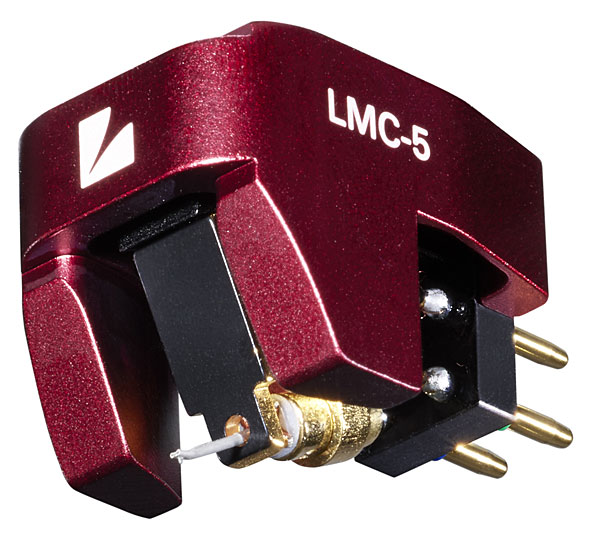
Since 1925, Japan-based Luxman Corporation has manufactured high-quality integrated amplifiers, preamplifiers, power amplifiers, phono stages, turntables, and, more recently, DACs and CD players. But it has been 40 years since Luxman introduced a new phono cartridge; the last one was the LMC-2 in 1982, released just after 1981's LMC-1. That dry period ended with the introduction of the Luxman LMC-5 ($2695).
Lyra Atlas MC phono cartridge
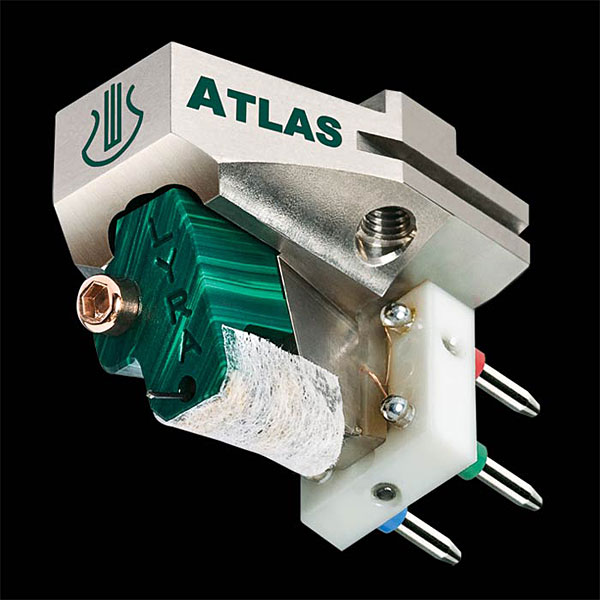
At the 2012 Consumer Electronics Show, I spoke with Lyra's Jonathan Carr about the Atlas. He told me that, rather than having started as a blank sheet of paper, the Atlas is an outgrowth of the Kleos ($2995), which I reviewed in January 2011, when I thought it Carr's best balanced design yet, even if it didn't have quite the resolution of the Titan i. Like the lower-priced Delos ($1650, reviewed in August 2010), the Kleos included Carr's New Angle technology, which mechanically aligns the coils to be perfectly positioned relative to the front and rear magnets when the stylus is in the groove.
Lyra Atlas SL and Etna SL phono cartridges
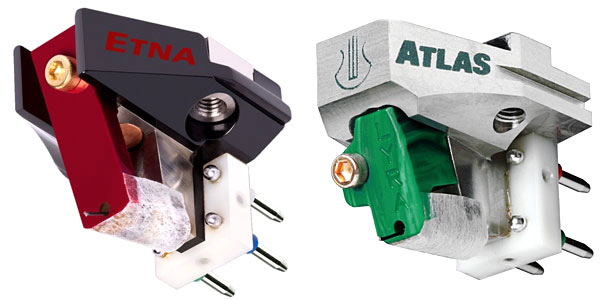
My 0.56mV-output Lyra Atlas moving-coil cartridge ($11,995) has put in four years of heavy-duty use. But not long ago I began to hear some problems with sibilants from records that previously hadn't given me trouble in that department. Lyra's Jonathan Carr and Stig Bjorge suggested I bring my Atlas to the 2016 Consumer Electronics Show, held last January in Las Vegas, where they would exchange it for a new one.
Lyra Clavis Da Capo moving-coil phono cartridge
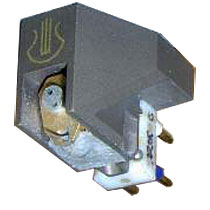
Scan-Tech builds low-output moving-coil cartridges for a number of companies, including AudioQuest, Linn, and Spectral (footnote 1). It also markets its own line, under the Lyra brand name (Lydian, Clavis, Parnassus), which is imported and distributed by Immedia out of Berkeley, CA.
Lyra Parnassus D.C.t phono cartridge
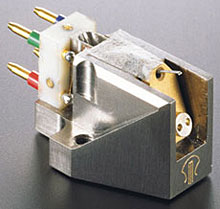
What makes a phono cartridge worth $3500 or $4000? Pride of ownership? Snob appeal? Sound? Tracking ability? Exotic materials? Styling? Labor cost for skilled artisans? Special ether? Cool wooden box? All of the above?
Lyra Skala moving-coil phono cartridge
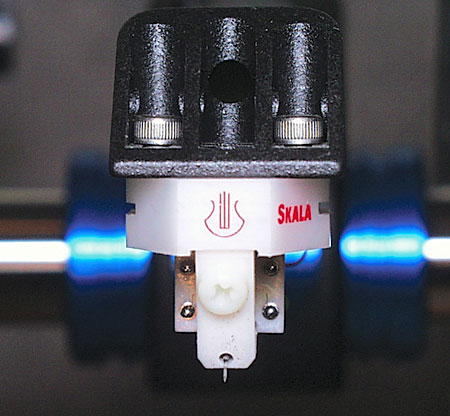
Back in 2000, when Lyra introduced the Helikon moving-coil cartridge, which replaced the then six-year-old Clavis D.C., the company inexplicably retained the Clavis D.C.'s retail price of $2000. This was inexplicable because the Helikon's revolutionary design was new from the ground up, and because audiophiles—like most, if not all, consumers—perceive price to be a reflection of quality and performance.
Miyajima Shilabe phono cartridge
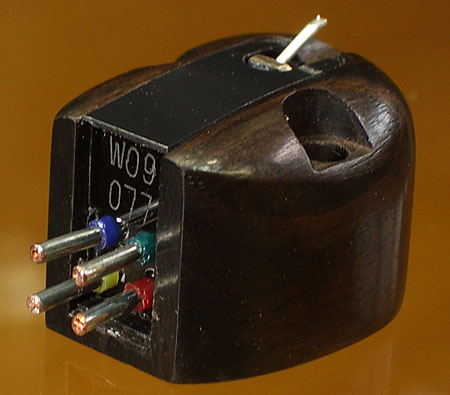
The unusual Miyajima Shilabe moving-coil cartridge ($2800) came to my attention through a friend, and I obtained one from the importer, Robin Wyatt of Robyatt Audio, a music lover and dedicated audiophile who imports gear as a sideline, and who lives nearby in New Jersey.
Monster Cable Alpha Genesis 500 phono cartridge
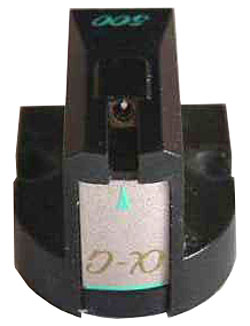 The Genesis 500 ($650) is the baby brother of Monster Cable's top-of-the-line Genesis 1000 cartridge. It is almost identical in physical appearance, differing only in its use of green body trim (the 1000 sports red pinstripes). All of the functional differences appear to be in the stylus and cantilever. The cantilever of the 500 is a hollow sapphire rod tightly attached to an inner aluminum tube (the 1000 has a diamond-coated boron tube cantilever). Its stylus is a 6µm x 35µm line-contact (3µm x 60µm for the 1000). Monster claims a stylus life in excess of 600 hours for the Genesis 500, more than 1000 hours for its higher-priced sibling.