

The Big Announcement
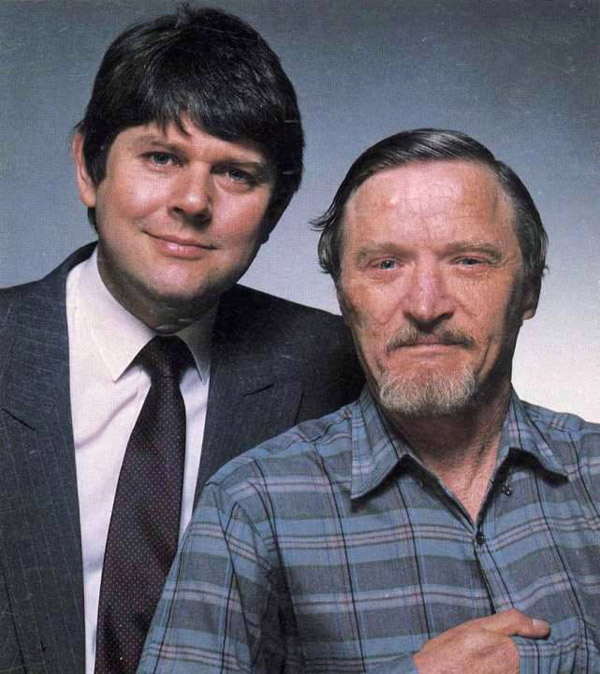
The rumors have been flying, and his arrival is imminent—a couple weeks after you read this—so it's time our readers know: John Atkinson, for the last four years Editor of Britain's prestigious Hi-Fi News & Record Review (left), is joining the staff of Stereophile as Managing Editor and International Editor.
The Blind leading the Deaf
As the person who "invented" subjective testing, I have followed with great interest the many articles in the mainstream audio press which purport to prove that none of us can really hear all the differences we claim to hear, particularly those between amplifiers. My reaction has usually been: "Why didn't they invite me to participate? I would have heard the differences under their double-blind listening conditions." I could make that assertion with supreme confidence because I had never been involved in any such test.
The Carver Challenge
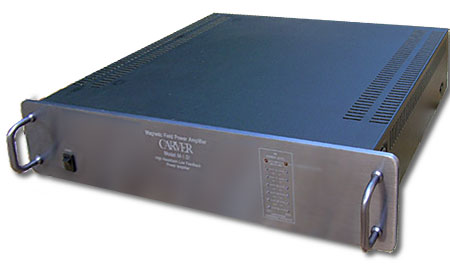
Is it possible to make a $700 "mainstream-audio" power amplifier sound exactly like a high-priced perfectionist amplifier? Bob Carver, of Carver Corporation, seemed to think he could, so we challenged him to prove it.
The Case Against Show Reports
Now that Stereophile's reporting on the 1985 Summer Consumer Electronics Show has ended (I hope!), I would like to express strong dissent with its style and content. In fact, I believe that most of it should never have appeared in print.
The Final Final Word
This is my final "Final Word." Although, combined with the announcement of J. Gordon Holt's resignation, this will undoubtedly cause rumors to swirl about Emap Petersen forcing all the old guys out, I assure you that my departure is of my own volition. It's a process that started back in 1997, when John Atkinson and I first talked about selling Stereophile, and for me it reaches its conclusion here.
The Flexible Firms
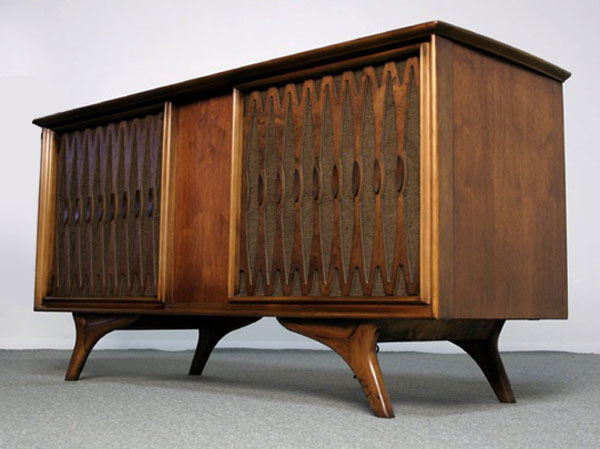
Some years ago, we attended a hi-fi show in New York City where one of the exhibitors was RCA Victor. Their presence there would have been forgotten were it not for the fact that their exhibit, featuring their own discs played on their own line of phonographs, was producing some of the filthiest sound at the entire show. And that, in the proverbial nutshell, is why you never see reports in Stereophile on equipment made by RCA, Philco or General Electric.
The Highs & Lows of Double-Blind Testing
Editor's Note: In 1985 and 1986, an argumentative thread ran through Stereophile's pages, discussing the benefits or lack of double-blind testing methods in audio component reviewing, triggered by J. Gordon Holt's review">http://www.stereophile.com//asweseeit/121/">review of the ABX Comparator. As this debate is still raging nearly 15 years later, we present here the entire discussion that bounced back and forth between the magazine's "Letters" section and features articles. It was kicked off by a letter from C.J. Huss that appeared in Vol.8 No.5.—John Atkinson
The Horse's Mouth (Stereo Review's 1983 cable tests)
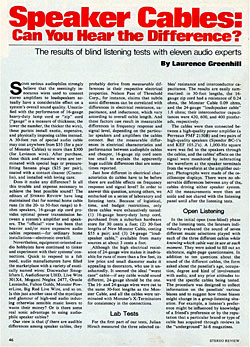
It's not often that you get a chance to have extensive discussions with the horse's mouth, but we recently had that opportunity. Since July of this year there has been extensive discussion in the audio community, particularly the high-end segment, of Larry Greenhill's article">http://bruce.coppola.name/audio/Greenhill.pdf">article on speaker cable listening tests in the August, 1983 issue of Stereo Review (footnote 1). From recent talks with author Greenhill we've learned that the most interesting story was not in Stereo Review; instead it can be found in the varying reactions from different quarters, and what they say about the high-end industry in general.
The Music Goes Round & Round
"Turntable Wars" was the phrase used by Anthony H. Cordesman to head his review of the Oracle, SOTA, and VPI turntables in Vol.9 No.4. To judge from the reaction of the manufacturers at CES to this innocent phraseology, you would have thought that Stereophile had been warmongering, rather than publishing what were actually pretty positive opinions of the products concerned. So enraged was Jacques Riendeau of Oracle, and concerned that the record be put straight, that he insisted on a "right to reply" to AHC's review; as it happened, Ivor Tiefenbrun and Charlie Brennan of Linn (right in photograph, footnote 1), and SOTA's Rodney Herman (center in photo, footnote 2), also wanted to contribute to the debate, so a small crowd of illuminati gathered in Room 417 of the Americana Congress to commit opinions to tape. I held the microphone and clicked the shutter; Larry Archibald (left in photo) was there to lend the proceedings a businesslike air.
The Musician in the Middle
Ask most professional symphony musicians for their views concerning recording sessions, and you might be greeted with seemingly nonchalant and cavalier responses. You will probably be told that although recording can be quite lucrative, it is almost always an exercise in futility. If you press further, and inquire as to why these "artists" display such negative attitudes, they would treat you to both a lecture concerning the shortcomings and gross musical distortions usually involved in the recording process, and to a tirade on the incompetence and arrogance of many recording engineers and producers. And once you have opened this can of worms, you will undoubtedly be told about the frustrations of having to deal with inaccurate and distorted representations of their art at the hands of the musically inept.