

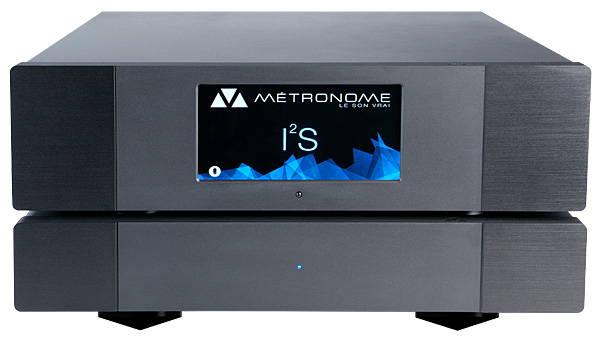
Métronome Technologie AQWO SACD/CD transport and D/A processor
In an era when polar opposites compete as absolutes, it can be a challenge to acknowledge the different and equally valid ways in which audiophiles approach musical truth. But the reality is that our perceptions of how reproduced music should sound are determined, to a large extent, by how we approach the live experience.
M2Tech Young D/A processor & Palmer Power Station battery power supply

You know what's fascinating? As digital audio technology matures, DAC design is not converging on a single most popular or overall best approach. Multiple design paths continue to thrive, new ones are still appearing, and each variation on the DAC theme has its adherents and side trails: bitstream, non-oversampling, upsampling, various filters, DSD playback options, and on and on.
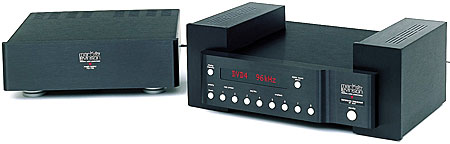
Mark Levinson No.30 Reference Digital Processor
Over the past two and a half years, I've auditioned and reviewed a number of digital audio products. It has been a fascinating experience both to watch digital playback technology evolve and to listen to the results of various design philosophies. The road to more musical digital audio has been a slow and steady climb, with occasional jumps forward made possible by new techniques and technologies. Making this odyssey even more interesting (and confounding), digital processors seem to offer varying interpretations of the music rather than striving toward a common ideal of presenting what's on the disc without editorial interjection.
Mark Levinson No.30.5 Reference digital processor
The arrival of the Mark">http://www.stereophile.com/digitalprocessors/mark_levinson_no30_referen… Levinson No.30 digital processor more than 2½ years ago marked a turning point in digital-audio reproduction. Although the No.30's $13,950 price tag put it out of reach of all but a few audiophiles, its stunning performance suggested that much more musical information was encoded on our CDs, waiting to be recovered by better digital processors. Further, it was inevitable that this level of performance would become less expensive over time. I was more excited by the No.30 than I've been over any other audio product. In fact, its musical performance was so spectacular that it alone occupied the Class A category in Stereophile's "Recommended Components."
Mark Levinson No.30.6 Reference D/A processor
The Mark Levinson No.30 has enjoyed a continuing residence in Class A of Stereophile's "Recommended Components" listing since it was reviewed in our February 1992 issue (Vol.15 No.2). Madrigal includes the No.30 in its "Reference" series, by which they mean that the unit will not become obsolete. Thus, when new technology became available, the No.30.5 update was introduced, consisting of a single digital-receiver printed circuit board to replace the original's three boards, and a new digital-filtering board. This revision was favorably reviewed by Stereophile in October 1994 (Vol.17 No.10).
Mark Levinson No.35 D/A processor
 When a manufacturer sets out to design and build a product, be it in high-end audio or any other field, the final retail price is usually a prime consideration. Parts and assembly are only part of the equation; there also must be enough buyers to amortize the design and development costs. If the product is to be a flagship modelsomething a company hopes will give a lift to its entire lineengineers will sometimes throw caution to the winds, designing a product without thought to its ultimate price, which is only set after the design is complete. When Madrigal Audio Laboratories set out to design their No.30 Reference Digital Processor, they appear to have chosen exactly this approach.
Mark Levinson No.36 D/A converter
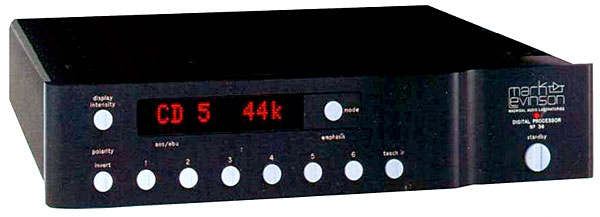
To echo Audio Cheapskate Sam Tellig, who was in turn paraphrasing Thomas R. Marshall, what the world needs is a great $299 CD player. Certainly there's no shortage of expensive units vying for your attentionmost of them consisting of separate transports and D/A converters.
Mark Levinson No.360 D/A converter
Unlike the imposing mbl and Burmester DACs that I review elsewhere in this issue, the Mark Levinson No.360 is New England conservative in appearance. Its operation was simple to master despite the sophistication and flexibility on tap. Flanked by Fasolt and Fafner, the Levinson No.360 seemed as amiable as Freia.
Mark Levinson No.37 CD transport & No.36S D/A converter
We are now well past the era in which every review of digital playback equipment had to begin with an apology for the medium. CD replay performance may, in fact, now be bumping up against a glass ceiling. But that doesn't discourage high-end audio manufacturers from trying to advance the art, and tempt audiophiles (at least those among us who are not hopeless digiphobes) out of our minds.
Mark Levinson No.390S CD Processor
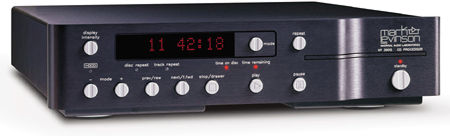
It was 20 years ago that I appeared on one of the UK's equivalents of NBC's Today show to comment on the launch of CD. I wanted to talk about digital technology, but my host was more interested in the medium's lack of surface noise, which he demonstrated by showing that a disc smeared with butter and marmalade—this was breakfast television, remember—would play without skipping. (Actually, it wouldn't play; after the jammy CD was loaded, the program cut to a pretaped segment in which the player had a pristine disc inside it.)