

Pure Vinyl LP recording & editing software
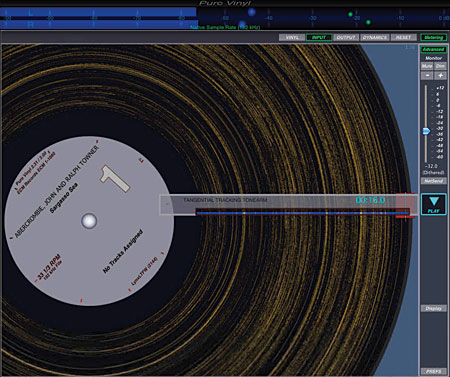
As long as you're spinning an LP for your listening pleasure, and if digitizing it at a resolution of 24-bit/192kHz is transparent to the analog source, why not record and store the LP on your computer at that high sampling rate for future convenient playback via iTunes or for iPod use, or for burning to CD-R? And, while you're at it, why not record the LP unequalized and apply the RIAA curve in the digital domain, where you're not dependent on capacitors and resistors that are imprecise to begin with, and can drift over time? With no drift of phase or value, the virtual filter's results should be better than with any analog filter. And in the digital domain, you can program in any curve known, and select it at the click of a mouse. Aside from the sweat equity invested in programming it in the first place, it wouldn't add a penny to the program's cost.
Sentec EQ11 phono preamplifier

With quiet elegance, the Sentec EQ11 phono stage and equalizer entered my expanding world of gramophone dreams. The EQ11 ($2500) is a modestly sized, tubed phono stage with the industry-standard RIAA phono equalization and five other EQ curves. These additional curves are for records pressed by companies that did not fully or promptly comply with the new, supposedly global industry standard introduced by the Recording Industry Association of America (RIAA) in 1954.
Seta Model L phono preamplifier
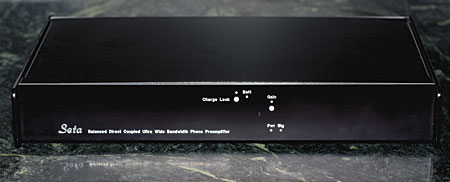
The minuscule electrical output of an analog signal from a moving-coil cartridge needs to be boosted before it can be converted to digital and equalized in the digital domain. Of course, you could use your current phono preamplifier and record an equalized signal to hard disk, but then you wouldn't get to experience Pure Vinyl's digital RIAA correction—nor would you be able to avail yourself of all the equalization curves provide by Pure">http://www.stereophile.com/computeraudio/pure_vinyl_lp_recording_amp_ed… Vinyl, of which there are almost too many to count.
Seta Nano phono preamplifier
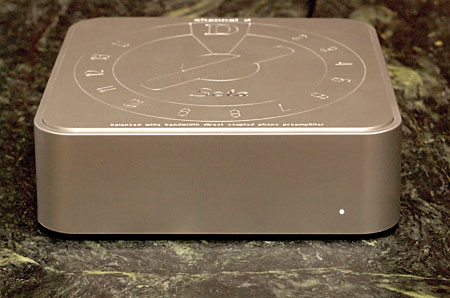
The minuscule electrical output of an analog signal from a moving-coil cartridge needs to be boosted before it can be converted to digital and equalized in the digital domain. Of course, you could use your current phono preamplifier and record an equalized signal to hard disk, but then you wouldn't get to experience Pure">http://www.stereophile.com/computeraudio/pure_vinyl_lp_recording_amp_ed… Vinyl's digital RIAA correction—nor would you be able to avail yourself of all the equalization curves provide by Pure Vinyl, of which there are almost too many to count.
Shindo Aurieges Equalizer Amplifier
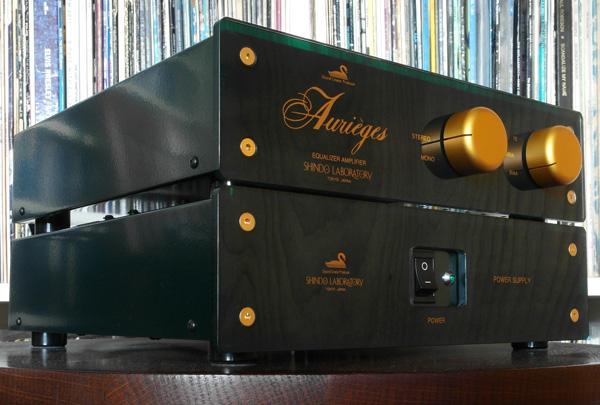
At some point within the last few years of his life, the late Ken Shindo designed an outboard phono preamplifiera decision perhaps made inevitable by his earlier decision to answer popular demand with line-only versions of the Aurieges and the more upmarket Vosne-Romanee preamps...
Simaudio Moon LP5.3 phono preamplifier
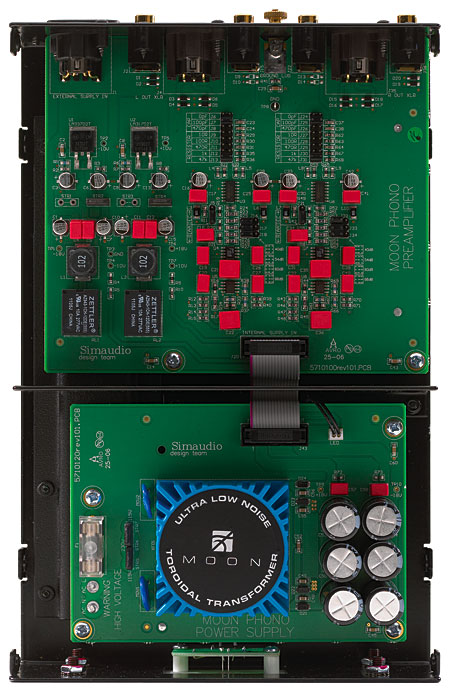
Simaudio's Moon LP5.3 MM/MC phono preamplifier ($1400) is silly good! It has single-ended RCA inputs and both single-ended and true balanced-differential outputs. It also offers a wide range of adjustments for gain (54, 60, and 66dB), resistive loading (10, 100, 470, 1k, and 47k ohms), and capacitive loading (0, 100, and 470pF), all accomplished via a series of internally mounted jumper banks. You can even choose RIAA or IEC equalization. Removing the top plate to get to the adjustments reveals boards filled with high-quality parts for the well-isolated power-supply and signal-handling circuits.
Sonic Frontiers Phono One phono preamplifier
I've been in love with British sports cars ever since a visiting highway engineer brought a green MGB-GT to my tiny Nebraska town 30 years ago. Since then, there's been a steady stream of ferocious little cars in my life. Triumphs, MGs, Healeys, you name it—right up to my current crop, a Triumph TR6 and roughly two-and-a-half Jensen-Healeys.
Sutherland Engineering 20/20 phono preamplifier
Why no batteries?
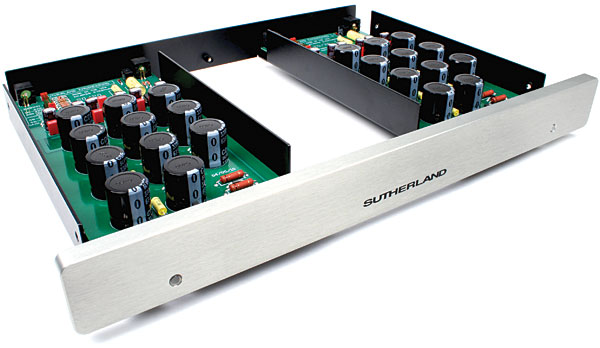
It seemed a simple and obvious question, but I couldn't get an answer out of Ron Sutherland. Why did his new 20/20 phono preamp use an AC power supply instead of batteries? I asked directly, I asked repeatedly, I tried framing the question in different ways, all to no avail. Did the AC supply make it sound better? Was it less expensive to build? Were potential customers turned off by having to replace batteries once every year or two?
Sutherland Engineering Duo phono preamplifier
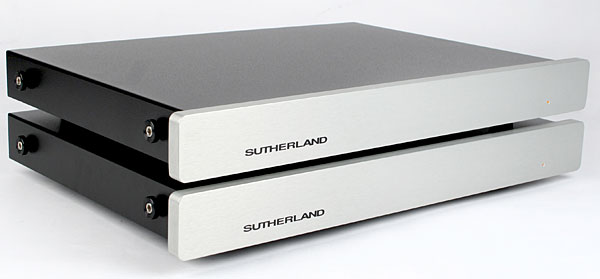
"Saying that Sutherland Engineering builds a nice line of phono stages is like saying that the Porsche 911 Carrera is a nice line of sports cars." So began my review of Sutherland's PhonoBlock in the January 2012 issue. I went on to note that similar philosophies underpin both product lines, and to link the cost-no-object PhonoBlock ($10,000/pair) with the GT2 RS ($245,000), then the pinnacle of Porsche's 911 family. It's now 2017, and though Sutherland and Porsche have both gone through a complete development cycle and replaced their flagship models, the analogy still holds true.
Sutherland Engineering Little Loco phono preamplifier

Descriptions of the sounds of products from Sutherland Engineering nearly always include "refined." While that word is certainly justified, it would be more apt to use it as a verb: Ron Sutherland spends more time than any audio designer I've known studying and fine-tuning and refining every detail of his work. I have the impression he knows those products so well that when he decides to design a less expensive version of his newest and best models, he knows exactly what to do.