

Ortofon Rondo Bronze MC phono cartridge
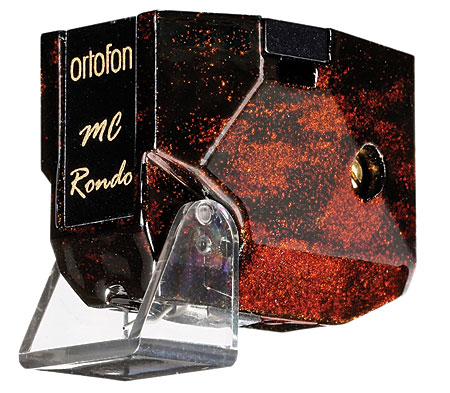
An enduringly healthy phono-cartridge industry? After a quarter of a century of rushing right out to buy the latest digital music appliances? You bet.
Outlaw Audio RR2150 stereo receiver
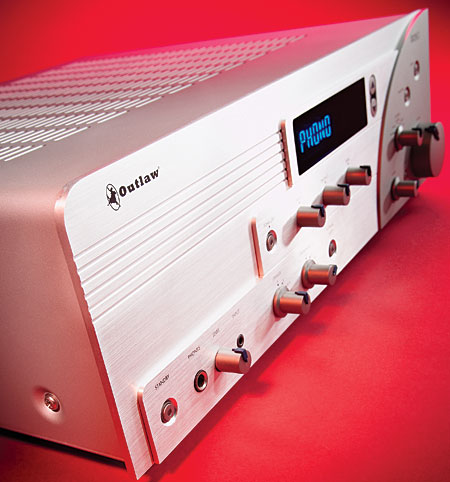
Wilson Audio Specialties' David Wilson likes to say that you should build a stereo system from the speakers down. Of course he does—he sells speakers. But that doesn't mean he's wrong. So recently, when offered an inexpensive new product for review, I decided it would be a good test of Wilson's theory. I tried driving Wilson's $45,000/pair MAXX2http://www.stereophile.com/floorloudspeakers/805wilson">MAXX2; speakers with Outlaw Audio's RR2150, a $599 stereo receiver.
Outlaw Audio RR2160 stereo receiver
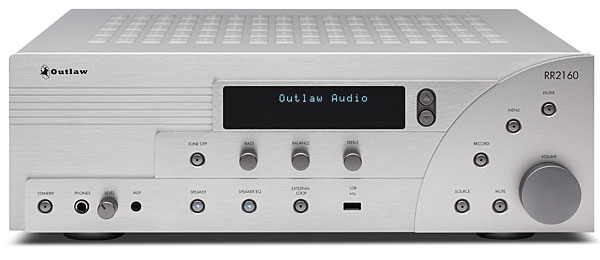
For audiophiles of a certain age, the mere mention of NAD Electronics' original 3020 integrated amplifier (1980, designed by Erik Edvardsen), or Adcom's GFA-555 stereo power amplifier (1985, designed by Nelson Pass), conjures up happy memories of audio's last Golden Agean idyllic time when working stiffs could luxuriate in the same audio arcadia as bankers and brokers. Since then, few, if any, audio components have achieved that level of iconic high value. Which caused me to wonder: What would it take, nowadays, to manufacture a genuinely high-value audiophile product: one that delivers exciting, satisfying sound at a price most audiophiles can afford?
Paradigm Atom Monitor v.5 loudspeaker
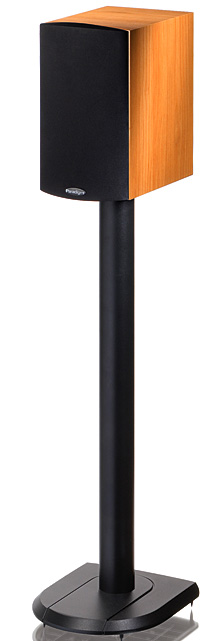
When folks visit from out of town, they frequently remark that my Brooklyn neighborhood reminds them of "a real neighborhood" from their neck of the woods. "Except that we know all our neighbors and talk to them when we're cutting the grass, watering the lawn, and walking the dog. You probably don't even know the names of any of yours."
Paradigm Atom v.3 loudspeaker
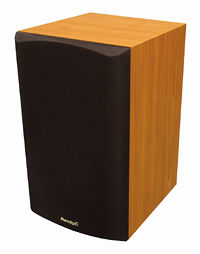
I had mixed feelings about reviewing the $189/pair Paradigm Atom loudspeaker. Although in the past I've been favorably impressed with Paradigm's speakers—the $600/pair Reference">http://www.stereophile.com//loudspeakerreviews/628/">Reference Studio/20 remains one of my favorite affordables—Budget Bob tends to get a bit nervous when a speaker's price drops below $250/pair. In my experience, even when the most talented speaker designers attempt to make a speaker to sell at such a low price, the result is often a very small cabinet with limited bass extension and inferior high-level dynamics.
Paradigm Control Monitor loudspeaker

If speakers were cars, the Infinity IRS Beta and B&W 801 Matrix would represent the luxury end of the mass market, with perhaps the Celestion SL700, Quad ESL-63, and MartinLogan Sequel II analogous to rather hairy, temperamental sports carsthe Porsche 911, for example. But most people don't buy Porsches, or even Lincoln Town Cars; they buy Hyundai Excels and Ford Escorts. In the same way, when the car is garaged for the night, they don't sit down in front of IRS Betas; in all likelihood they listen to their records with a compact two-way design. If competently designed, a small two-way can give a great deal of musical satisfaction, and, to take a current hobbyhorse of mine out for a trot, if a designer can't produce an at least competent two-way loudspeaker, he or she has no business trying to design larger, more ambitious modelsthere's nowhere to hide your lack of talent if all you have to play with is a tweeter, a woofer, a rectangular enclosure, and a handful of crossover components.
Paradigm Reference Studio/20 loudspeaker
The least expensive model in Paradigm's Reference series, the Studio/20 loudspeaker is a rear-ported two-way dynamic bookshelf/satellite design, superficially identical to the powered Active/20 that JA">http://www.stereophile.com//loudspeakerreviews/597/">JA reviewed last November. It features Paradigm's 25mm PAL pure-aluminum dome tweeter in a die-cast heatsink chassis, and a 170mm MLP mica-polymer cone in an AVS die-cast heatsink chassis with a 38mm voice coil. The crossover is third-order, quasi-Butterworth, said to be "phase-coherent." It features high-power ceramic resistors, film capacitors in all signal paths, and both air-core and steel-core inductors.
Paradigm Reference Studio/20 loudspeaker
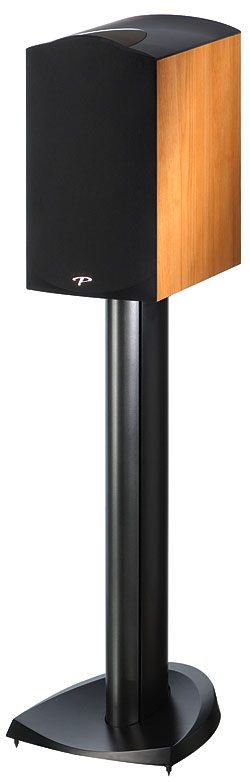
One of the first affordable loudspeakers I reviewed for Stereophile was the original Paradigm">http://www.stereophile.com/standspeakers/628">Paradigm Reference Studio/20 bookshelf model, in the February 1998 issue (Vol.21 No.2). At the time, I felt that the $650/pair speaker was a breakthrough—although not completely devoid of colorations, its ratio of price to performance set a benchmark a decade ago. I kept the Studio/20s around for several years to compare with other bookshelf speakers I reviewed, and they remained listed in Stereophile's "Recommended Components" for several years after that. The Studio/20 is now in its fourth (v.4) iteration, so I thought I'd grab a pair to hear how they compared with current affordable bookshelf designs.
Paradigm Reference Studio/60 v.3 loudspeaker
I am biased in favor of Paradigm loudspeakers. I've used them for 10 years; they offer good sound and good value, properties they share with a number of other Canadian makes who have taken advantage of Canada's National Research Council facilities in Ottawa. In fact, the first components I bought specifically for what is now my multichannel system were Paradigm Esprit/BP speakers, which had impressed me at a Stereophile show. When I took the step into multichannel and found that there wasn't a matching center-channel speaker for the Esprits, I replaced them with Paradigm's Reference Studio/60 v.2s. But while the smaller Reference">http://www.stereophile.com/loudspeakerreviews/628">Reference Studio/20, and the larger Studio/100http://www.stereophile.com/loudspeakerreviews/252">Studio/100; have both been reviewed in Stereophile, the Studio/60 had not. The release of the v.2's successor, the Reference Studio/60 v.3 ($1699/pair), was an opportunity to fill that gap.
Parasound Halo P 5 2.1-channel D/A preamplifier
Asked how to make a guitar, the celebrated luthier Wayne Henderson offered a straight-up answer: "Just get a pile of really nice wood and a whittling knife. Then you just carve away everything that isn't a guitar." (footnote 1)
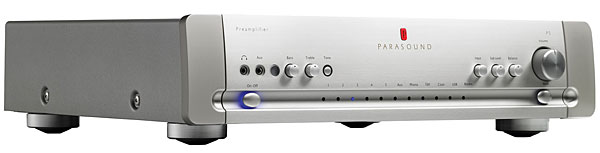
The making of a preamplifier seems more or less the opposite. You start with a simple volume control and a couple of jacks, then add whatever you think constitutes a preamplifier. Choices might include electronic source switching, line-level gain, phono-level gain and equalization, tone controls, tone-defeat switches, a balance control, a headphone jack, an iPod input, and maybe even a digital-to-analog converter with a USB receiver. The sky is pretty much the limit.