

Quad 405 power amplifier
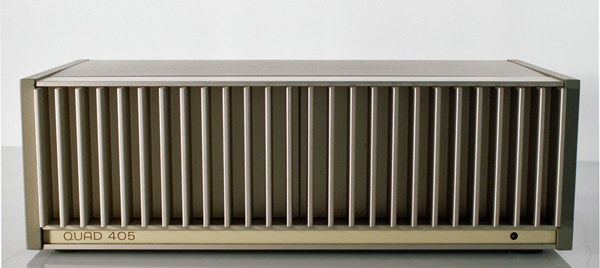
This is something we don't see too often: an entirely new approach to power amplifier design. As Quad points out in its literature for the 405, class-A operation of transistors provides the lowest distortion, but drastically limits the amount of power an output transistor can deliver without overheating. (Most transistor amps use class-AB output operation, in which each of a pair of power transistors handles part of each signal cycle and shuts down during the other part. Imperfect synchronism between the two halves causes the familiar "crossover distortion," which accounts for most solid-state sound. In class-A operation, each output transistor draws current though the entirety of each signal cycle, eliminating the crossover transition but doubling the amount of time current is drawn, and thus tending to cause the transistor to heat up more.)
Quad ESL-63 loudspeaker
Warning to Purists: Despite certain qualities about the ESL-63 speakers which you will probably like, Quad equipment is not designed primarily for audiophiles, but for serious-music (call that "classical") listeners who play records more for musical enjoyment than for the sound. Quad's loudspeakers do not reproduce very deep bass and will not play at aurally traumatizing volume levels, and Quad's preamplifier is compromised through the addition of tone controls and filters, all for the purpose of making old, mediocre, and/or worn recordings sound as listenable as possible.
Quicksilver MS190 power amplifier
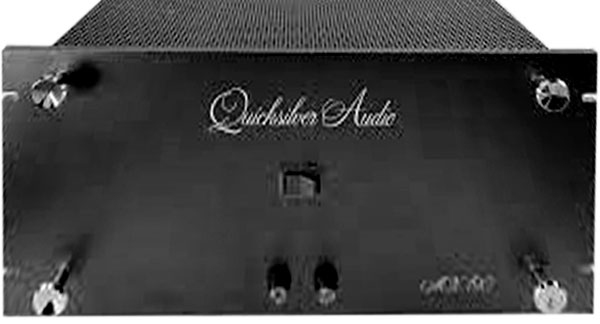
It would appear that there are still people out there who are unaware that this is the age of the transistor. Not only are tubed amplifiers not vanishing from the face of the earth, they are proliferating. Audio's equipment directory for 1977 listed three tubed power amplifiers. The same directory for 1984 lists over 30 of them, and the Quicksilver amplifier is not even included!
Recommended Components #1
[Note - this article is from the May, 1963 issue of Stereophile]
Many readers have asked why we don't maintain a permanent listing in each issue of The Stereophile of those components that we feel to be the best available, with or without qualification.
So, we are following our readers' suggestion, and will list in each issue groups of components which, at publication time, we feel are ones from which our readers would be well advised to assemble their systems. The list will change from time to time, as new products appear, old ones are obsoleted, or manufacturers change their quality control standards. Components will be added to or dropped from the list without advance notice if we see adequate reason for doing so, but each change in the list will be explained in the magazine at the time the change is made.
Recording of April 1967: An Audio Obstacle Course
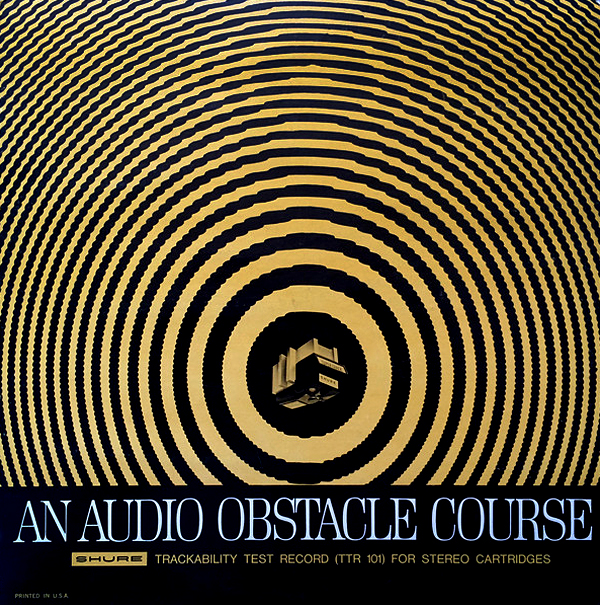
An Audio Obstacle Course: The Shure Trackability Test Record
Shure Bros. TTR-101. Shure's new "Supertrack" V-15 Type II pickup was designed as an answer to all those high-powered discs whose excessive modulations make them shatter all over the place on lesser pickups, But just in case anyone didn't happen to own any of these difficult discs, Shure decided to issue one of these, too. The result is a collection of some of the meanest modulations ever gathered together in one place.
Shure Bros. TTR-101. Shure's new "Supertrack" V-15 Type II pickup was designed as an answer to all those high-powered discs whose excessive modulations make them shatter all over the place on lesser pickups, But just in case anyone didn't happen to own any of these difficult discs, Shure decided to issue one of these, too. The result is a collection of some of the meanest modulations ever gathered together in one place.
Recording of April 1978: The Power and the Majesty
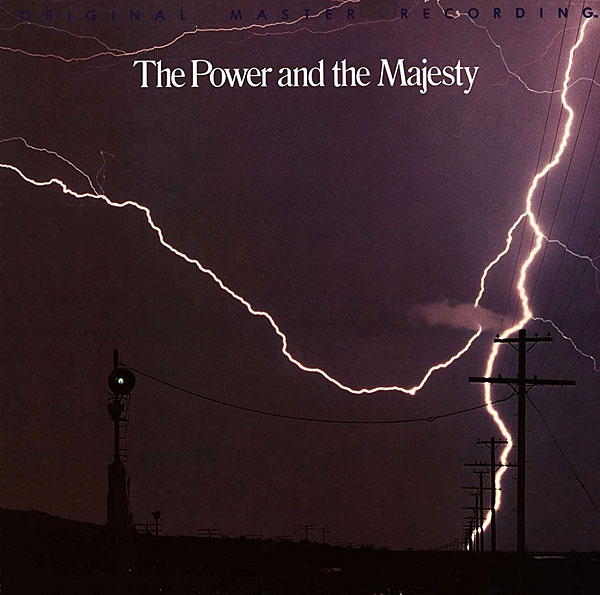
This is more to my liking than the other records I review this month! Side 1 is devoted entirely to a real humdinger of a thunderstorm, replete with rain, thimble-sized hailstones, and five minutes of someone diddling with a set of wind chimes. Side 2 is four sequences in the saga of Steam Locomotive 4449, which was refurbished from rusty decrepitude to haul the bicentennial Freedom Train 28,000 miles around the continent.
Recording of April 1982: Williams: Film Music
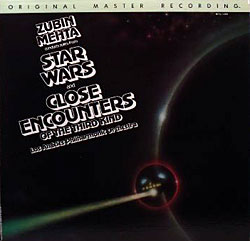 Williams: Suites from Star Wars and Close Encounters of the Third Kind
Los Angeles Philharmonic orchestra, Zubin Mehta.
Mobile Fidelity MFSL-C.008 (cassette). Originally released on London Records, then re-released with better sound on a Mobile Fidelity disc (now a cutout), these are stunning performances of these popular film scores, rivaling the composer's own performances of them. (Composers aren't always the best conductors of their own music, but John Williams is one who is.) Sonically, this is simply a tour de force: Without a doubt the best commercially made cassette I've ever heard (and I've heard a lot of them). Last month, I expressed some doubt that the high end on any cassette could rival that of a half-speed LP and, indeed, there is a softening at the top on this cassette, when compared with the Mobile Fidelity disc. But the truth of the matter is that the cassette's high end is substantially more natural than that from the disc, which was one of Mobile Fidelity's first and had a slightly steely edge to it.
Recording of April 1989: The Symphonic Soundstage
 It is often said that anyone with a recorder and a couple of microphones can record an orchestra. It's true, assuming you can get permission to do it (another story entirely). But that statement fails to address an important question: "How well?"
The rudiments of any skill can be learned from books. Practice can develop a fair level of competence. Beyond competence, however, the student is governed by his genes and/or family environment, depending on which theory of human potential you subscribe to. Whatever the reason, some practitioners of both disciplines never seem able to transcend mere competence, while others go on to become legends in their own times. John Eargle, chief recording engineer for Delos Records and producer of this fascinating recording, may or may not qualify as a legend, but he is obviously 'way past "a fair level of competence."
It is often said that anyone with a recorder and a couple of microphones can record an orchestra. It's true, assuming you can get permission to do it (another story entirely). But that statement fails to address an important question: "How well?"
The rudiments of any skill can be learned from books. Practice can develop a fair level of competence. Beyond competence, however, the student is governed by his genes and/or family environment, depending on which theory of human potential you subscribe to. Whatever the reason, some practitioners of both disciplines never seem able to transcend mere competence, while others go on to become legends in their own times. John Eargle, chief recording engineer for Delos Records and producer of this fascinating recording, may or may not qualify as a legend, but he is obviously 'way past "a fair level of competence."
Recording of August 1980: Capriccio Italien & Capriccio Espagnol
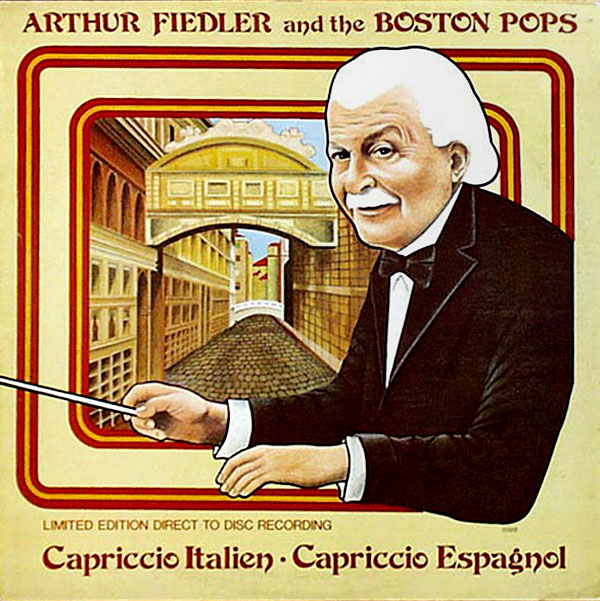
TCHAIKOVSKY: Capriccio Italien
RIMSKY-KORSAKOV: Capriccio Espagnol
Boston Pops conducted by Arthur Fiedler.
Crystal Clear CCS-7003 (Direct-cut LP). Ed Wodenjak, prod.; Bert Whyte, eng.; George Piros, Richard Simpson, Stan Ricker, mastering; John Meyer, special equipment; John Curl, console design. One of Crystal Clear's earlier releases (1978), this has very distant, directionally vague sound, but the sound (stupendous by standards of only a few years ago) cannot stand in the way of two of the most exciting performances of these potboilers that have ever been committed to disc.
RIMSKY-KORSAKOV: Capriccio Espagnol
Boston Pops conducted by Arthur Fiedler.
Crystal Clear CCS-7003 (Direct-cut LP). Ed Wodenjak, prod.; Bert Whyte, eng.; George Piros, Richard Simpson, Stan Ricker, mastering; John Meyer, special equipment; John Curl, console design. One of Crystal Clear's earlier releases (1978), this has very distant, directionally vague sound, but the sound (stupendous by standards of only a few years ago) cannot stand in the way of two of the most exciting performances of these potboilers that have ever been committed to disc.
Recording of August 1984: Saint-Saëns & Ravel Orchestral Works
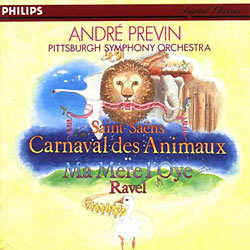 Saint-Saëns: Carnival of the Animals
Ravel: Mother Goose Suite
Pittsburgh Symphony Orchestra, André Previn, cond.
Philips CD 400-016 2 (CD). The whimsical Carnival, with its nose-thumbing at Saint-Saëns' contemporaries (eg a lugubrious "Can-Can" and a stately cello rendition of Berlioz's Dance of the Sylphs, from The Damnation of Faust), is given a delightful treatment here, and put on one of the best-sounding CDs I've heard to date from a major record company. Philips has been less up-front about the roots of its CDs than most other record manufacturers, If fact, they have been downright sneaky about it. This releasebilled prominently on the CD jacket as a "Digital Recording"sounds very much as if it was analog-mastered. The is certainly nothing Philips should ashamed of, because this is a better-sounding recording than most digitally mastered ones.