

iPad Daze
"Reviewed in the box!" is what Stereophile's founder, the late J">http://www.stereophile.com/news/j_gordon_holt">J. Gordon Holt, used to call it. You might think you're reading a review, but the realization slowly dawns that there's nothing in the text that could not have been gleaned from the manufacturer's brochure, nothing to indicate that the writer had even opened the box the product came in. When I read a review in another publication or online, I judge it by doing what I recommend Stereophile's readers do when they read this magazine: I look for the nugget I didn't already know, the facet I wasn't expecting, the concluding jewel I couldn't have predicted without ever having tried the component myself. Sadly, all too often too many of what are promoted as "reviews" on the Web are merely descriptions.
Is Ambisonics the Future of Sound Reproduction?
Scene the First. You are sitting in a concert hall, dead center, row M; the cellist walks on to the stage, sits down and starts to play the prelude to the first of Bach's">http://www.stereophile.com/musicrecordings/1192yoyoma">Bach's solo cello suites, that intricate unfolding of a rhapsodic melodic line within the tight framework of an implied chordal structure. Melody, harmony, rhythm—none exist at any one point of time in this most exquisite of Bach's solo instrumental writing, yet the skill of the composer, coupled with the artistry of the musician, allow you to perceive the abstract as reality.
Is Analog Dead?
1950: "The ultimate in disc recording is to make the reproduced sound as near as possible to the original..." (The founder of Audio magazine, C.G. McProud, in "Recording Characteristics," Audio Engineering, January 1950, reprinted in The 2nd Audio Anthology, p.67, Radio Magazines, 1954.)
Is it Live? Or is it . . .
As someone who started out as a classically trained musician but who then stepped sideways into rock, I'm fascinated by the one music I've never played: jazz. It seems to me that the essential difference between a performance of a classical work and a jazz performance is that in the former, the musicians use their technique to breathe life into dead notes on a page, while in good jazz, the performer not only applies a similar level of technical expertise, but also has simultaneously to have all of music theory at the fingertips in order to decide what the next note should be. It is a rare musician---Keith Jarrett, for example---who can excel in both arenas.
Is It Real? Or Is It...
Enid Lumley accosted me in the corridors of Santa Monica's BayView Plaza Hotel in March: "That doesn't sound like a real piano!" I was taken aback. The sound to which the redoubtable Ms. Lumley was referring emanated from a 7' Steinway we had hired for James">http://www.performancerecordings.com/">James Boyk to play at the Stereophile show. Jim was conducting a series of tutorials on how the sound of a real piano is constituted, so Enid's criticism, on the face of things, seemed absurd. As my face obviously showed this conclusion, she hastily explained that, of course it was a real piano, but the fact that it overloaded the 40-seat room in which it was being played caused it to sound different from the sound of a real piano played in a concert hall. To lead visitors to the show to expect piano records to sound similar to what Jim was producing was dishonest.
Is Music in Danger?
When I attended the Audio Engineering Society convention in October 1987 (my first time in over eight years; full report in this issue), I was impressed by the incredible technology now available to composers of music. I was also dismayed, however, by the extent to which so-called purist audio, as well as "acoustical" music, have been consigned to oblivion by the pro audio community. It was clear, both from the exhibits and the many conversations on which I eavesdropped, that audio professionals are no longer concerned about fidelity, in the sense of trying to reproduce sounds accurately. A "real" sound has become to them merely raw material of no value except as something to be processed, manipulated, folded, bent, and spindled to produce any sonic effect except the original one. About a third of the products displayed at the 83rd AES convention were tools for doing that.
Is This the Ultimate Old-School Analog Move?

This month, I am writing about what could be the ultimate analog topic circa 2025: A prominent vinyl-only record club is going totally offline. Is it a marketing gimmick? Sure it is, but read on.
It Don't Mean A Thing If It Ain't Got That Schwing
Epiphanies only come when you stop looking for them, and mine came in a room full of preschoolers watching cartoons at a Pizza Hut. I was taking my little nieces Alix (4) and Casey (1) out for dinner, and the last thing on my mind was audio; we wanted to PARTY! So my girlfriend Dara and I bundled them up in their car-seats and we high-tailed it over to the Hut, with visions of continuous-loop Tom'n'Jerry and cheap buffet pizza dancing in our heads.
It Isn't Just the Music
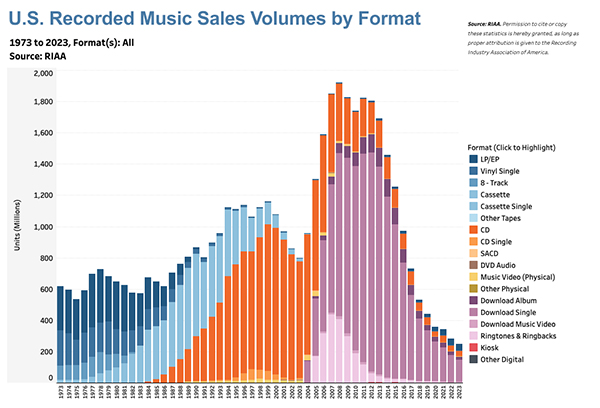
Physical media market shares, from 19732024. From riaa.com/u-s-sales-database.
When the CD is gone, and it will be soon, we'll miss it. New CD releases are winding down (footnote 1). In the classical world, the era of big, bargain-priced boxes of CDsa somewhat recent developmentis ending because, after a long, slow descent, retail sales have fallen off a cliff in the past year or so. In pop and rock, if you discover a new band you like, you may or may not be able to buy a CD. Perhaps they'll self-publish a few to sell at concerts; there's a better chance they'll have LPs, assuming they can get time at a vinyl-mastering studio and a pressing plant, both of which are booked to the max. CDs, though, are an afterthought if they're even that.
Vinyl records will likely stay around indefinitely as a collector's artifact, but new CDs are fading fast. This is momentous. CD will be remembered as the last mainstream physical music format. Its passing marks the death of physical music media.It Takes More than Martinis, Mister!
In the 1970s, a small black-and-white ad sometimes ran in the pages of Playboy magazine. The ad pictured an attractive young woman with lots of disheveled hair and a crooked grin. There was little else to the ad other than the headline, which the reader would assume was being spoken by the model: "It takes more than Martinis to build an image, Mister!"