

Dynamics & Dynamic Range
One of the delights of being published by a multinational conglomerate that grows through acquisition, as Emap Petersen does, is that Stereophile finds itself in interesting company. Like La Nouvelle Revue du Son in France, for example, edited by the legendary Jean Hiraga, who turned me on to the sonic importance of wires and passive components almost 25 years ago. And Mojo, an English music magazine tightly targeted on baby boomers like me, who bought their first stereo systems in the '60s to better appreciate the progressive rock we lived and loved by. (I wonder if turn-of-the-millennium college students gather 'round a new G4 Mac to get off on MP3s the way, 30 years ago, we gathered 'round our precious vinyl.)
E-Commerce & Specialty Audio Retailing
"But I want to buy Thiel loudspeakers over the Internet!" cried an insistent music lover from the back of the room.
Elements of Our Enthusiasm
At the end of August, we watched as the number of registered users in our online forums quickly ticked past the 10,000 mark. Ten thousand registered users! While it might prove interesting to learn just how that number breaks down into men and women, old and young, subjectivists and objectivists, or any of several other demographic and philosophical divides, that would only obscure the point: In our online forums, there are over 10,000 members who are eager to share their enthusiasm for music and hi-fi. What a beautiful thing!
Enough with the Hobby Already
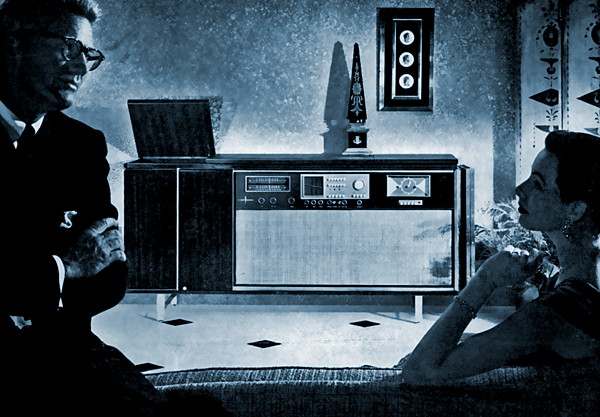
For the longest time, I've found the label "hobby" inadequate to describe the audiophile goal of better sound reproduction. Yes, for some, the mechanics of the High End have become an end in themselvesa way to tinker and tweak, build and rebuild in classic hobby fashion. But for many others, specifically earbud listeners, folks with whole-house systems, and those who'd rather push a button on a remote and sit back or dance rather than roll tubes or tinker, the descriptor hobby falls woefully short.
Envelop Me
If there's a technical thing nearly every audiophile knows, it's that low frequencies (LF) aren't directional. We tend to treat LF as monothink sub/sat systems in stereo, "LFE" in home-theater. But if the conclusions of a study by Thomas Lund, a researcher at Genelec OY, imply what they seem to, then that conviction is quite wrong.
In addition to resetting that bit of conventional wisdom, Lund's study may have uncovered an important contributor to the feeling of envelopment so many audiophiles crave, itself a profound source of pleasure beyond the music itself. As I have often said, and probably written once or twice, listening to a good hi-fi system is like getting a massage.
Eye Anchors: LaserVision Discs
Until recently, I have considered LaserVision video discs as a rather dubious medium for serious music reproduction. The only review I had read about it by a critical listener (Harry Pearson in The Absolute Sound) was I singularly unenthusiastic, and since I had not heard one myself, I was inclined to take his word for it.
Fashions, Fads, & Single-Ended Amplifiers
As in any community bound tightly together by shared enthusiasms, the High End is regularly swept by tides of fashion. Some of the fads prove to be based on something of value, and outlast the initial burst: loudspeaker spikes and Tiptoes, for example, or the resurgence of tube designs, or making use of high-quality passive components. Other fads, particularly if not based on good engineering, fall by the wayside. (Does anyone still use a Tice">http://www.stereophile.com/miscellaneous/784/index4.html">Tice Clock in their system? Or suspend their cables and interconnects on little acrylic bridges?)
Feeling As One
A few nights ago, I listened to mezzo-soprano Lorraine Hunt Lieberson's recording of J.S. Bach's great solo cantata, "Ich habe genug" (It is enough), BWV 82 (Nonesuch 79692-2). Hunt Lieberson was one of those rare mezzos, like Janet Baker and Kathleen Ferrier before her, whose voice conveyed an innately spiritual sense of connection with something greater than the individual self. Especially when she sang softly, she was able to imbue her tone with a hallowed reverence that is easier to feel than describe in words. To the extent that anyone can communicate the "tender mercies" and sacred intimacies of life, love, and spirit, Lorraine Hunt Lieberson proved herself a master.
Format War? What Format War?
What if they gave a format war and nobody came?
Fragile Souls
And every time, this thought hit me: It wasn't a record she was handling. It was a fragile soul inside a glass bottle.—From South of the Border, West of the Sun, by Haruki Murakami