

Nagra CDP CD player
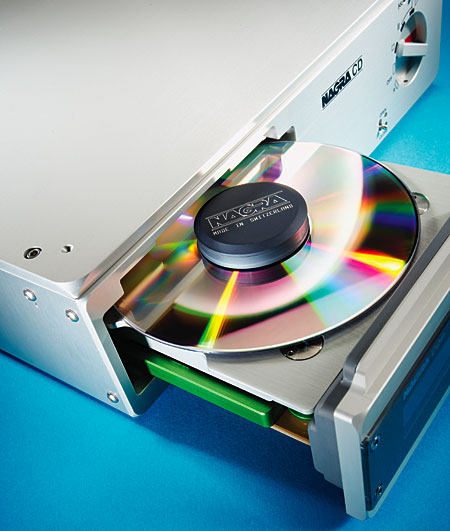
Audiophiles are frequently accused of being more in love with gizmos than with music. There may be a kernel of truth in that, but a scant few companies actually exploit the giz factor to give you mo'—a lot mo'.
Naim CD 3.5 CD player
"Them which is of other naturs thinks different," said Martin Chuzzlewit's Mrs. Gamp. If that is true, then Naim's Julian Vereker must be of a very different nature indeed. Vereker—and, by extension, Naim—has never done things the conventional way. Take, for example, power regulation and stiffening power supplies. Long before the rest of the world was taking them seriously, Naim offered upgrades to their components not by changing the audio circuitry, but by adding stiffer and stiffer outboard power regulation.
Naim CD5 CD player with Flatcap 2 power supply
Give an engineering team a blank page and a blank check and there's no telling what they'll come up with. At the Consumer Electronics Show in Las Vegas in January, for example, one company showed a $25,000">http://www.stereophile.com//digitalsourcereviews/430/">$25,000 CD transport with laser-pickup mechanism that was separate from its disc drive—almost the cosmic equivalent of having the sun revolve around the earth.
Naim CD5 XS CD player

By no means could I undertake a survey of candidates for Your Last Perfectionist-Quality CD playerso far, my ongoing series of reviews has focused on models from Audio Note, Bryston, EAR, Luxman, and Metronomewithout including Naim Audio. After all, it was Naim that brought to market the first really good-sounding CD player of my experience: the two-box CDS, introduced in 1991 at a then-staggering price of $6999. In doing so, they convinced me that a digital future might not be so bad after all.
Naim CD555 CD player
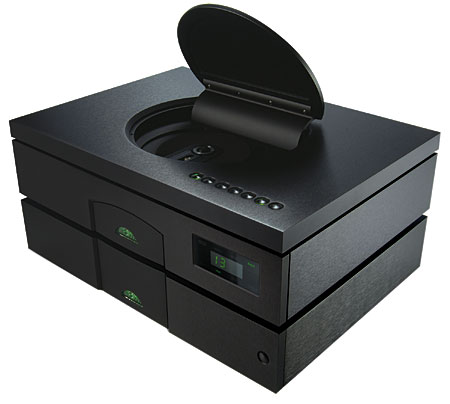
Naim's new "statement" CD player, the CD555 ($20,300 by itself, $28,150 with PS555 power supply), breaks no new technological ground. Rather, in typical Naim fashion, it attempts to optimize 16-bit/44.1kHz CD performance by paying fanatical attention to the devilish details. It doesn't play the DVD-Video, DVD-Audio, or SACD formats, nor does it have a digital output—and it doesn't create an illusion of higher resolution by upsampling the data.
Naim CD5x CD player
Naim Audio has a reputation for making products that are truer than most to music's temporal content: rhythm, pacing, the beat almighty. Beginning with their classic solid-state amps of the mid-1970s, Naim's designers have stressed, above all else, the reduction of distortions that puff up and pad the attack and decay components of musical sounds: Getting rid of those additives seems to clarify the timing relationship between different notes in a line, making music more compelling and easier to enjoy. That their gear has historically favored musical content over sonic attributes is no shock to the Naim faithful.
Naim CDX CD player
To compartmentalize or not to compartmentalize, that is the question. Does one review an expensive CD player at the dawn of the 24-bit/96kHz digital age by pulling a "Clinton," standing defiantly before a jury of audio peers to deliver a speech on the state of the CD art, boxing in, roping off, and all but ignoring the new, supposedly unimpeachable medium?
Naim NA CDS CD player
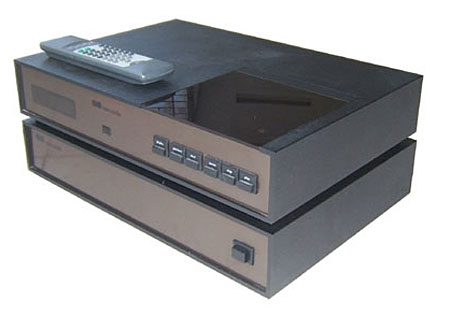
"A reasonable man adapts himself to the world around him. An unreasonable man expects the world to adapt to him. All progress, therefore, is made by unreasonable men."
Naim Uniti CD player/receiver
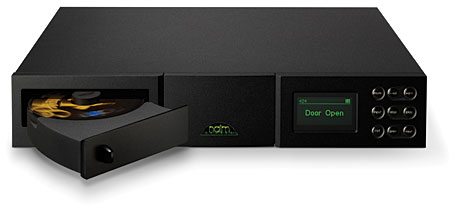
In an industry whose newest products are often as discouragingly unaffordable as they are short of the sonic mark, the Naim Audio Uniti ($3795) stands out. In a single reasonably sized box, the Uniti combines the guts of Naim's Nait 5i integrated amplifier and CD5i CD player with various additional sources: an FM/DAB tuner, and interfaces for an iPod, a USB memory stick, an iRadio, and a UPnP-compatible connected computer or server—all for the price of a very good television set.
NuForce CDP-8 CD player
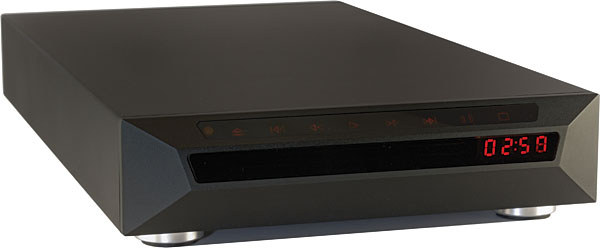
"So, what are you reviewing these days?" my friend Mark e-mailed me recently.
"A CD player," I said.
"They're still making those?"
Yesand better than ever, for the most part. But I understood Mark's confusion. When a "Vote!" question on the Stereophile website asked readers what digital source components they used, a surprising number responded that they did not, or hadn't bought a dedicated player in years. Topping the list were computers and universal players.