

Hegeman Model 1 omnidirectional loudspeaker
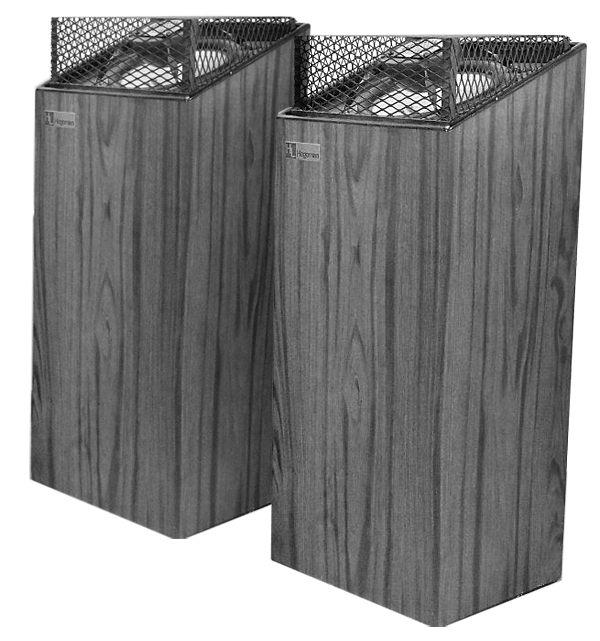
Ye Editor had his first exposure to a true omnidirectional speaker system 15 years ago, while he was employed as chief equipment tester for High Fidelity magazine. The speaker was a most unusual-looking device for its time, being roughly a foot square and standing 3 feet high, with a "cube" of grille cloth at the top like a cupola. Inside the cupola was an 8" woofer facing upwards. Directly above it was the weirdest-looking tweeter you ever saw.
Hill Plasmatronics Type 1 loudspeaker
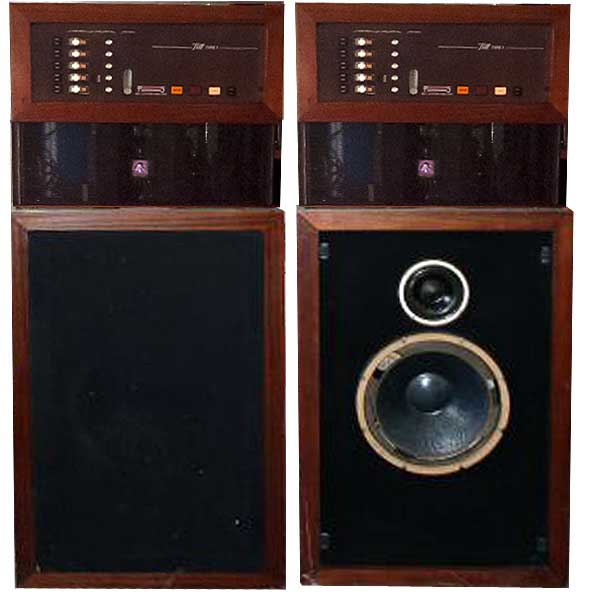
Dr. Alan Hill, president of Plasmatronics Inc., was previously employed by the US Government in laser research. His assignment: To increase the efficiency of lasers so that they could do something more impressive than produce holograms, mend leaky retinal blood vessels, and punch pinholes in steel blocks. Dr. Hill earned his keep, thus advancing laser technology a giant step closer to Star Wars, and then retired from government service to design. . . a loudspeaker?!!!?
Horn Shoppe Horn loudspeaker
Like most people, I'm not interested in long, windy essays about audio reviewing, having barely enough time and interest for audio itself. But I do perk up when the debate turns to the audio reviewer's purpose in life: Should I write about everything that crosses my path, or should I limit my attention to those products that interest me, and that stand a chance of being good?
Icon Parsec loudspeaker
"My vision for the future is one where all manufacturers sell their products directly to the end user. In this way, even the audiophiles in Dead Horse, Alaska can have access to all the audio manufacturing community has to offer." Thus wrote loudspeaker designer David Fokos in a letter introducing his new company Icon Acoustics to the press at Stereophile's High End Hi-Fi show in San Mateo, CA last April (footnote 1). Mr. Fokos, a Cornell graduate who for some years worked for Conrad-Johnson Design and designed that company's well-regarded Synthesis and Sonographe loudspeaker models, feels very strongly that the traditional retailing setup is inefficient when it comes to exposing audiophiles to a wide enough choice of product, particularly when it comes to loudspeakers. With 300 speaker manufacturers listed in the Audio directory issue but even a major retailer restricted to probably six brands, even big-city audiophiles will only be able to audition a fraction of the total number of brands. "Our industry is suffering from product saturation of its retail distribution network."
Image Concept 200 loudspeaker
I like reviewing loudspeakers. The more you become familiar with the art, the greater the sense of anticipation as you open up a pair of cartons. A visual inspection of the speaker always reveals a challenging mixture of the familiar and the new. The size of the cabinet is always the first clue—has sensitivity been a design priority or was low-frequency extension uppermost in the designer's thoughts? You espy a known drive-unit—has this tweeter's propensity for upper-presence sizzle been tamed? You find a reflex port on the rear panel—has the temptation to go for a "commercial," under-damped bass alignment been successfully resisted? You spot factors which intuitively seem wrong for precise stereo—a wide baffle lacking any kind of absorbent covering for diffraction control; a grille frame which puts acoustic obstacles in the way of the wavefront emerging from the tweeter.
Impact Airfoil 5.2 loudspeaker system
"You're a toy junkie!" laughed Trish, my fiancée. "Your life is a search for bigger and better toys!"
Infinity Composition Prelude P-FR loudspeaker
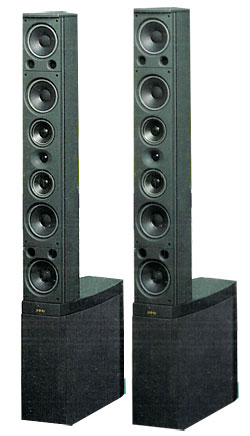 I can't think of two products at further ends of the audio spectrum than a single-ended triode tubed amplifier and a mass-market Home Theater loudspeaker. Single-ended tubed amplifiers are about reproducing subtlety, delicacy, nuance, and communicating the music's inner essence. Conversely, a Home Theater loudspeaker systemparticularly one made by a mass-market manufacturerwould appear to put the emphasis on booming bass and reproducing shotgun blasts, with little regard for musical refinement.
What a bizarre marriage it was, then, to pair the new Infinity Composition Prelude P-FR loudspeakers with the Cary Audio Design CAD-300SEI 11W single-ended triode amplifier (reviewed elsewhere in this issue). This combination didn't happen by accident; as you'll see, these apparently disparate products are a match made in heaven.
I discovered the Infinity Preludes while surveying Home Theater loudspeaker systems for the upcoming second issue of the Stereophile Guide to Home Theater. In addition to evaluating the loudspeaker systems under review with video soundtracks, I assessed their musical qualitiesor lack thereof. The Preludes were such a musical standout that I rescued them from the Home Theater room (where they had been powered by mass-market receivers and fed with a laserdisc source) and gave them a new lease on life in the larger music room, with reference-quality source and amplification components. The Preludes' extraordinary musical performance and unique design compelled me to tell you about how they performed in an audiophile-quality two-channel playback system.
I can't think of two products at further ends of the audio spectrum than a single-ended triode tubed amplifier and a mass-market Home Theater loudspeaker. Single-ended tubed amplifiers are about reproducing subtlety, delicacy, nuance, and communicating the music's inner essence. Conversely, a Home Theater loudspeaker systemparticularly one made by a mass-market manufacturerwould appear to put the emphasis on booming bass and reproducing shotgun blasts, with little regard for musical refinement.
What a bizarre marriage it was, then, to pair the new Infinity Composition Prelude P-FR loudspeakers with the Cary Audio Design CAD-300SEI 11W single-ended triode amplifier (reviewed elsewhere in this issue). This combination didn't happen by accident; as you'll see, these apparently disparate products are a match made in heaven.
I discovered the Infinity Preludes while surveying Home Theater loudspeaker systems for the upcoming second issue of the Stereophile Guide to Home Theater. In addition to evaluating the loudspeaker systems under review with video soundtracks, I assessed their musical qualitiesor lack thereof. The Preludes were such a musical standout that I rescued them from the Home Theater room (where they had been powered by mass-market receivers and fed with a laserdisc source) and gave them a new lease on life in the larger music room, with reference-quality source and amplification components. The Preludes' extraordinary musical performance and unique design compelled me to tell you about how they performed in an audiophile-quality two-channel playback system.
Infinity IRS Beta loudspeaker
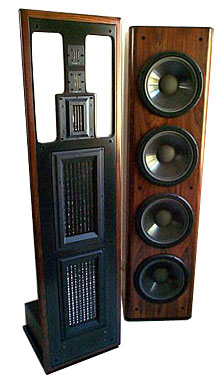
In 1966, two avid audiophile/music lovers—a nuclear physicist named Arnold Nudell and an airline pilot named Cary Christie—labored over weekends and evenings for 18 months in Nudell's garage to put together the world's first hybrid electrostatic/dynamic loudspeaker system. It cost them $5000 for materials, launched a company (New Technology Enterprises), and helped contribute to the popular myth that all of the really important audiophile manufacturers got started in somebody's basement or garage (footnote 1). The system was marketed as the Servo-Statik I, for the princely sum of $1795. (At the time, the most expensive loudspeaker listed in Stereo Review's "Stereo/Hi-Fi Directory" was JBL's "Metregon," at $1230.)
Infinity IRS Epsilon loudspeaker
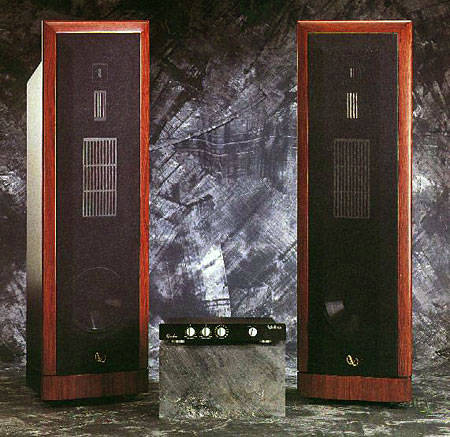
Like all companies that have been in business long enough to become fixtures in the marketplace, Infinity has seen its share of changes. It has long been that audio rarity—a company with one foot in the High End and one in the mass market. For the past few years, however, and despite continuing production of the now-classic IRS in its Series V incarnation, Infinity's mass-market foot has been the more firmly planted. Infinity, now a large company, is part of an even larger conglomerate, Harman International.
Infinity Prelude MTS loudspeaker
Sometimes you have to wonder why big corporations gobble up small speaker companies. Most such firms are built by individualist entrepreneurs chasing an elusive dream—an up-close and personal thing that is the antithesis of the corporate mentality. That's why speaker companies are so often named after the founder.