Sidebar 4: Measurements
I used DRA Labs' MLSSA system, a calibrated DPA 4006 microphone, and an Earthworks microphone preamplifier to measure the Voxativ Ampeggio 2024's quasi-anechoic frequency- and time-domain behavior in the farfield. I used an Earthworks QTC-40 microphone for the nearfield responses and examined the loudspeaker's impedance with Dayton Audio's DATS V2 system.
Footnote 1: EPDR is the resistive load that gives rise to the same peak dissipation in an amplifier's output devices as the loudspeaker. See "Audio Power Amplifiers for Loudspeaker Loads," JAES, Vol.42 No.9, September 1994, and stereophile.com/reference/707heavy/index.html. Footnote 2: See fig.2 here.
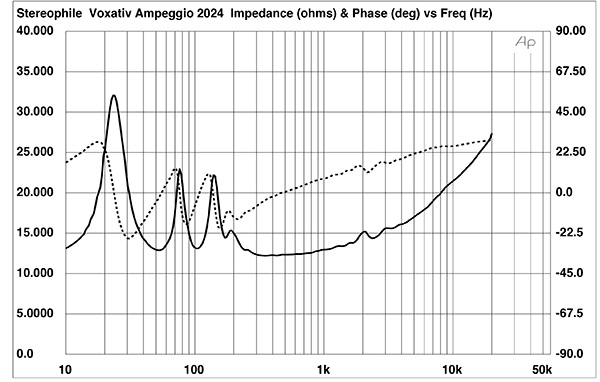
Fig.1 Voxativ Ampeggio 2024, electrical impedance (solid) and phase (dashed) (2 ohms/vertical div.).
The Voxativ Ampeggio 2024's impedance magnitude (fig.1, solid trace) lay above 12 ohms from 10Hz to 20kHz, with an average value close to 15 ohms. The minimum value was 12.21 ohms at 251Hz. The electrical phase angle (fig.1, dotted trace) was generally low, which means that the effective resistance, or EPDR (footnote 1), remains above 9 ohms across the entire audioband. The minimum EPDR values are 8 ohms at 37Hz, 8.15 ohms at 228Hz, and 8.41 ohms at 4.6kHz. The Ampeggio is an extremely easy load for the partnering amplifier.
Voxativ specifies the sensitivity of the Ampeggio with the AC-1.9 driver as 94dB/W/m. My B-weighted estimate of the Ampeggio's voltage sensitivity was higher than that, at 95.5dB(B)/2.83V/m. However, because of the speaker's high impedance, 2.83V is significantly less than 1W. Adjusting my measured figure for the Voxativ's average impedance of 15 ohms gives a power-related sensitivity of 98.2dB(B)/W/m. This is one of the highest sensitivities I have encountered in almost four decades of measuring loudspeakers. The Ampeggio will give satisfyingly high sound-pressure levels even with flea-watt tube amplifiers.
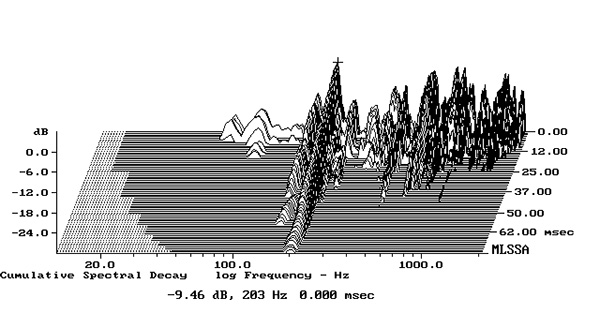
Fig.2 Voxativ Ampeggio 2024, cumulative spectral-decay plot calculated from output of accelerometer fastened to front baffle below the drive unit (MLS driving voltage to speaker, 7.55V; measurement bandwidth, 2kHz).
The impedance traces in fig.1 have discontinuities that imply the presence of cabinet resonant modes of various kinds. Using a plastic-tape accelerometer, I found a fairly strong resonance at 203Hz on the sidewalls and on the front baffle below the drive unit (fig.2), as well as several higher-frequency modes, especially on the back panel. However, taking the speaker's high sensitivity into account, which means that the speaker's acoustic output with music will be significantly lower than it is with the level of the test signal that I use for these measurements, this behavior probably won't have audible consequences.
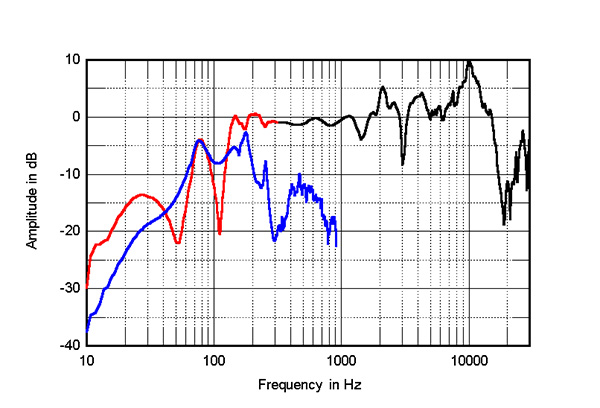
Fig.3 Voxativ Ampeggio 2024, anechoic response on drive unit axis at 50", averaged across 30° horizontal window and corrected for microphone response (black trace), with the nearfield responses of the drive unit (red) and the horn opening (blue), respectively plotted below 310Hz and 900Hz.
The drive unit's response in the nearfield, shown as the red trace in fig.3, has deep suckouts in its output centered on 52Hz and 110Hz. The blue trace in this graph shows the nearfield output of the horn opening on the front baffle, which compensates to some extent for the suckouts but doesn't extend the speaker's low-frequency response.
The black trace above 310Hz in fig.3 shows the Ampeggio's quasi-anechoic farfield response, averaged across a 30° horizontal window centered on the driver axis. The midrange balance is even, but there are then some peaks and suckouts in the treble. This response is very similar to that of the original version of the Ampeggio, which Art Dudley reviewed in the September 2011 issue (footnote 2), but here the amplitude of the peak at 10kHz is significantly larger.
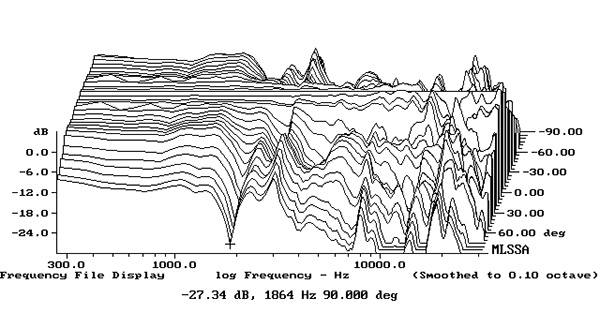
Fig.4 Voxativ Ampeggio 2024, lateral response family at 50", normalized to response on drive unit axis, from back to front: differences in response 90–5° off axis, reference response, differences in response 5–90° off axis.
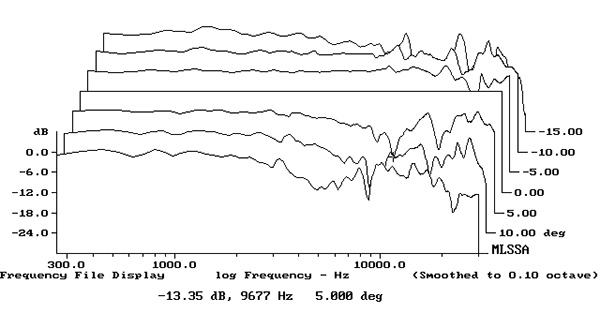
Fig.5 Voxativ Ampeggio 2024, vertical response family at 50", normalized to response on drive unit axis, from back to front: differences in response 15–5° above axis, reference response, differences in response 5–15° below axis.
The Voxativ's horizontal dispersion, normalized to the response on the driver axis (which therefore appears as a straight line), is shown in fig.4. Comparing this graph with fig.3, it appears that the treble peakiness is at its most extreme on axis. As with the original Ampeggio, firing the speakers in the forward direction—not toeing them all the way in to the listening seat—should give a more neutral tonal balance in the top audio octaves. The center of the Ampeggio's single drive unit is 36" from the floor. The dispersion in the vertical plane, again normalized to the response on the driver axis (fig.5), shows that the high-frequency response is maintained up to 10° above the central axis but slightly suppressed below that axis.
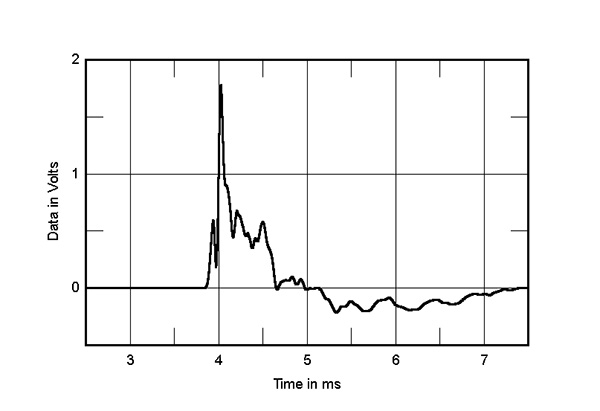
Fig.6 Voxativ Ampeggio 2024, step response on drive unit axis at 50" (5ms time window, 30kHz bandwidth).
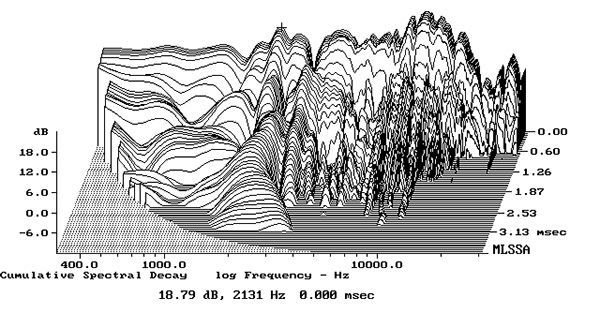
Fig.7 Voxativ Ampeggio 2024, cumulative spectral-decay plot on drive unit axis at 50" (0.15ms risetime).
In the time domain, the Ampeggio's step response (fig.6) indicates that the drive unit is connected in positive acoustic polarity. The output of the treble whizzer cone arrives first at the microphone, followed almost immediately by that of the main, lower-frequency cone. The ripples in the decay of the step correlate with ridges of delayed energy in the Voxativ's cumulative spectral-decay (waterfall) plot (fig.7). The peak just above 2kHz in the on-axis response shown in fig.3 coincides with a strong ridge of delayed energy, indicated by the cursor position in this graph, and there is another ridge of delayed energy at 3kHz in the waterfall plot, the frequency of the suckout in fig.3. This behavior was very audible with MLSSA's pseudo-random noise signal that I use for the measurements but might not be so with music, where it could be perceived as heightened detail.
As I wrote in my measurement report for the original Voxativ Ampeggio, the Ampeggio 2024's measured performance "doesn't look impressive." But, like the original version, the measurements may well look worse than they sound, especially given that extremely high sensitivity and the amplifier-friendly impedance.—John Atkinson
Footnote 1: EPDR is the resistive load that gives rise to the same peak dissipation in an amplifier's output devices as the loudspeaker. See "Audio Power Amplifiers for Loudspeaker Loads," JAES, Vol.42 No.9, September 1994, and stereophile.com/reference/707heavy/index.html. Footnote 2: See fig.2 here.