Sidebar 1: Raising the Full-Range–Driver Bar
Too much overlap results in unwanted reflections. The smaller crease on the Ampeggio driver was just enough to add some rigidity.
What changed with the new drivers in the 2024, compared to the driver in the 2011 Ampeggio? Adler told Stereophile, "We have moved forward to reduce the Lowther influence in sound. ... I still wanted to optimize it now as a final version based on my experience in driver construction in the last 12 years."
As noted in the main text, the cones in the new drivers are larger than the old, 8" instead of 7". Both the AC-1.9 and the AC-4B are capable of even longer excursion than the AC-3X used in the 2011 Ampeggio. As a result, while the original driver was limited on the low end to 60Hz (at –5dB), with the AC-1.9 driver in particular "the Ampeggio 2024 must go 20Hz lower," Adler said. The AC-4B doesn't go as low, which is why Adler prefers to sell the AC-4B Ampeggio in a package with a pair of Voxativ Z-Bass subwoofers.
With both new drivers, the highs and mids are smoother, Adler said, and "the impedance rise over the frequency band is much lower now, which makes the speaker more solid state amplifier friendly."—Ken Micallef
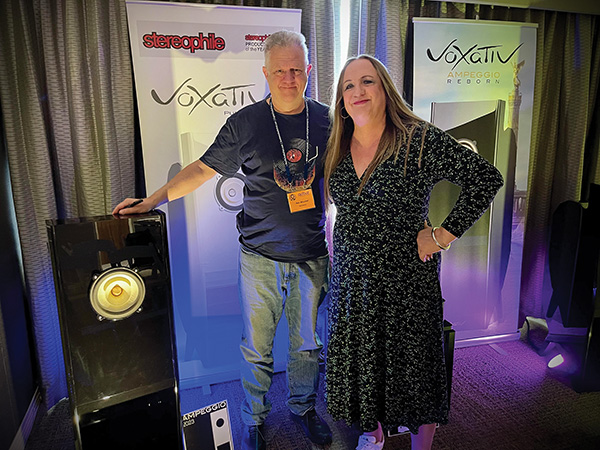
Inès Adler with Ken Micallef at the Capital Audiofest.
In his 2011 review of the original Ampeggio loudspeaker, Art Dudley wrote about Inès Adler's and Ampeggio's efforts to move beyond the original Lowther's shortcomings. "After working for Mercedes-Benz for a number of years—and with 14 patents to her name in the field of electronic monitoring systems for diesel motors—Adler and some friends decided to try to make a better wideband driver. 'I think everyone who owns Lowthers becomes interested, at some point, in improving them,'" Adler told Art. "Then she added, with a laugh, 'It is the German way: When we make something, we want to make it perfect!'"
"I saw three things that I disliked about the Lowther driver," Adler continued. "One, it was impossible to make good bass; the cone had insufficient stability at high excursions. Two, it had the famous Lowther 'shout' that made voices sound sharper than real. The louder the driver played, the worse the shout—but turning them up was something people wanted to do, to get good bass. And three, the top range was missing: There was nothing over 15kHz. So it was clear, I had to design my own driver."
In contrast to the Lowther, the driver in the 2011 Ampeggio—called the Voxativ AC-3X—had a convex foam surround. Why convex? Because they needed room behind it. "We give the cone more material, more paper, so it goes past the surround at the rear. The cone is effectively larger for the rear wave than the front wave." Also, the "special foam" the surround is made from isn't just rot resistant as mentioned in the main text; it also allowed longer cone excursion: 6mm compared with the Lowther's 2mm. "The cone geometry, too, is different, and the generously sized whizzer cone has a very slight roll on its outer edge, compared with the much larger roll Lowther added to their own whizzers beginning in the late 1990s."