Sidebar 3: Measurements
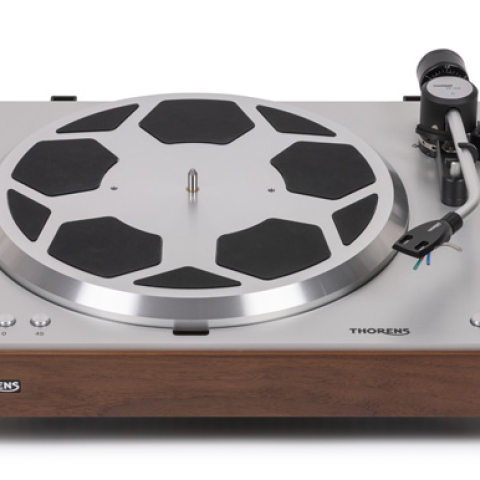
Building on the success of Thorens's first direct-drive deck in decades—the TD 124 DD—the TD 404 DD shares a close derivative of, if not exactly the same, motor designed by Yahorng, one of two large Taiwanese suppliers. Thorens and Yahorng have collaborated on everything from the firmware that supports the 12-pole Hall-effect sensors to the choice of self-lubricating stainless steel bearing spindle and Delrin thrust pad. In this instance the TD 404 DD's 12-pole, 24V motor and radial magnet (attached to the underside of the 3.8kg alloy platter) has sufficient torque to bring the deck up to speed within 1–2 seconds, just as Thorens's electronic brake ensures the platter stops almost instantly.
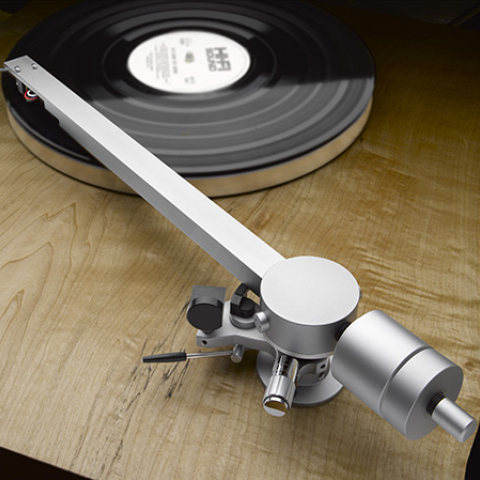
The partnering TP 160 tonearm has a slightly higher 18gm effective mass than the TP 150 variant, delivering a 7–8Hz arm/cartridge resonance with Thorens's optional TAS 1600 moving coil pickup. The J-shaped tube design is based on the brand's earlier "TP" models, just as the auto-lift mechanism was seen on earlier decks, including the TD 1601. However, the magnetically stabilized knife-edge bearing and spring-loaded antiskating mechanism are new for the TP 160.
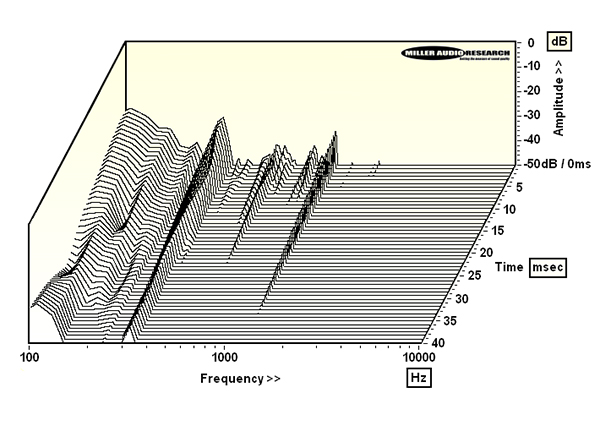
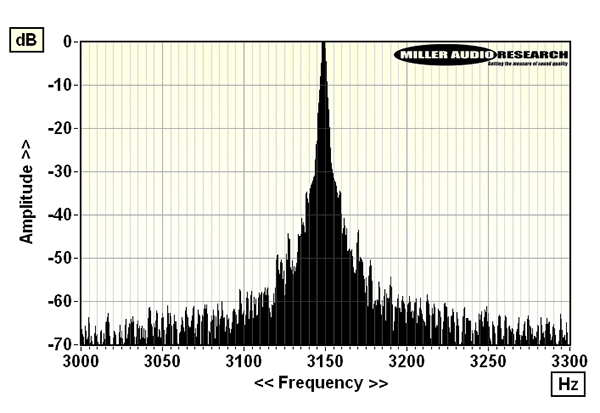
Fig.1 Thorens TD 404 DD, wow and flutter, ref. 3150Hz tone at 5cm/s (plotted ±150Hz, 5Hz per minor division).
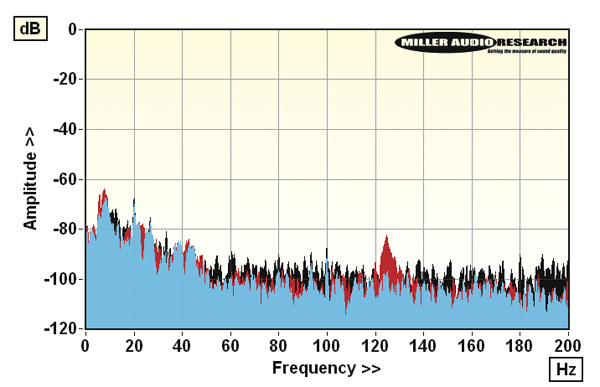
Absolute speed, adjusted via the integral strobe, is nearly spot-on, with a –0.05% error. Low-rate speed stability is similarly impressive, with a 0.02% peak-weighted wow (fig.1). That said, discrete, higher-rate sidebands at ±20Hz, ±27Hz, and ±33Hz, add up to a modest 0.035% peak-weighted flutter. These peaks all correlate with modes visible on the unweighted rumble spectrum (fig.2) and most likely originate from the direct-drive motor.
Fig.2 Thorens TD 404 DD, unweighted bearing rumble from DC–200Hz (black infill) vs silent LP groove (with lightweight clamp, blue; without, red), ref. 1kHz at 5cm/s.
These resonances contribute to a through-spindle rumble of –70.0dB (DIN-B weighted, ref. 1kHz at 5cm/s). This is an excellent figure, more than competitive with the traditional stainless steel and phosphor-bronze bearing assemblies employed by the better belt-drive turntable solutions, even though there is clearly some additional noise in the 20–45Hz region visible on the same unweighted spectra (fig.2). Through-groove rumble—arguably the more important figure—is lower still at –72.5dB but can be reduced further to –73.0dB, along with improved attenuation of acoustic noise, if the LP is gently pressed onto the platter's silicone rubber pads with a lightweight clamp or puck. The difference is again visible on the unweighted rumble spectra (blue vs red, fig.2). As it stands, the CNC-machined alloy platter has a 5mm-thick damping ring underneath that renders the entire rotating mass very inert indeed, but while the Beogram-esque pattern of pads is visually compelling it does fail to support the LP over its entire surface, leaving pockets of air beneath.
Fig.3 Thorens TD 404 DD, cumulative tonearm resonant decay spectrum, illustrating various bearing, pillar, and "tube" vibration modes spanning 100Hz–10kHz over 40ms.
J-shaped arms necessarily have more complex bending and torsional modes than straight tubes, and this is the case here (see the cumulative spectral decay waterfall, fig.3). Otherwise, the arm's main bending mode is around 120Hz, with lower-Q resonances at 170Hz and 230Hz, and a sharper break at 310Hz. The short-lived high-Q mode at 1.3kHz has been detected in previous decks using Thorens's auto-lift system, but the TP 160's overall pattern of resonances is still less cluttered than we've seen with other J-shaped designs.—Paul Miller