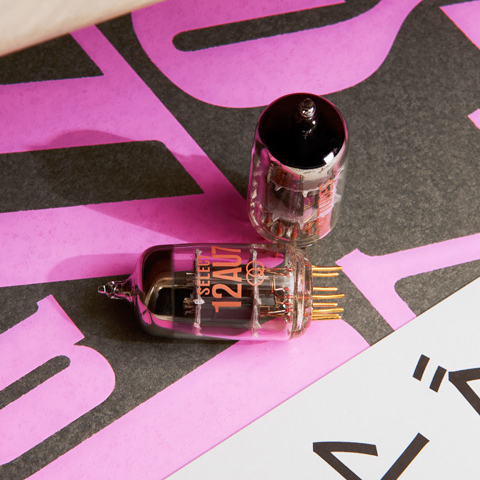
With up to 75 rooms to cover on multiple floors of the Marriott’s tower, I decided to check out Synergistic Research’s much-heralded new products before the show officially began. Inventor Ted Denney decided to dem his new babies, not with the expected megabuck system, but rather with a Bose radio. Positioned atop one of his Tranquility Bases, used as shelves on a Solid Tech rack, the radio played a vocal track by Anne Vada and Aki Fukakura as Denney demonstrated the cumulative effects of his tiny aluminum passive HFTs (High Frequency Transducers, $299/5 pack), active FEQ (Frequency Equalizer, $750), and Tranquility Bases. (In the photo, Ted is pointing to the HFT affixed to the front of the radio.)
My initial impression, with everything in the system, was that despite the radio’s glaring limitations, the room-filling size and depth of the soundstage were pretty amazing. As Denney progressively removed the 20 HFTs he had positioned around the room (including two on the front and back of the radio, and one on his Synergistic Research active FireWire cable), then the FEQ which rested on a table behind the equipment rack, and finally the Tranquility Bases, the soundstage shrank, bass lost impact, music became localized in the radio, and, most important, the listening experience became less compelling.
Activating just the Tranquility Bases made the bass more solid and the picture more dimensional. Even with just two out of the 20 HFTs returned to the front and back of the Bose radio, sonic depth increased. The more HFTs Denney added—there are five levels of treatment, each comprised of five HFTs—the larger and more room-filling the soundstage became. With everything restored, percussion seemed to be coming from all over the place, color increased, and the three-dimensional illusion was pretty uncanny.
Having said that, I wish I could have heard this experiment on a far more refined system. After all, a Bose radio can do only so much, no matter how much help it gets. Regardless, the demonstration sure whet my appetite to hear the HFTs and FEQ again, and experiment with them in my reference system (currently in storage [sigh] pending a move to new house).