Sidebar 3: Measurements
I measured a different sample of the Soulution 727 preamplifier than that auditioned by JVS. Mine had the serial number 727-0053. I primarily used my Audio Precision SYS2722 system to measure the Soulution, repeating some tests with the magazine's higher-performance APx555.
Looking first at the performance of the 727's line-level inputs, the maximum gain for the balanced and unbalanced inputs to the balanced outputs was a little lower than the specified 4dB, at 3.7dB. The maximum gain from the balanced and unbalanced input to the unbalanced outputs was –2.31dB. With polarity set to "In-Phase," the preamplifier preserved absolute polarity (ie, was noninverting) with both the balanced and unbalanced inputs and outputs. (The XLR jacks are wired with pin 2 hot, the AES convention.) The volume control operated in accurate 1dB steps.
The 727's line input impedance is specified as an extraordinarily high 4.4M ohms. I measured 1.4M ohms at 20Hz and 1kHz and 790k ohms at 20kHz for the balanced inputs. The unbalanced input impedance was a still-high 86k ohms at low and middle frequencies and 55k ohms at the top of the audioband. The balanced output impedance was an extremely low 0.73 ohms at 20Hz and 1kHz, rising to the specified 0.8 ohms at 20kHz. The unbalanced output impedance was 0.5 ohms.
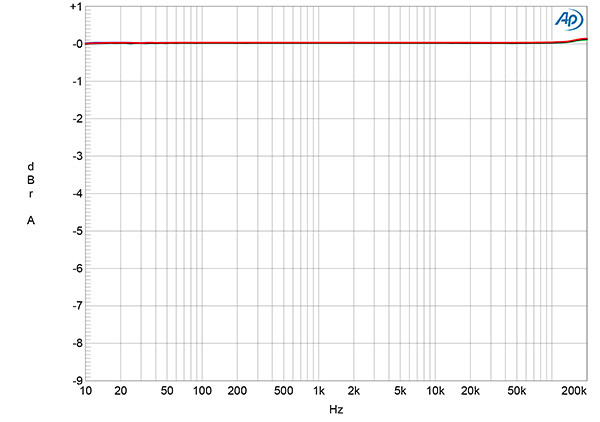
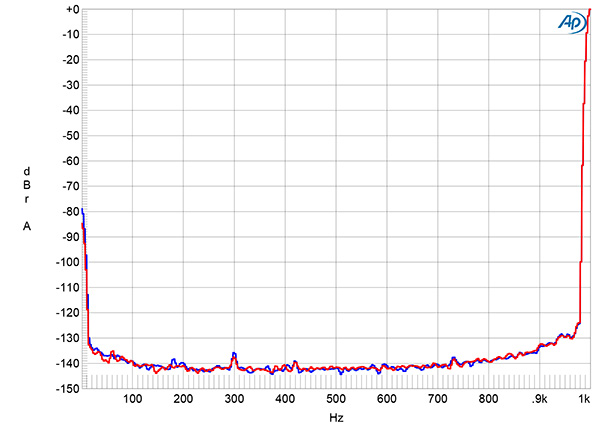
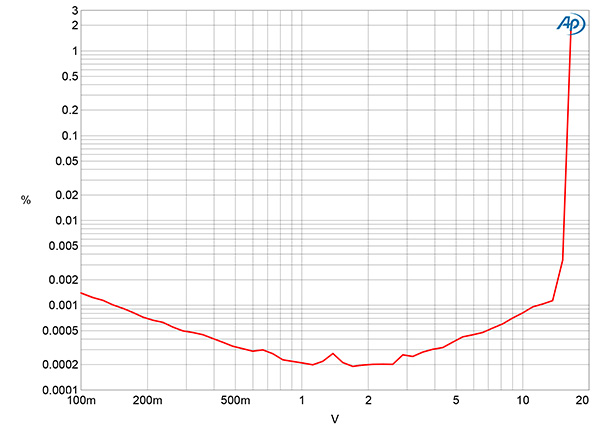
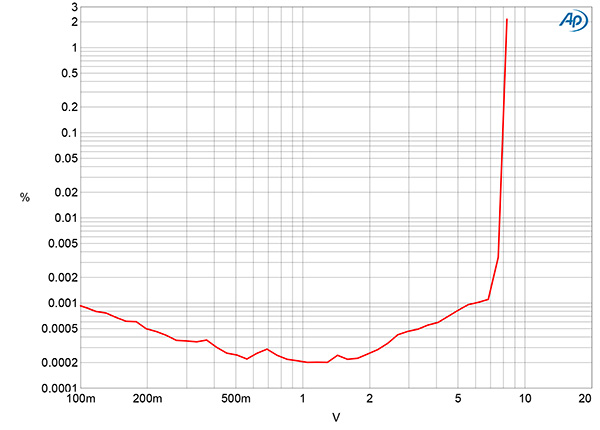
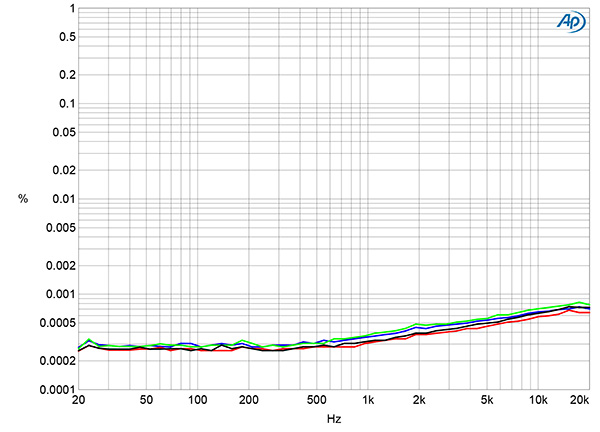
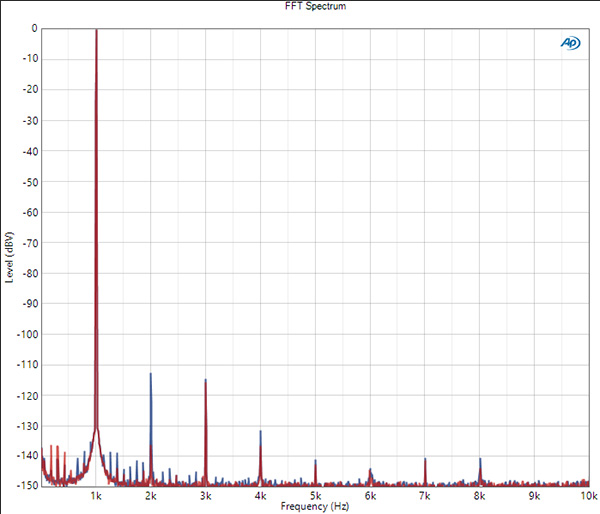
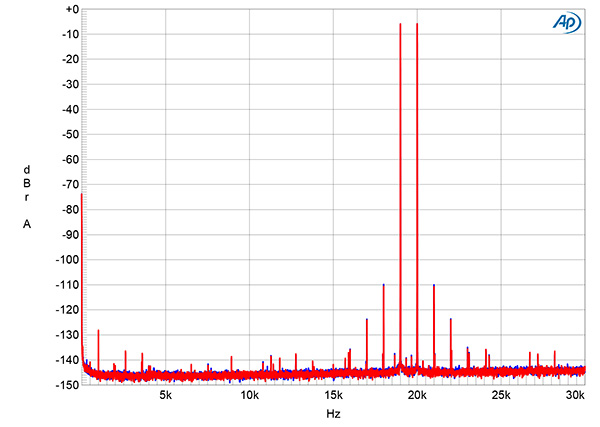
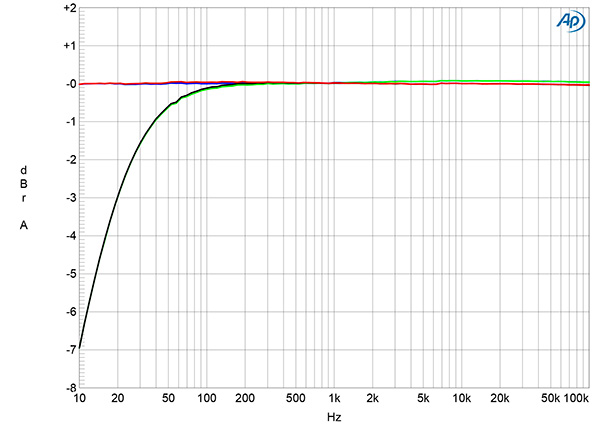
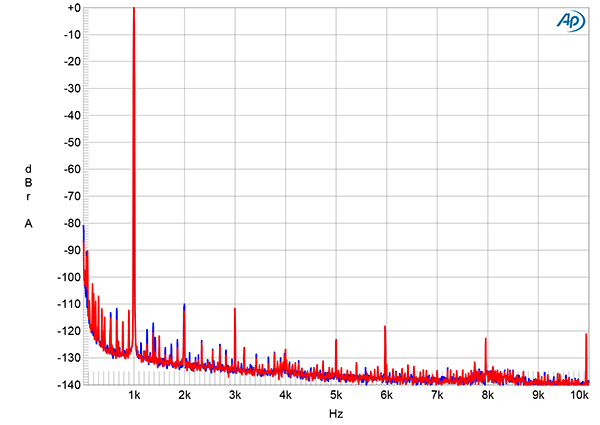
Fig.1 Soulution 727, balanced frequency response with volume control set to "80" at 2V into: 100k ohms (left channel blue, right red), 600 ohms (left green, right gray) (1dB/vertical div.).
The preamplifier's balanced frequency response was flat from 10Hz to 200kHz into both 100k ohms (fig.1, blue and red traces) and 600 ohms (green and gray traces). Fig.1 was taken with the 727's volume control at its maximum setting of "80." Both the frequency response and the superb channel matching were preserved at lower settings of the control and with the unbalanced inputs and outputs. The Soulution 727's channel separation was superbly high, at >135dB in both directions below 10kHz, and decreased only slightly, to 129dB, at the top of the audioband (not shown).
Fig.2 Soulution 727, balanced spectrum of 1kHz sinewave, DC–1kHz, at 4V into 100k ohms with volume control set to "80" (left channel blue, right red, linear frequency scale).
From balanced inputs to balanced output, the 727 offered extremely low noise, without any power-supply–related spuriae present in its output, even with the volume control set to the maximum (fig.2). The wideband, unweighted signal/noise ratio, measured with the balanced input shorted to ground but the volume control set to its maximum, was an astonishingly high 102.5dB ref. 2V output (average of both channels, which were very similar). Restricting the measurement bandwidth to the audioband increased the S/N to a superb 122.7dB, while switching an A-weighting filter into circuit further improved this ratio, to 125.4dB. The Soulution 727 is the quietest preamplifier I have encountered, though this might be related to its relatively low maximum gain.
Fig.3 Soulution 727, balanced distortion (%) vs 1kHz output voltage into 100k ohms.
Fig.4 Soulution 727, unbalanced distortion (%) vs 1kHz output voltage into 100k ohms.
Soulution specifies the 727's maximum output level as 14V, balanced, and 7V, unbalanced. Figs.3 & 4 respectively plot the percentage of THD+noise in the 727's balanced and unbalanced output against the output voltage into 100k ohms. With the clipping voltage defined as being when the THD+N reaches 1%, the balanced output clipped at 16.3V, the unbalanced output at 8V. Repeating these tests into the punishing 600 ohm load didn't result in any change in these clipping voltages. The 727 has a bomb-proof output stage.
Fig.5 Soulution 727, balanced distortion (%) vs frequency at 4V into: 100k ohms (left channel blue, right red), 600 ohms (left green, right gray).
Fig.6 Soulution 727, balanced spectrum of 1kHz sinewave, DC–10kHz, at 3V into 200k ohms (left channel blue, right red; linear frequency scale).
The downward slope below 2–3V of the traces in figs.3 & 4 indicates that the actual distortion lies below the noisefloor. To be sure that the reading was not dominated by noise, I measured how the 727's distortion changed with frequency at 4V. The THD+N percentage was extremely low throughout the audioband into both 100k ohm and 600 ohm loads (fig.5), and there was only a very small increase in the top audio octaves. At 3V into 200k ohms, the second harmonic was the highest in the left channel (fig.6, blue trace), the third in the right channel (red trace). However, at close to –124dB (0.00006%), these harmonics are negligible and their levels didn't rise into 600 ohms. Tested for intermodulation distortion with an equal mix of 19 and 20kHz tones at a peak voltage of 4V into 600 ohms, the second-order difference product at 1kHz lay at –129dB (0.00003%) and the higher-order products lay at –110dB (0.0003%; fig.7).
Fig.7 Soulution 727, balanced HF intermodulation spectrum, DC–30kHz, 19+20kHz at 4V into 100k ohms (left channel blue, right red; linear frequency scale).
The optional phono module operates with the unbalanced Input 6. Although JVS didn't audition the Soulution 727's phono input, I did examine its performance after connecting a wire from one of the Audio Precision's ground terminals to the grounding lug on the preamplifier's rear panel.
Using the Configuration controls on the front panel, the phono input's gain can be set from 40dB to 80dB in 10dB steps. With the volume control set to the maximum, I measured gains of 44.1dB, 54.2dB, 64.1dB, 74.15dB, and 84dB at the balanced outputs. The gains at the unbalanced outputs were all 6dB lower. The input impedance can be set to a number of values, from 20 ohms to 47k ohms. With the impedance set to 100 ohms and the input capacitance set to 0pF, I measured 101 ohms at 20Hz and 1kHz and 98 ohms at 20kHz. With it set to 1000 ohms, I measured 998 ohms at 200Hz, 1048 ohms at 1kHz, and 580 ohms at 20kHz. With it set to 47k ohms, which is appropriate for moving magnet cartridges, the input impedance was 44.3k ohms at 20Hz but 23k ohms at 1kHz and 20kHz.
Fig.8 Soulution 727, phono input, balanced output, response with RIAA correction (left channel blue, right red) (1dB/vertical div.).
The phono input's RIAA correction (fig.8) was well matched between the channels and extremely accurate in the audioband. Switching on the High-Pass Filter gently rolled off the low frequencies below 100Hz, the response reaching –7dB at 10Hz (fig.8, green and gray traces). With the phono input's gain set to 40dB, the wideband, unweighted S/N ratio, assessed at the balanced output with the inputs shorted to ground and the volume control set to the maximum, was an excellent 80dB ref. 1kHz at 5mV in both channels. Restricting the measurement bandwidth to 22Hz–22kHz increased the ratio by 2dB, while inserting an A-weighting filter resulted in a ratio of 92.2dB. Increasing the gain by 20dB reduced these ratios by the same 20dB. Spectral analysis of the phono input's low-frequency noisefloor (not shown) indicated that supply-related spuriae all lay below –100dB.
Fig.9 Soulution 727, phono input, balanced output, spectrum of 1kHz sinewave, DC–1kHz, for 20mV input (left channel blue, right red, linear frequency scale).
To be sure I wasn't prematurely clipping the output, I examined the phono input's overload margins with the volume control set to "70" (–10dB). With the gain set to 40dB, the margin was very high, at 23dB ref. 1kHz at 5mV from 20Hz to 20kHz. Resetting the gain to 60dB, which is appropriate for moving coil cartridges, the margin was 23dB ref. 1kHz at 500µV, again at all audio frequencies. Even with an input 12dB below the 1kHz overload level, all the distortion harmonics lay at or below –110dB (0.0003%; fig.9). The levels of the intermodulation products with an equal mix of 19 and 20kHz tones were similarly inconsequentially low.
Overall, the Soulution 727's measured performance was superb, with extraordinarily low distortion and noise.—John Atkinson