The Sony's analog stage is superbly linear. Fig.8 shows the spectrum of a full-level 50Hz tone. Only the third harmonic pokes its head above the -100dB level, with the fifth at -105dB. (I suspect that the higher-order components in this graph are not real, but mathematical artifacts of the FFT.) The Sony's performance on the high-level, high-frequency intermodulation test was also superb, with the balanced output (fig.9) being a little better than the unbalanced (fig.10). Both of these graphs were taken with the "std" digital filter. Using, for example, "dfil-4" (fig.11) allows some "image leakthrough" to appear in and just above the audioband, but not to any serious degree. 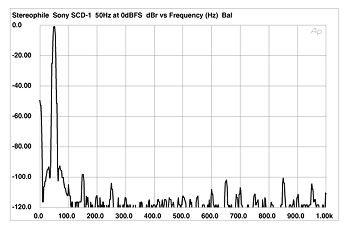 Fig.8 Sony SCD-1, CD spectrum, DC-1kHz, 50Hz at 0dBFS, 100k ohm load (linear frequency scale, 20dB/vertical div.).
 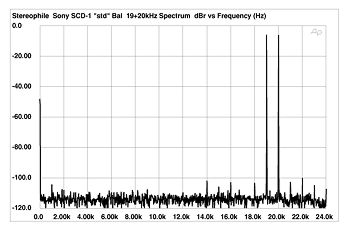 Fig.9 Sony SCD-1, CD balanced HF intermodulation spectrum, DC-22kHz, 19+20kHz at 0dBFS, 100k ohm load, "std" filter (linear frequency scale, 20dB/vertical div.).
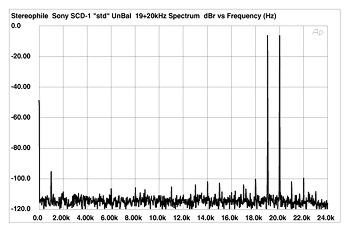 Fig.10 Sony SCD-1, CD unbalanced HF intermodulation spectrum, DC-22kHz, 19+20kHz at 0dBFS, 100k ohm load, "std" filter (linear frequency scale, 20dB/vertical div.).
 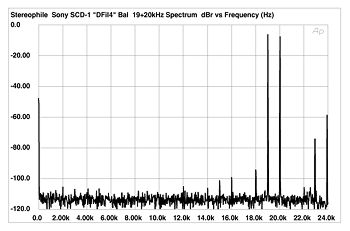 Fig.11 Sony SCD-1, CD balanced HF intermodulation spectrum, DC-22kHz, 19+20kHz at 0dBFS, 100k ohm load, "dfil-4" (linear frequency scale, 20dB/vertical div.). Finally, I used the Miller Audio Research processor to analyze the Sony's jitter spectrum on CD replay (fig.12). The absolute noise floor is close to the theoretical 16-bit level and the absolute jitter level is among the lowest I have measured at 146.8ps peak-peak. The only sidebands easily visible are due to data-related jitter at ±229Hz and its harmonics (footnote 1) (red markers), but these sidebands are still very low in level. The highest-level sidebands, in fact, are at a subsonic frequency, ±15.6Hz, each marked in this graph with a purple "1."
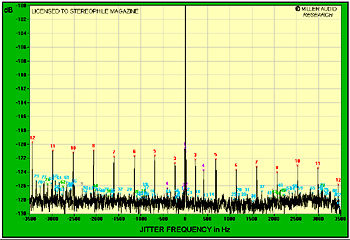 Fig.12 Sony SCD-1, high-resolution jitter spectrum of analog output signal (11.025kHz at -6dBFS with LSB toggled at 229Hz, CD data). Center frequency of trace, 11.025kHz; frequency range, ±3.5kHz. As a conventional CD player, Sony's SCD-1 features state-of-the-art technical performance. Even if it didn't handle SACDs, the SCD-1 would be worth buying for its CD performance, in my opinion.—John Atkinson
Footnote 1: The test signal is a high-level 11.025kHz (fs/4) tone accompanied by the LSB toggling at a 229Hz rate.
Fig.8 Sony SCD-1, CD spectrum, DC-1kHz, 50Hz at 0dBFS, 100k ohm load (linear frequency scale, 20dB/vertical div.). Fig.9 Sony SCD-1, CD balanced HF intermodulation spectrum, DC-22kHz, 19+20kHz at 0dBFS, 100k ohm load, "std" filter (linear frequency scale, 20dB/vertical div.). Fig.10 Sony SCD-1, CD unbalanced HF intermodulation spectrum, DC-22kHz, 19+20kHz at 0dBFS, 100k ohm load, "std" filter (linear frequency scale, 20dB/vertical div.). Fig.11 Sony SCD-1, CD balanced HF intermodulation spectrum, DC-22kHz, 19+20kHz at 0dBFS, 100k ohm load, "dfil-4" (linear frequency scale, 20dB/vertical div.). Finally, I used the Miller Audio Research processor to analyze the Sony's jitter spectrum on CD replay (fig.12). The absolute noise floor is close to the theoretical 16-bit level and the absolute jitter level is among the lowest I have measured at 146.8ps peak-peak. The only sidebands easily visible are due to data-related jitter at ±229Hz and its harmonics (footnote 1) (red markers), but these sidebands are still very low in level. The highest-level sidebands, in fact, are at a subsonic frequency, ±15.6Hz, each marked in this graph with a purple "1." Fig.12 Sony SCD-1, high-resolution jitter spectrum of analog output signal (11.025kHz at -6dBFS with LSB toggled at 229Hz, CD data). Center frequency of trace, 11.025kHz; frequency range, ±3.5kHz. As a conventional CD player, Sony's SCD-1 features state-of-the-art technical performance. Even if it didn't handle SACDs, the SCD-1 would be worth buying for its CD performance, in my opinion.—John Atkinson Footnote 1: The test signal is a high-level 11.025kHz (fs/4) tone accompanied by the LSB toggling at a 229Hz rate.