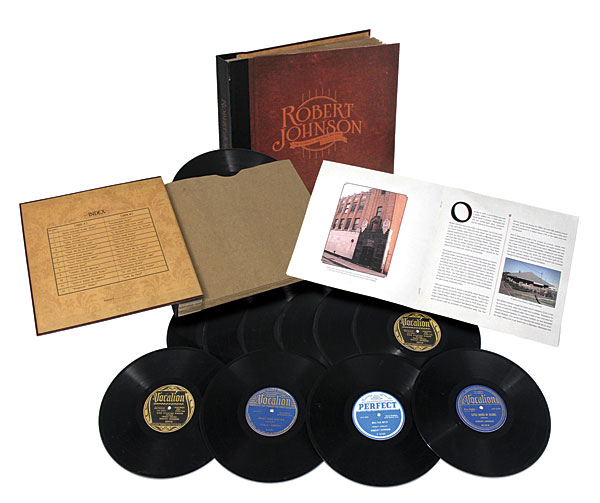
The second Johnson anthology, The Complete Original Masters: Centennial Edition, available only at www.thecompleterobertjohnson.com, is a far more ornate affair—"deluxe" is the word Sony's marketing department uses—whose centerpiece is a dozen vinyl replicas of 10" 78rpm shellac discs, to be played at 45rpm, on which are pressed the 12 singles released on 78s in Johnson's lifetime. Also included in this package, which is limited to 1000 copies and retails for $349, is the above-mentioned two-CD set of Johnson's music, as well as two intriguing collections on CD of related recordings. The first, a treasure for early blues collectors, is Blues from the Victor Vault (BMG and Sony merged in 2004), and features two dozen A and B sides of 78s by Furry Lewis, Sleepy John Estes, Memphis Minnie, and others, all recorded between 1928 and 1932, and which might have been familiar to or influenced a young Robert Johnson. The other non-Johnson disc is the fascinating Also Playing, which collects performances of music of all types, from Mexican to country, all cut direct to disc, on the same days in the same makeshift studios in San Antonio (1936) and Dallas (1937), by the same American Record Company crew that recorded Johnson—in other words, these folks were recorded just before and just after Johnson. Lastly, this luxury package contains a DVD of director Peter Meyer's 1998 documentary Can't You Hear the Wind Howl? The Life & Music of Robert Johnson, narrated by Danny Glover and featuring classic interviews with a number of Johnson's boyhood friends and musical contemporaries, such as Johnny Shines and Son House.
Yes, it's Johnson's centennial; but why the remastering and release of two separate reissue sets in the same year by the same label?
 "There's a lot of sonic archeology that's gone on here," coproducer Michael Brooks explains. "As the understanding of the digital format and its tools and the ears to work within it has improved, we find ourselves at a point where a better set of masters can be made. And there's always someone coming out of the woodwork saying, 'I've got a better track, a better-condition track than x or y.' We're always trying to upgrade."
For those unfamiliar with Johnson or his music, the new collections are windows on the utter genius of his vision and performances. For collectors and those who own any or all of the three previous digital remasters (from 1990, 1992, and 1997, all of which share some source material), the sound quality of the vinyl records in the deluxe set is the biggest draw, especially those made from four metal parts recently uncovered in the Sony archives.
In an early draft of his liner note for the vinyl set, Brooks gave a primer in how 78s were made, and explained the specifics of this project: "Before tape, recording masters were cut onto wax, which was electro-plated. The metal was stripped away to form a perfect mirror image of the grooves; ie, the grooves projected upwards. Then, this negative was again plated to form a positive; this served as the 'mother' and was used to produce one or more negatives or stampers for production runs. When these wore out, more stampers were plated from the mother.
"Unfortunately, for the purposes of this project, most of these masters consisted of takes unreleased on 78 rpm. The only relevant parts existing were: '32-20 Blues,' 'Rambling On My Mind,' 'Little Queen of Spades,' and 'Preaching Blues.' These negative stampers proved impossible to track; the San Antonio sessions were heavily modulated, causing the stylus to jump from the grooves, while the Dallas parts had apparently been cut with a worn cutting head, also causing tracking problems. Glenn Korman, head of Sony Archives, authorized the parts to be shipped to sound engineer Harry Coster in Hilversum, Holland, who made test pressings from the negatives and transferred them digitally. Those transfers were the used to cut new 45rpm masters."
In an interview at the Sony offices on Madison Avenue, in New York, Berkowitz and Brooks elaborate on Coster's unusual methods: "He has a hand-operated press," Brooks says "He does it in a barn behind his house. He'll press maybe five or six copies, and he'll look at them, and five of them he'll throw out." (Berkowitz: "Or he keeps a few for himself, because he's a fan as well!") "He can only press in the summer, because in the winter the horses go in the barn. He can't use vinyl because of the regulations in the Netherlands—you have to have incredible safety measures—so he gets polystyrene, and he can only buy 50 bags at a time, which he says will last him for 20 years."
Berkowitz jumps in: "If the metal part exists, even if it's really warped, in the past, with an acetylene torch, we've literally done blacksmith work and moved these metal parts, cooled them, and pressed or played them. The idea was, if you press it in vinyl, which is a quieter surface [than shellac], when a needle hits it, if the metal in the stamper has the information and it's not rusty or corroded or something else . . . Sure enough, when you hear the master of '32-20' from the deluxe set, there's no more noise. There's no noise! There's no ghaaaaaaaaaa. [Imitates sound of 78rpm disc playing] You're no longer playing a reclaimed, remastered old record. You are pressing a new master, and it sounds like the guy's in the room. It's getting back to the moment of creation. It's a deeper dig to where it really is."
The hunt for clean copies and/or better sources of Johnson's recorded legacy—and the legacies of many pre-WWII musicians—is an alluring yet maddening detective story that continues to this day; liner notes from all Johnson reissues are lacking in hard information. Three cuts on the deluxe set's 45rpm vinyls were mastered from metal parts. One 78 came from Oregon; four from Bruce Bastin of Interstate Music, in England; and one each from collectors in Canada and Denmark. Eight sides came from the Library of Congress, and the rest were taken from flat transfer tapes made by producer Frank Driggs in 1960 from 78s borrowed from various collectors, for the 1961 Robert Johnson compilation King of the Delta Blues Singers.
"There's a lot of sonic archeology that's gone on here," coproducer Michael Brooks explains. "As the understanding of the digital format and its tools and the ears to work within it has improved, we find ourselves at a point where a better set of masters can be made. And there's always someone coming out of the woodwork saying, 'I've got a better track, a better-condition track than x or y.' We're always trying to upgrade."
For those unfamiliar with Johnson or his music, the new collections are windows on the utter genius of his vision and performances. For collectors and those who own any or all of the three previous digital remasters (from 1990, 1992, and 1997, all of which share some source material), the sound quality of the vinyl records in the deluxe set is the biggest draw, especially those made from four metal parts recently uncovered in the Sony archives.
In an early draft of his liner note for the vinyl set, Brooks gave a primer in how 78s were made, and explained the specifics of this project: "Before tape, recording masters were cut onto wax, which was electro-plated. The metal was stripped away to form a perfect mirror image of the grooves; ie, the grooves projected upwards. Then, this negative was again plated to form a positive; this served as the 'mother' and was used to produce one or more negatives or stampers for production runs. When these wore out, more stampers were plated from the mother.
"Unfortunately, for the purposes of this project, most of these masters consisted of takes unreleased on 78 rpm. The only relevant parts existing were: '32-20 Blues,' 'Rambling On My Mind,' 'Little Queen of Spades,' and 'Preaching Blues.' These negative stampers proved impossible to track; the San Antonio sessions were heavily modulated, causing the stylus to jump from the grooves, while the Dallas parts had apparently been cut with a worn cutting head, also causing tracking problems. Glenn Korman, head of Sony Archives, authorized the parts to be shipped to sound engineer Harry Coster in Hilversum, Holland, who made test pressings from the negatives and transferred them digitally. Those transfers were the used to cut new 45rpm masters."
In an interview at the Sony offices on Madison Avenue, in New York, Berkowitz and Brooks elaborate on Coster's unusual methods: "He has a hand-operated press," Brooks says "He does it in a barn behind his house. He'll press maybe five or six copies, and he'll look at them, and five of them he'll throw out." (Berkowitz: "Or he keeps a few for himself, because he's a fan as well!") "He can only press in the summer, because in the winter the horses go in the barn. He can't use vinyl because of the regulations in the Netherlands—you have to have incredible safety measures—so he gets polystyrene, and he can only buy 50 bags at a time, which he says will last him for 20 years."
Berkowitz jumps in: "If the metal part exists, even if it's really warped, in the past, with an acetylene torch, we've literally done blacksmith work and moved these metal parts, cooled them, and pressed or played them. The idea was, if you press it in vinyl, which is a quieter surface [than shellac], when a needle hits it, if the metal in the stamper has the information and it's not rusty or corroded or something else . . . Sure enough, when you hear the master of '32-20' from the deluxe set, there's no more noise. There's no noise! There's no ghaaaaaaaaaa. [Imitates sound of 78rpm disc playing] You're no longer playing a reclaimed, remastered old record. You are pressing a new master, and it sounds like the guy's in the room. It's getting back to the moment of creation. It's a deeper dig to where it really is."
The hunt for clean copies and/or better sources of Johnson's recorded legacy—and the legacies of many pre-WWII musicians—is an alluring yet maddening detective story that continues to this day; liner notes from all Johnson reissues are lacking in hard information. Three cuts on the deluxe set's 45rpm vinyls were mastered from metal parts. One 78 came from Oregon; four from Bruce Bastin of Interstate Music, in England; and one each from collectors in Canada and Denmark. Eight sides came from the Library of Congress, and the rest were taken from flat transfer tapes made by producer Frank Driggs in 1960 from 78s borrowed from various collectors, for the 1961 Robert Johnson compilation King of the Delta Blues Singers.
"There's a lot of sonic archeology that's gone on here," coproducer Michael Brooks explains. "As the understanding of the digital format and its tools and the ears to work within it has improved, we find ourselves at a point where a better set of masters can be made. And there's always someone coming out of the woodwork saying, 'I've got a better track, a better-condition track than x or y.' We're always trying to upgrade."