Everyone knows that world-class analog and digital sources are the bedrock of all fine audiophile systems. Everyone also knows that a happy relationship of amplifier, speakers, and room makes audiophiles smirk Aren't I lucky? Fewer among us are aware that the upper limit of sound quality an audio system can deliver will be established by whichever audio contraption we use to select our sources and adjust their volume.
A hi-fi system with too little gain or an impedance mismatch (especially at the interfaces of the selector switch and volume control) can sound dim or hesitant. A system with too much gain can sound jumpy, noisy, or unsubtle. In contrast, when our world-class sources feed a stable, non-fluctuating, high-impedance load, and the control unit's output is low enough in impedance and high enough in gain to stimulate the power amplifier to its full dynamic effect—then the system will sound as good as it can sound.
In my 100 years of life I have experimented with every possible preamplifier/control device: passive, active, digital, analog, tube, and solid-state. In the end, I usually prefer the liquid transparency and full-color jump factor of a well-engineered, tubed line stage.
You see, preamps don't have just their own sound—they affect the performance of everything that precedes and follows them.
Nowadays, I anchor my Bed-Stuy bunker system around my reference Pass Labs HPA-1 headphone amp and line stage ($3500), or the fresh transparency of one of these tubed preamps: Linear Tube Audio's microZOTL2.0 ($1100), the over-achieving Rogue Audio RP-1 ($1699), or the PrimaLuna ProLogue Premium ($2199). The Pass HPA-1 is the near-perfect rock star of the bunch, but of the three other preamps, the PrimaLuna ProLogue Premium delivers the most jump factor, seductive liquidity, and instrumental color. Which is why I must tell you about it.
Description
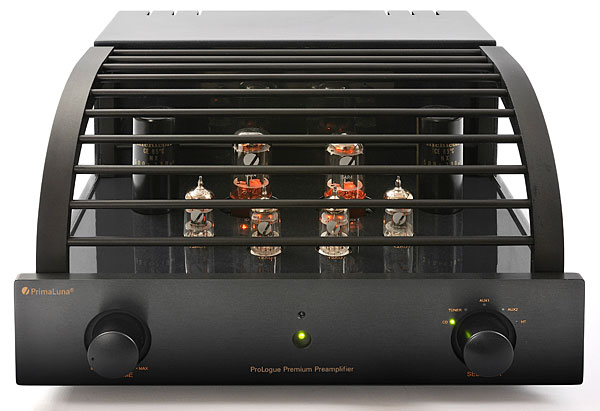
The PrimaLuna ProLogue Premium is basically an old-school, line-level tubed preamp, created in the Netherlands by Herman van den Dungen, and built in China to levels of quiet, durability, and sonic sophistication not possible in the 20th century.
The ProLogue Premium is built into the same type of blue-gray, subtle metal-flake, lacquer-on-steel case as the ProLogue Premium EL34 tubed power amplifier, which I reviewed in the November 2016 issue. That stereo amp weighs 46.3 lbs; surprisingly, this preamp weighs almost as much: 37.5 lbs. It's so heavy because it has two large, potted toroidal power transformers and two power-supply filter chokes, all sitting atop the chassis, hidden inside a vented box. Including its tube cage, the ProLogue measures 14.5" wide by 8" high by 15.5" deep.
 The ProLogue Premium's dual-mono heavy-duty-ness is enhanced by the use of one GZ34/5AR4 rectifier tube per channel. This design choice is extremely unusual—most tube amps forgo tube rectifiers, instead using solid-state diodes to save space and cost. In their defense, the amp manufacturers often say that solid-state rectifiers are quieter (they're not), or that they sound better (which I question), or that they do it to make their gear sound less like tubes and more like transistors (which is possible).
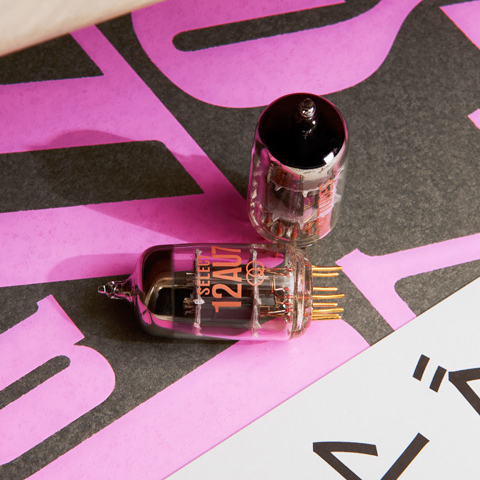
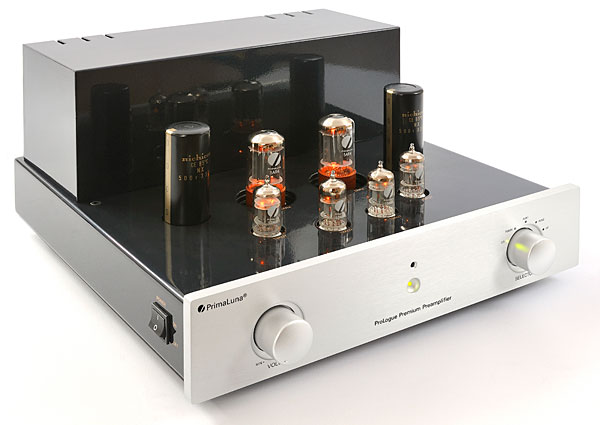
When a preamplifier does have a tube rectifier, it's usually a miniature 12X4 or 6X4 tube rated to draw 90 milliamperes of current—not the indestructible and organic-sounding, octal-base GZ34/5AR4, rated at 250mA. Each of the ProLogue Premium's 12AU7 twin-triode tubes draws only 20mA, so you can be sure that PrimaLuna is not using massively overspecced and costly octal tube rectifiers for durability alone—no way. I can assure you that PrimaLuna is using one high-current rectifier per channel because Herman van den Dungen believes it makes his $2199 preamp sound richer, faster, and less mechanical than other preamplifiers employing bevies of $1 rectifiers. Why else?
When I removed the ProLogue Premium's bottom plate, I was instantly impressed by the quality of parts and labor I saw. I've serviced countless tube amps, including some of the world's most expensive, and have never seen better-crafted point-to-point wiring or more intelligent layout. On their website, PrimaLuna makes a big deal about their tube sockets being bolted directly to their steel chassis. This is because it is a big deal—it makes their products more durable and trouble free than those of competitors who attach tube sockets directly to circuit boards. The latter strategy saves space, labor, and money, but every time the user removes or inserts a tube, there's a danger of irreparably damaging the board. Over time, that danger becomes a certainty.
Likewise with those volume controls and selector switches I was talking about. Many of the biggest high-end names use a $4 chip, a DS1666 Audio Digital Resistor, as a solid-state potentiometer to control volume; PrimaLuna uses a motorized Blue Velvet potentiometer, made by Alps in Japan, that costs at least ten times as much. Expensive, Japanese-made relays are used for the source-selector switch.
DuRoch polypropylene capacitors are featured in the power supply and signal path, while Solen polypropylene caps, made in France, are used at the outputs. Almost as impressive as all that are the Japanese-made Nichicon storage caps that proudly project from the ProLogue Premium's chassis top.
On the 7/16"-thick aluminum front panel are two symmetrically placed knobs: volume control on the left, input selector on the right. Centrally located between them is a handsome Off/Warming Up/On LED. The On/Off rocker switch is hidden away on the preamp's left side, just around the protruding edge of the front panel.
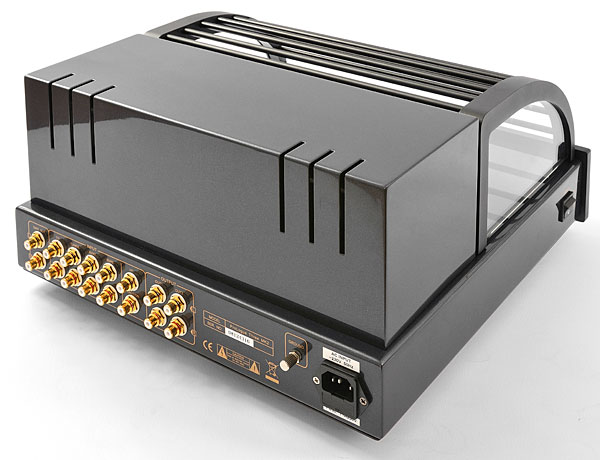
On the rear panel is a plethora of gold-plated RCA jacks for the inputs—CD, Tuner, Aux 1, Aux 2, HT (home theater)—and outputs: Tape Out, Out 1, Out 2. There's also a grounding post. A simple, slender, solid aluminum remote control is included.
Listening
The ProLogue Premium's dual-mono heavy-duty-ness is enhanced by the use of one GZ34/5AR4 rectifier tube per channel. This design choice is extremely unusual—most tube amps forgo tube rectifiers, instead using solid-state diodes to save space and cost. In their defense, the amp manufacturers often say that solid-state rectifiers are quieter (they're not), or that they sound better (which I question), or that they do it to make their gear sound less like tubes and more like transistors (which is possible).
When a preamplifier does have a tube rectifier, it's usually a miniature 12X4 or 6X4 tube rated to draw 90 milliamperes of current—not the indestructible and organic-sounding, octal-base GZ34/5AR4, rated at 250mA. Each of the ProLogue Premium's 12AU7 twin-triode tubes draws only 20mA, so you can be sure that PrimaLuna is not using massively overspecced and costly octal tube rectifiers for durability alone—no way. I can assure you that PrimaLuna is using one high-current rectifier per channel because Herman van den Dungen believes it makes his $2199 preamp sound richer, faster, and less mechanical than other preamplifiers employing bevies of $1 rectifiers. Why else?
When I removed the ProLogue Premium's bottom plate, I was instantly impressed by the quality of parts and labor I saw. I've serviced countless tube amps, including some of the world's most expensive, and have never seen better-crafted point-to-point wiring or more intelligent layout. On their website, PrimaLuna makes a big deal about their tube sockets being bolted directly to their steel chassis. This is because it is a big deal—it makes their products more durable and trouble free than those of competitors who attach tube sockets directly to circuit boards. The latter strategy saves space, labor, and money, but every time the user removes or inserts a tube, there's a danger of irreparably damaging the board. Over time, that danger becomes a certainty.
Likewise with those volume controls and selector switches I was talking about. Many of the biggest high-end names use a $4 chip, a DS1666 Audio Digital Resistor, as a solid-state potentiometer to control volume; PrimaLuna uses a motorized Blue Velvet potentiometer, made by Alps in Japan, that costs at least ten times as much. Expensive, Japanese-made relays are used for the source-selector switch.
DuRoch polypropylene capacitors are featured in the power supply and signal path, while Solen polypropylene caps, made in France, are used at the outputs. Almost as impressive as all that are the Japanese-made Nichicon storage caps that proudly project from the ProLogue Premium's chassis top.
On the 7/16"-thick aluminum front panel are two symmetrically placed knobs: volume control on the left, input selector on the right. Centrally located between them is a handsome Off/Warming Up/On LED. The On/Off rocker switch is hidden away on the preamp's left side, just around the protruding edge of the front panel.
On the rear panel is a plethora of gold-plated RCA jacks for the inputs—CD, Tuner, Aux 1, Aux 2, HT (home theater)—and outputs: Tape Out, Out 1, Out 2. There's also a grounding post. A simple, slender, solid aluminum remote control is included.
Listening
Whenever I insert a new preamplifier or source component in the bunker system, the first thing I listen for is a change in the quantity or character of the musical energy projected between the loudspeakers. Is it denser? More textured? Weaker? Does it occupy more or less space in my room? Is it harder or softer? These are important traits to notice.
 That in mind, I began my auditions of the PrimaLuna ProLogue Premium with Iggy Pop singing a very stoned, slurry, after-hours take of "Jesus Loves the Stooges" (7" 45rpm EP, Bomp BEP-114). The song, by James Osterberg and James Williamson, appears to have been recorded with only two poorly positioned microphones: one on Iggy's upright piano, the other on his thick voice.
I was tracing this strange Iggy moment with a humble Ortofon 2M Black moving-magnet cartridge installed in a Jelco SA750B tonearm mounted an Analogueworks Zero turntable (review to come), driving a Tavish Design Adagio phono preamplifier, and instantly I recognized how the ProLogue Premium enhanced not only the music's force and strength, but also the space and scale of the sound. Momentum was excellent, and timbres were surprisingly real sounding; but it was the ProLogue Premium's listenability that made this crazy-ass recording so enjoyable. With my other preamps, "Jesus Loves the Stooges" sounds more ragged and fuzzy—more as if it's coming out of a boom box. With the PrimaLuna, it sounded all sweaty and solid, like Iggy onstage.
But as much as I love them, Stooges records are not always good for checking tonal beauty, imaging, or fundamental realisms. So I upped the beauty quotient a little and played Béla Bartók's Piano Concerto 1, in the 1977 recording by Maurizio Pollini with Claudio Abbado conducting the Chicago Symphony Orchestra (LP, Deutsche Grammophon 2530 901), on the not-so-humble analog rig of Palmer 2.5 turntable, Audio Origami PU-7 tonearm, and Mighty Cala Sound MCS TNT 15 moving-coil cartridge, with a Parasound Halo JC 3+ phono preamplifier and Bob's Devices CineMag 1131 step-up transformer. This world-class combo let the ProLogue Premium preamp and power amp strut their high-value stuff. The metal-flake blue team brought this spectacular DGG recording to a very high level of fine detail and lush lucidity.
The PrimaLuna tube combo produced the most mind-grabbing spatial contrasts: big and small, far and near were explicitly portrayed. Instrumental tones, staccato rhythms, and artistic intents were vividly exposed. Pollini plays with uncharacteristically wild attacks, and this system let me lose myself in them. Likewise, Abbado and the CSO explode this fantastic concerto—and the ProLogue Premiums let me savor every fast-moving fragment. (This record played so well with this group of components that it created, for me, an unforgettable moment.)
That in mind, I began my auditions of the PrimaLuna ProLogue Premium with Iggy Pop singing a very stoned, slurry, after-hours take of "Jesus Loves the Stooges" (7" 45rpm EP, Bomp BEP-114). The song, by James Osterberg and James Williamson, appears to have been recorded with only two poorly positioned microphones: one on Iggy's upright piano, the other on his thick voice.
I was tracing this strange Iggy moment with a humble Ortofon 2M Black moving-magnet cartridge installed in a Jelco SA750B tonearm mounted an Analogueworks Zero turntable (review to come), driving a Tavish Design Adagio phono preamplifier, and instantly I recognized how the ProLogue Premium enhanced not only the music's force and strength, but also the space and scale of the sound. Momentum was excellent, and timbres were surprisingly real sounding; but it was the ProLogue Premium's listenability that made this crazy-ass recording so enjoyable. With my other preamps, "Jesus Loves the Stooges" sounds more ragged and fuzzy—more as if it's coming out of a boom box. With the PrimaLuna, it sounded all sweaty and solid, like Iggy onstage.
But as much as I love them, Stooges records are not always good for checking tonal beauty, imaging, or fundamental realisms. So I upped the beauty quotient a little and played Béla Bartók's Piano Concerto 1, in the 1977 recording by Maurizio Pollini with Claudio Abbado conducting the Chicago Symphony Orchestra (LP, Deutsche Grammophon 2530 901), on the not-so-humble analog rig of Palmer 2.5 turntable, Audio Origami PU-7 tonearm, and Mighty Cala Sound MCS TNT 15 moving-coil cartridge, with a Parasound Halo JC 3+ phono preamplifier and Bob's Devices CineMag 1131 step-up transformer. This world-class combo let the ProLogue Premium preamp and power amp strut their high-value stuff. The metal-flake blue team brought this spectacular DGG recording to a very high level of fine detail and lush lucidity.
The PrimaLuna tube combo produced the most mind-grabbing spatial contrasts: big and small, far and near were explicitly portrayed. Instrumental tones, staccato rhythms, and artistic intents were vividly exposed. Pollini plays with uncharacteristically wild attacks, and this system let me lose myself in them. Likewise, Abbado and the CSO explode this fantastic concerto—and the ProLogue Premiums let me savor every fast-moving fragment. (This record played so well with this group of components that it created, for me, an unforgettable moment.)
The PrimaLuna ProLogue Premium is basically an old-school, line-level tubed preamp, created in the Netherlands by Herman van den Dungen, and built in China to levels of quiet, durability, and sonic sophistication not possible in the 20th century.
The ProLogue Premium's dual-mono heavy-duty-ness is enhanced by the use of one GZ34/5AR4 rectifier tube per channel. This design choice is extremely unusual—most tube amps forgo tube rectifiers, instead using solid-state diodes to save space and cost. In their defense, the amp manufacturers often say that solid-state rectifiers are quieter (they're not), or that they sound better (which I question), or that they do it to make their gear sound less like tubes and more like transistors (which is possible).
When a preamplifier does have a tube rectifier, it's usually a miniature 12X4 or 6X4 tube rated to draw 90 milliamperes of current—not the indestructible and organic-sounding, octal-base GZ34/5AR4, rated at 250mA. Each of the ProLogue Premium's 12AU7 twin-triode tubes draws only 20mA, so you can be sure that PrimaLuna is not using massively overspecced and costly octal tube rectifiers for durability alone—no way. I can assure you that PrimaLuna is using one high-current rectifier per channel because Herman van den Dungen believes it makes his $2199 preamp sound richer, faster, and less mechanical than other preamplifiers employing bevies of $1 rectifiers. Why else?
Whenever I insert a new preamplifier or source component in the bunker system, the first thing I listen for is a change in the quantity or character of the musical energy projected between the loudspeakers. Is it denser? More textured? Weaker? Does it occupy more or less space in my room? Is it harder or softer? These are important traits to notice.
That in mind, I began my auditions of the PrimaLuna ProLogue Premium with Iggy Pop singing a very stoned, slurry, after-hours take of "Jesus Loves the Stooges" (7" 45rpm EP, Bomp BEP-114). The song, by James Osterberg and James Williamson, appears to have been recorded with only two poorly positioned microphones: one on Iggy's upright piano, the other on his thick voice.
I was tracing this strange Iggy moment with a humble Ortofon 2M Black moving-magnet cartridge installed in a Jelco SA750B tonearm mounted an Analogueworks Zero turntable (review to come), driving a Tavish Design Adagio phono preamplifier, and instantly I recognized how the ProLogue Premium enhanced not only the music's force and strength, but also the space and scale of the sound. Momentum was excellent, and timbres were surprisingly real sounding; but it was the ProLogue Premium's listenability that made this crazy-ass recording so enjoyable. With my other preamps, "Jesus Loves the Stooges" sounds more ragged and fuzzy—more as if it's coming out of a boom box. With the PrimaLuna, it sounded all sweaty and solid, like Iggy onstage.
But as much as I love them, Stooges records are not always good for checking tonal beauty, imaging, or fundamental realisms. So I upped the beauty quotient a little and played Béla Bartók's Piano Concerto 1, in the 1977 recording by Maurizio Pollini with Claudio Abbado conducting the Chicago Symphony Orchestra (LP, Deutsche Grammophon 2530 901), on the not-so-humble analog rig of Palmer 2.5 turntable, Audio Origami PU-7 tonearm, and Mighty Cala Sound MCS TNT 15 moving-coil cartridge, with a Parasound Halo JC 3+ phono preamplifier and Bob's Devices CineMag 1131 step-up transformer. This world-class combo let the ProLogue Premium preamp and power amp strut their high-value stuff. The metal-flake blue team brought this spectacular DGG recording to a very high level of fine detail and lush lucidity.