Herb Reichert wrote about the Palmer & Origami in July 2017 (Vol.40 No.7):
The words right and wrong and good and bad make me uncomfortable. Assigning virtue or value is against my religion. And thinking that I know the best way to design a loudspeaker, amplifier, or record player would only prove that I'm a conceited old fool. Therefore . . .
When I feel the urge to upgrade my analog pleasures, I keep an open mind and endeavor to shop outside my comfort zone. And, because I can, I consult with me ol' runnin' buddy Michael Trei, contributing editor to Sound & Vision, and collector and setter-up of turntables. I also study the wisdom of Stereophile senior editor Michael Fremer.
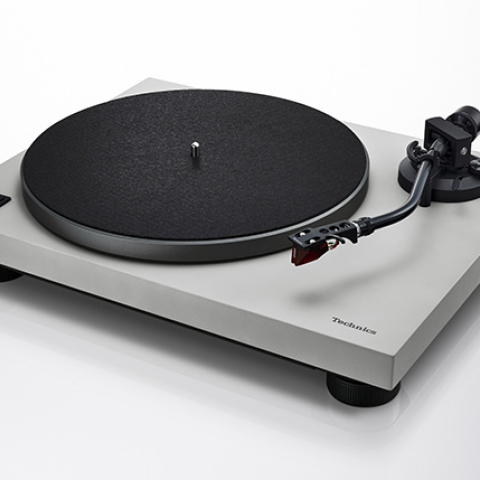
Last year, after I'd reviewed the Technics SL-1200GAE and Roksan Radius 7 turntables, the two Michaels spoke in unison: "Herb, you need to move up the analog food chain." Meaning I needed to experience some 21st-century perfectionist analog. Trei suggested I try auditioning turntables from the likes of Brinkmann Audio, Dr. Feickert Analogue, and Döhmann. "But they're not British!" I protested. He laughed. "Okay, maybe you're not ready for Nietzsche or Kant. What about Palmer Audio?"
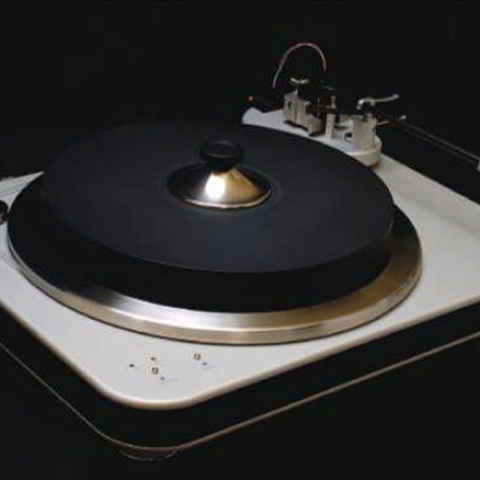
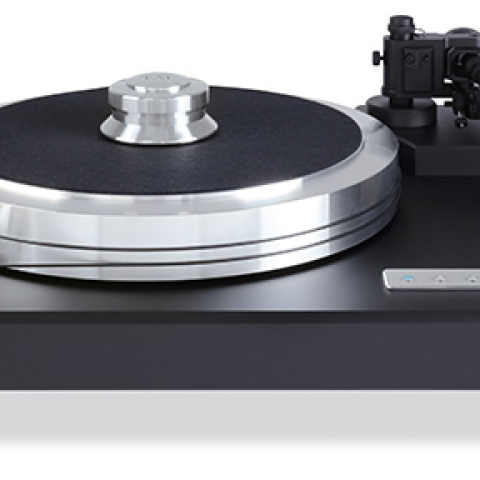
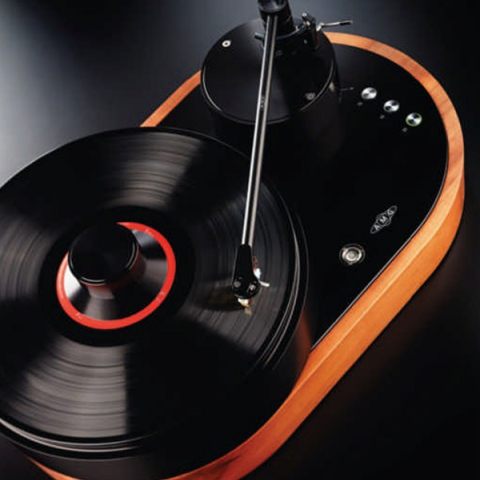
That night, I read Fremer's November 2014 review of the Palmer 2.5 turntable ($8990) with Audio Origami PU7 tonearm ($3000), and the quotes from that review's summary in "Recommended Components": "attractive, velvety midband," "black backgrounds," "serenity and smooth musical flow." I liked the sounds of all those words, especially "velvety midband" and "serenity and smooth musical flow." They made me call Palmer importer Walter Swanbon, of Fidelis Music Systems, and ask to borrow that same setup so that I could write a Follow-Up on the 2.5. He told me that borrowing a 2.5 "was possible—but not probable. Jon Palmer makes them one at a time and they all go to customers."
A month later, Swanbon was standing, unannounced, outside my bunker, holding a big, heavy box.
Since buying my very first turntable, a Dual 1019, I've owned dozens of exotic record-playing systems. None of them prepared me for the experience of the British-made Palmer 2.5 with Audio Origami PU7 tonearm.
I listened to the Palmer-Origami deck with a variety of as-yet-unreviewed cartridges, but I have restricted this Follow-Up to what I heard using EMT's luminous and real-sounding TSD 75 moving-coil ($2095), which is an anniversary edition of the popular TSD 15, fitted with a super-fineline stylus ($1950). Also, I describe the Nottingham Audio Tom Fletcher-ness of the Palmer and Pear Audio turntables in my review of the Analogueworks Zero turntable, elsewhere in this issue. Here I'll describe only how the Palmer 2.5 worked, slowly and subtly, to teach me an important lesson in the sound characters of turntable drive systems.
Fremer was surprised when he saw the Palmer 2.5 in a photo on my Facebook page. He said it was a great 'table. "Did you buy it? You could learn from it."
The first and most obvious thing I learned was how raucous and unquiet all my previous turntables had been. Fremer always writes about "black" backgrounds, and I'd always assumed I knew what he meant. But moments after I'd first started the Palmer's 22-lb platter spinning by giving it a push with my hand, I sat down and smiled. There it is, I thought: a genuine "black" background. My next thought: What a fool I've been. I used to make fun of Tom Fletcher and low-torque turntable motors, and now I'm marveling at this one's silence and understated authority.
Then I remembered: True audio connoisseurship requires a long life of mindful listening and open-mindedness.
Now, suddenly, I am stunned, drunk, stoned as I revel in the Palmer 2.5's "black" backgrounds. This dark quietness frames singers and instruments in a way that directs my attention toward the musical content. Obviously, we have to pay extra for such luxurious framing—but that silent "blackness" and the deep musical spaces it makes possible added visual, sonic, and emotional impact to every record played.
Then I remembered how, once upon a time, my hero Art Dudley marveled at his serendipitous discovery of high-torque turntable motors: "The turntables that have impressed me most . . . the ones that are the most musically compelling, and that tease from my records the greatest degree of musical flow, momentum, drama, and sheer force—all have high-torque motors." Until recently, me and my 1957 Thorens TD 124 turntable felt that way too. But buying a Linn LP12 reopened my mind to suspended subchassis turntables and the low-torque motors they virtually always use. To take this a step further: Using the Roksan Radius 7 with its Nima tonearm showed me how unipivot tonearms can deliver extra-textured midranges. Reviewing Rega Research's Planar 3 started me thinking philosophically about the natures of music, noise, and silence. Now, the Palmer 2.5 and Analogueworks Zero are showing me the deeper pleasures of almost no torque.
Of course, a lower-powered motor generates less powerful noise. But does it hamper musical flow or momentum? I have tediously investigated that question, and I would now say that in the Palmer 2.5 it does not. But clearly, the force and feel of that momentum differed greatly between a low-torque motor turning a high-mass platter of copper and aluminum (like the Palmer's), and lots of torque twisting a relatively low-mass Lexan platter (like the Voyd TT3 Super turntable Art was discussing).
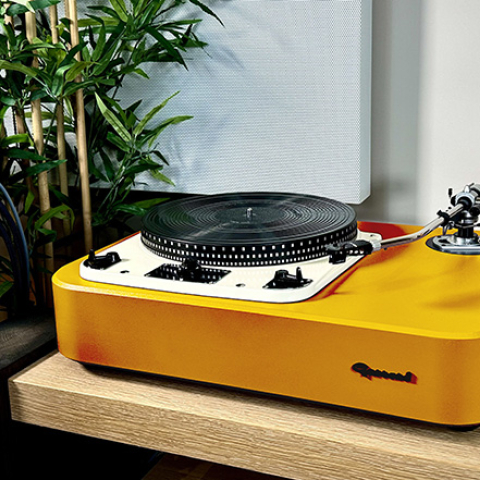
Long ago, I owned and loved a three-motor Voyd turntable. I was friendly with its designer, Guy Adams, and thought highly of his engineering intelligence. I felt uncomfortable selling my trusty Denon direct-drive 'table and replacing it with a British belt-drive design—but the Voyd was simply more together, in terms of rhythm and momentum. Most important, the Voyd played solo-piano LPs with beguiling authority. However, today I'm experiencing a more focused force behind the Palmer's musical flow than I remember hearing from my high-torque Voyd—or from any other turntable I've owned. I hear more subtlety, more realistic piano corpus from the Palmer.
Recordings played on the Palmer displayed a unique form of momentum that reminded me of gravity and planetary motions. There was an eerie cosmic strength and silent power behind the Palmer's transcriptions that was more powerful than my Thorens TD 124, Linn LP12, and Technics SL-1200GAE combined. But the Palmer's power was completely invisible—like the hand of God.
Something tells me that the source of this uncanny, invisible force was the rotating mass of the Palmer's thick copper-clad aluminum platter. Whatever the cause, this natural power imparted a unique form of transparency to the Palmer's bass and treble. This constant sense of a silent, invisible force was the Palmer 2.5's core virtue. Fremer called it "serenity and smooth musical flow."
A chunk of this serenity must be attributed to the Audio Origami PU7 tonearm, which steers and wrangles every cartridge with extraordinary precision. Our Recommended Components blurb noted the midrange richness of the Palmer-Origami duo, but urged prospective owners to "consider cartridges that, in other settings, might be considered on the lean side of neutral."
In my modest system, the Palmer-Origami combo sounded best with cartridges that were fast, beautiful, and resolving—like the EMT TSD 75. But surely, the Palmer's outer-space silence, coupled to the PU7's precision, just begs for a nice Lyra, Fuuga, or Koetsu cartridge.
"Herb, you should buy that Palmer—it'll be good for you!" Ultimately, the Palmer Audio 2.5 played the zydeco, bluegrass, choral, piano, and early music I cherish so damned evocatively that I feel I must now do as the two Michaels suggested.—Herb Reichert
Palmer Audio 2.5 turntable & Audio Origami PU7 tonearm Herb Reichert

Company Info
ARTICLE CONTENTS
- Log in or register to post comments