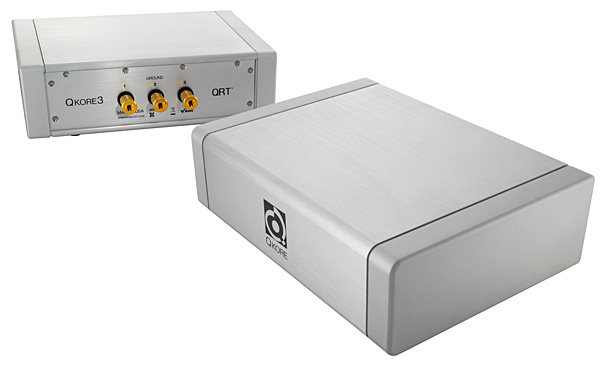
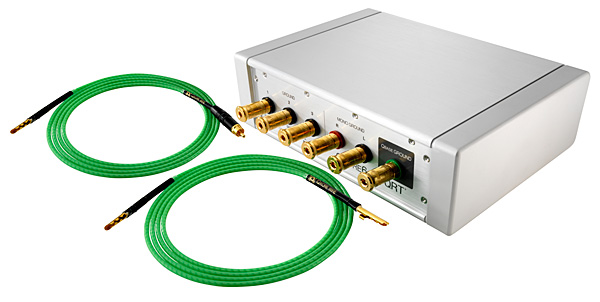
Setup decisions were simplified when Taylor explained that, since the component LVAPs in the QKore3 and 6 are identical, and the power-product LVAPs in the QKore1 and 6 are also identical, if I were to use the QKore6 to connect only three components plus a power product, the sound would be equivalent to connecting a separate QKore1 and QKore3. It got even easier when I discovered that the only open digital connectors on my components were single-ended BNC and RCA. This meant that I wouldn't be able to compare the sounds of the QKores' grounding via single-ended vs balanced connectors.
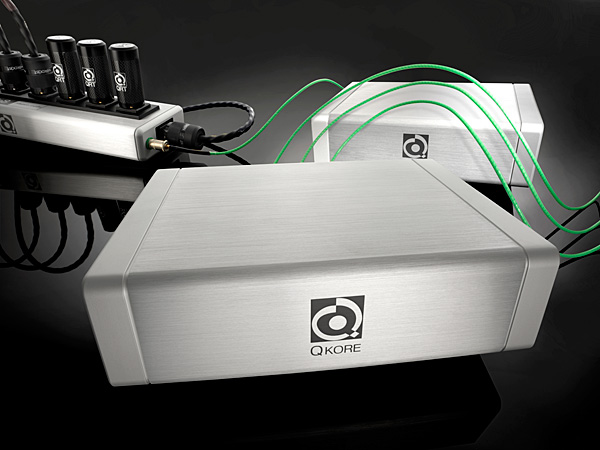
With no room on my rack, and little floor space behind a system wired with 1,001 cables, I feared that more boxes and wires would consume all the remaining space behind the rack. Happily, the QKores perched securely atop the diffusers that Bart Andeer of Resolution Acoustics had designed for the front wall of my listening room. I could still tiptoe through the cables.
I began by removing the QKores' rubber feet and perching each Ground Unit atop one titanium and two bronze Sort Kones. Later, well into my listening, I discovered that using two titaniums and one bronze better illumined the sound.
 Listening
I listened to three reference recordings: Lou Harrison's percussion-rich Concerto for Violin with Percussion Orchestra, with soloist Tim Fain accompanied by Angel Gil-Ord&3243;ñez leading the PostClassical Ensemble (24-bit/48kHz WAV, Naxos 8.559825); Andris Nelsons and the Boston Symphony Orchestra's knockout performance of Shostakovich's Symphony 4 (24/96 WAV, Deutsche Grammophon 002859502); and Michael Tilson Thomas and the San Francisco Symphony's recording of Berg's Three Pieces for Orchestra (24/192 WAV, SFS Media SFS0070). All three wallop the listener with copious bass, considerable high extension, dramatic outbursts, and a hell of a lot going on all at once. Listening to the CH Precision I1, which includes a DAC, I heard a pervasive grayness that covered the music's glory like a light, transparent fog. I longed for richer colors in the Berg, more silence around climactic percussive strokes in the Shostakovich. Then, when I connected the QKore1 to the Tweek Geek Dark Matter Stealth power conditioner, I was ready to swear that the soundstage had widened and colors were now a bit more distinct. Once I'd gotten past the shock of discovering how more transparent and vivid everything sounded, I realized that while the soundstage had not widened, sounds now stood out more because much of the fog had lifted. I especially loved how I could hear more subtle bass differentiation in the Berg, and more vivid colors. In connecting the CH Precision I1 to the QKore3, I now had to make a choice between BNC and RCA inputs. No contest; using an open BNC clock input on the CH I1 delivered wetter, more transparent sound. With the Harrison concerto, for example, images grew notably more three-dimensional and round. There was more air around the violin, and the percussive explosions were now distinctly behind it.
I added the dCS Scarlatti clock to the signal chain, using one of its open BNC outputs, listened, and noted: "The sound is getting ghostly quiet. Everything I love about this music and these recordings is standing out more."
For the CH Precision review, I'd intended to compare the sound of the I1's internal DAC to that of an external dCS Rossini DAC, the latter's analog outputs connected to the I1's preamp section. Connecting the QKore3 to both the Rossini and the I1 further shifted the sound, from gray around the edges to remarkably more vivid. As for which open input sounded better, when I moved the QKore Wire from the Rossini's open RCA to its open BNC clock input, BNC again delivered wetter, more transparent images.
 Because I always listen to the Rossini DAC with the Scarlatti clock engaged, I next added the latter, but without the QKore3 attached. With the clock alone, the soundstage was more 3D, instruments moved farther back and seemed more naturally differentiated from each other, and an appreciable amount of additional air increased the distinction between hi-fi and high-end.
Next, when I connected the external Scarlatti clock to the QKore3, I heard the clearest, most color-differentiated sound, and the most silence between sounds, that I'd yet heard from the combo of Rossini DAC and CH Precision I1. Harrison's gamelan-like use of a wide variety of percussion—all manner of gongs, drums, bells, each with a different timbre and different length of decay—makes this recording a superb test for a sound system, as well as a thrilling musical ride.
Of the many improvements wrought by the Nordosts, one that stood out was how much longer I could hear the sounds of bells and gongs decay, even as other instruments began playing over those decays. That increased sense of natural decays in space—even with recordings, such as the Harrison, that lack a high sampling rate—validated all the energy and money that we audiophiles devote to searching out ways to increase our systems' capacity to reproduce what the finest recording and mastering engineers wish us to hear.
Because I always listen to the Rossini DAC with the Scarlatti clock engaged, I next added the latter, but without the QKore3 attached. With the clock alone, the soundstage was more 3D, instruments moved farther back and seemed more naturally differentiated from each other, and an appreciable amount of additional air increased the distinction between hi-fi and high-end.
Next, when I connected the external Scarlatti clock to the QKore3, I heard the clearest, most color-differentiated sound, and the most silence between sounds, that I'd yet heard from the combo of Rossini DAC and CH Precision I1. Harrison's gamelan-like use of a wide variety of percussion—all manner of gongs, drums, bells, each with a different timbre and different length of decay—makes this recording a superb test for a sound system, as well as a thrilling musical ride.
Of the many improvements wrought by the Nordosts, one that stood out was how much longer I could hear the sounds of bells and gongs decay, even as other instruments began playing over those decays. That increased sense of natural decays in space—even with recordings, such as the Harrison, that lack a high sampling rate—validated all the energy and money that we audiophiles devote to searching out ways to increase our systems' capacity to reproduce what the finest recording and mastering engineers wish us to hear.
 After listening some more, and having discovered my preference for one bronze and two titanium Sort Kones under each QKore Ground Unit, I found the music so convincing, colorful, and pleasing that I declared, "Enough snippets of orchestral tours de force!" Instead, I revisited some of the recordings I love of sopranos and mezzos singing music that brings warmth to my heart and smiles to my face, as I reveled in quieter backgrounds, more colorful accompaniment, and more thrilling overtones than I'd ever heard from my system. It was good—very, very good.
Conclusions
After listening some more, and having discovered my preference for one bronze and two titanium Sort Kones under each QKore Ground Unit, I found the music so convincing, colorful, and pleasing that I declared, "Enough snippets of orchestral tours de force!" Instead, I revisited some of the recordings I love of sopranos and mezzos singing music that brings warmth to my heart and smiles to my face, as I reveled in quieter backgrounds, more colorful accompaniment, and more thrilling overtones than I'd ever heard from my system. It was good—very, very good.
Conclusions
I can't imagine that anyone who's invested considerable time and energy and money in a high-end system would want to be without the markedly "blacker" backgrounds, increased transparency and detail, more vivid colors, and greater overall veracity delivered by Nordost's QKore Ground Units. Connecting just a single power distributor or conditioner to a QKore1 or QKore6 brought marked improvements; adding as many additional components as possible increased the effect greatly. The law of diminishing returns does not apply; the differences were cumulative, and anything but subtle.
ListeningI listened to three reference recordings: Lou Harrison's percussion-rich Concerto for Violin with Percussion Orchestra, with soloist Tim Fain accompanied by Angel Gil-Ord&3243;ñez leading the PostClassical Ensemble (24-bit/48kHz WAV, Naxos 8.559825); Andris Nelsons and the Boston Symphony Orchestra's knockout performance of Shostakovich's Symphony 4 (24/96 WAV, Deutsche Grammophon 002859502); and Michael Tilson Thomas and the San Francisco Symphony's recording of Berg's Three Pieces for Orchestra (24/192 WAV, SFS Media SFS0070). All three wallop the listener with copious bass, considerable high extension, dramatic outbursts, and a hell of a lot going on all at once. Listening to the CH Precision I1, which includes a DAC, I heard a pervasive grayness that covered the music's glory like a light, transparent fog. I longed for richer colors in the Berg, more silence around climactic percussive strokes in the Shostakovich. Then, when I connected the QKore1 to the Tweek Geek Dark Matter Stealth power conditioner, I was ready to swear that the soundstage had widened and colors were now a bit more distinct. Once I'd gotten past the shock of discovering how more transparent and vivid everything sounded, I realized that while the soundstage had not widened, sounds now stood out more because much of the fog had lifted. I especially loved how I could hear more subtle bass differentiation in the Berg, and more vivid colors. In connecting the CH Precision I1 to the QKore3, I now had to make a choice between BNC and RCA inputs. No contest; using an open BNC clock input on the CH I1 delivered wetter, more transparent sound. With the Harrison concerto, for example, images grew notably more three-dimensional and round. There was more air around the violin, and the percussive explosions were now distinctly behind it.
Because I always listen to the Rossini DAC with the Scarlatti clock engaged, I next added the latter, but without the QKore3 attached. With the clock alone, the soundstage was more 3D, instruments moved farther back and seemed more naturally differentiated from each other, and an appreciable amount of additional air increased the distinction between hi-fi and high-end.
After listening some more, and having discovered my preference for one bronze and two titanium Sort Kones under each QKore Ground Unit, I found the music so convincing, colorful, and pleasing that I declared, "Enough snippets of orchestral tours de force!" Instead, I revisited some of the recordings I love of sopranos and mezzos singing music that brings warmth to my heart and smiles to my face, as I reveled in quieter backgrounds, more colorful accompaniment, and more thrilling overtones than I'd ever heard from my system. It was good—very, very good.
I can't imagine that anyone who's invested considerable time and energy and money in a high-end system would want to be without the markedly "blacker" backgrounds, increased transparency and detail, more vivid colors, and greater overall veracity delivered by Nordost's QKore Ground Units. Connecting just a single power distributor or conditioner to a QKore1 or QKore6 brought marked improvements; adding as many additional components as possible increased the effect greatly. The law of diminishing returns does not apply; the differences were cumulative, and anything but subtle.