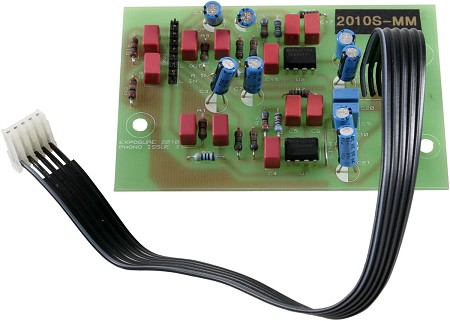
It's not nearly as sexy as the Bellari VP129, but I was still happy to receive it. The Exposure 2010S's phono card ($219) arrived on Thursday afternoon, secured in bubble wrap and covered by Styrofoam peanuts. There were no instructions.
Who needs instructions anyway?
Up until now, I had been listening to my vinyl through the Tangent AMP-50's onboard phono section. For only $259, you get fine styling, 50 watts of power, detailed sound, and the ability to listen to vinyl. Budget-strapped music lovers looking to build a system should definitely consider the Tangent, especially if they want to easily incorporate vinyl playback. Match the Tangent amp with an entry-level Rega turntable and a pair of PSB Alpha B1 loudspeakers, for instance, and you've got gorgeous music and great fun for under $1000. But the Tangent has its limitations, and I'd been eager to hear what the Exposure could do. So, on Friday morning, I set about installing the card.
The Exposure's black, aluminum-alloy chassis cover is held in place by four discreet screws—two on each side panel. I removed these screws slowly, careful to maintain the threads, and then gently slid the cover from the Exposure. Hidden beneath was a lovely thing.
I had never done this before, you know, so I was excited to see the clean circuit board. Just like
Art Dudley had said. Little red houses and blue towers set upon silent fields of green and gold and with highways of I don't know what going in so many odd directions, all just to make music.
So now what? On the left hand side of the board, just opposite the phono input, I noticed an outline for the phono card. Three small holes in the phono card matched up perfectly with three small holes in the circuit board. In addition, the phono card was packed with three white, plastic pins. These plastic pins would secure the card to the board. Clearly, this is where the phono card should go. Something would have to be removed in order to set the card in place, however. A small jumper rests in place of the phono card, keeping its space warm. I removed this jumper and set it aside. Inserting the white pins into the phono card was more of a problem, however. It wasn't obvious which side of the pin should go into the card and which side should go into the board. Similarly, I wasn't sure whether I should stick the pins into the board and press the card onto the pins, or stick the pins into the card and press the card onto the board.
This sounds stupid, doesn't it?
I
felt stupid. Where were those instructions?!
I set the whole project aside for awhile and watched some really bad daytime television. Midgets bench-pressing audience members, female bodybuilders reunited with their mothers, Judge Hatchett in tears.
I felt stupider. I turned back to the phono card.
After a few more minutes of fumbling about, sweat streaming from my forehead and my eyeglasses falling from my frustrated face, I did what any dude would do: I forced the damn thing into place. Snap! It worked.
With the phono card in place, I reattached the Exposure's cover and carefully tightened the four screws. I made the appropriate connections and, with the volume turned all the way down, I powered the unit. Then, I waited. I figured it would be a good idea to allow the Exposure to warm up for a bit. With no music playing, I slowly raised the volume and switched back and forth between inputs, while listening to the sound coming from the speakers. The CD input was considerably quieter than the phono input. This worried me. Had I done something wrong?
I watched some more bad television. An hour or so later, still uncertain as to whether I had made some installation mistake, I decided to start my listening with a CD. I pressed play, and music filled the room. The amplifier did not blow up! Even better: The sound was superb—fleshy, involving, and transparent. Whose voices are those coming from the background, five minutes into Miles Davis' "In A Silent Way"?
I switched to vinyl, still worried that something bad might happen. What if I had installed the card in the wrong place? What if I hadn't made the proper connections? But, then again, how could I have made a mistake? The installation was so simple, so obvious. Outside, early partiers sent rockets into the cloudy afternoon sky.
I turned the volume all the way down, switched the input selector to Phono, and reached for John Handy's vibrant
Projections. I placed the needle (I know it's called a stylus, thank you) on the record and heard silence. Silence is better than explosions, even on Independence Day.
I slowly raised the volume and was greeted by the bobbing, swinging, infectious sounds of Handy's "Three In One." I sat back, sighed a happy sigh, and listened all night long.