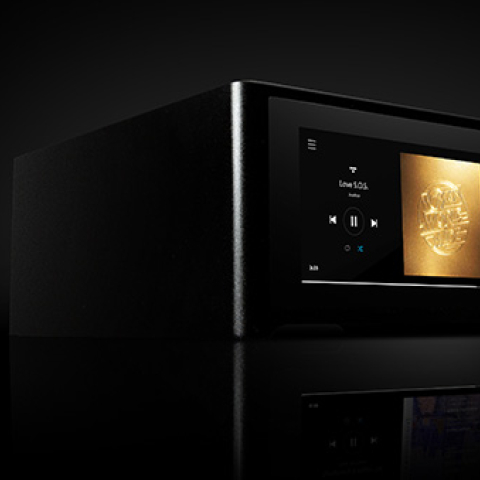
NAD includes five Dirac memory slots in the M33—that's five distinct sets of room-adjustment settings—in addition to bypass, a nice feature for experimentation and to optimize listening for different positions, music, or moods. The included "LE" (Limited Edition) version of Dirac is effective only up to 500Hz, but that covers the range of frequencies where room correction matters most in most domestic rooms. The M33 with LE did a great job with the main speakers running full-range by clarifying everything in the sub-200Hz range. Once the room was optimized, I consistently preferred the stereo performance of the M33 with Dirac to my reference setup without it.
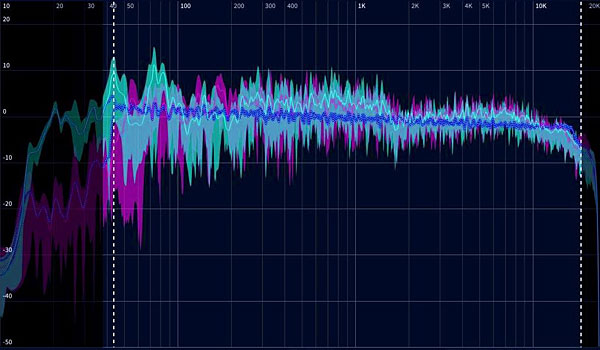 Things got even better when I added the three JL subwoofers, connected as one to the M33 with an 80Hz crossover and adjusted with Dirac Live 3 LE. The opening track on Pipes Rhode Island, John Dunstable's "Agincourt Hymn" played by Patrick Aiken (Riago 101), is remarkably clean and tight, with some distinct pedal notes of great power and definition. The M33 with Dirac and the subs let me play it at realistic levels with no taint of room modes to muddy it. And now the deep, shuddering tones of the synth bass on the eponymous track in Bela Fleck's Flight of the Cosmic Hippo (Warner Bros. 9 26562-2) were delineated as pitched, clear, musical notes. With "Jazz Variants," from the O-Zone Percussion Group's La Bamba (CD, Klavier KD 77017), it was as if my system had no dynamic limit at all. I annoyed my wife and neighbors for an entire afternoon, seeking the system's dynamic limits, only to find it was my own tolerance for loudness.
The improvements were even greater after I upgraded to the full version of Dirac Live, which can be unlocked in the M33 for $99.
I created several correction files with progressively higher upper frequency limits—500Hz, 1.6kHz, and 18.2kHz—and assigned them to different storage slots in the M33 so that I could select among them from the BluOS app on my iPad and assess their relative impact on the sound.
As I moved beyond the up-to-500Hz corrections permitted by the LE version to corrections with a higher upper-frequency limit, I perceived a subtle sharpening of the localization of voices and instruments in the acoustic space. A striking demonstration of this can be heard on Christian Euler's performance of solo viola pieces by Reger, Hindemith, Pochon, and Stravinsky (Viola Solo, MDG-Scene 903 2160-6, SACD). At first hearing, with the 500hz correction, the instrument is clean and warm in a moderately reverberant space: the Benedictine Abbey in Marienmünster. Switching in the 1.6kHz correction, the viola seemed just a bit more precisely defined. With the effectively full-range correction (18.2kHz), the Abbey walls stood aside, separating themselves from the instrument. There was no tonal shift, and the instrument was still right where it had been, but I had the impression that I was not hearing my room anymore.
Things got even better when I added the three JL subwoofers, connected as one to the M33 with an 80Hz crossover and adjusted with Dirac Live 3 LE. The opening track on Pipes Rhode Island, John Dunstable's "Agincourt Hymn" played by Patrick Aiken (Riago 101), is remarkably clean and tight, with some distinct pedal notes of great power and definition. The M33 with Dirac and the subs let me play it at realistic levels with no taint of room modes to muddy it. And now the deep, shuddering tones of the synth bass on the eponymous track in Bela Fleck's Flight of the Cosmic Hippo (Warner Bros. 9 26562-2) were delineated as pitched, clear, musical notes. With "Jazz Variants," from the O-Zone Percussion Group's La Bamba (CD, Klavier KD 77017), it was as if my system had no dynamic limit at all. I annoyed my wife and neighbors for an entire afternoon, seeking the system's dynamic limits, only to find it was my own tolerance for loudness.
The improvements were even greater after I upgraded to the full version of Dirac Live, which can be unlocked in the M33 for $99.
I created several correction files with progressively higher upper frequency limits—500Hz, 1.6kHz, and 18.2kHz—and assigned them to different storage slots in the M33 so that I could select among them from the BluOS app on my iPad and assess their relative impact on the sound.
As I moved beyond the up-to-500Hz corrections permitted by the LE version to corrections with a higher upper-frequency limit, I perceived a subtle sharpening of the localization of voices and instruments in the acoustic space. A striking demonstration of this can be heard on Christian Euler's performance of solo viola pieces by Reger, Hindemith, Pochon, and Stravinsky (Viola Solo, MDG-Scene 903 2160-6, SACD). At first hearing, with the 500hz correction, the instrument is clean and warm in a moderately reverberant space: the Benedictine Abbey in Marienmünster. Switching in the 1.6kHz correction, the viola seemed just a bit more precisely defined. With the effectively full-range correction (18.2kHz), the Abbey walls stood aside, separating themselves from the instrument. There was no tonal shift, and the instrument was still right where it had been, but I had the impression that I was not hearing my room anymore.
 What about Purifi?
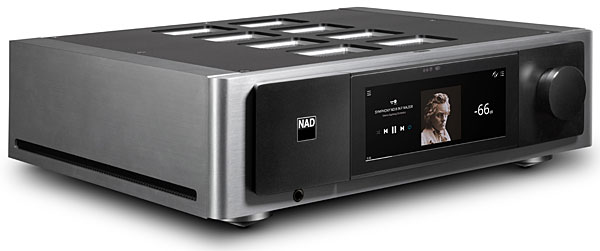
As impressive as the M33 is for a single component of modest dimensions, the inclusion of the Purifi Eigentakt modules is an indication of NAD's aim to compete with traditional multicomponent systems. This is what spurred my interest in the M33, and in all my auditions, I never felt limited by the amps. Still, I am obligated to compare them with other power amps.
With a component like the M33, which digitizes its analog inputs, it's not possible to make an apples-to-apples comparison with conventional analog amplifiers; there will always be an extra round of A/D/A conversions inside the M33. Still, it's the sound produced that matters, so onward.
I used my reference digital front end as a source, switching among the analog inputs of the various amplifiers, including the M33. For the comparisons, I used the Studio2s full-range because inclusion of the subwoofers would have greatly complicated level matching. Of course, since my goal was to compare amplifiers, I turned off Dirac Live. Using pink-noise levels measured at the speaker terminals, I adjusted the sources from Roon so that all settings in the M33 were identical for the two amps. Managing the amp swap involved muting the M33, switching the cables at the speakers, resetting the volume in the source, and unmuting the M33. All that took me about 30 seconds, mostly for unlocking and locking the eight banana plugs.
 Over the course of a week or so, I would start the day with one of the amps and, after a break for real-life events, switch to the other. I listened to many recordings in these sighted comparisons and, although there were no jarring differences, one recording helped me encapsulate best what I heard: The Americus Brass Band pays tribute to James Reese Europe's Harlem Hell Fighter's Band (Cambria Master Recordings CD-1263, CD). This is a stirring recreation of the Pathé recordings made 100 years ago (May 1919) after the WWI brass band returned from Europe, where they "filled all France with jazz." It swings and struts and didn't wear out its welcome even when I played it repeatedly for these tests.
Beginning with the M33's output modules, I found the sound notably transparent. There was a satisfying balance between the drum and tuba at the low end, the brashness of the upper brass, and the filigree of winds in between. The soundstage was full and wide, and there was the impression of significant weight and body. Depth of stage and sense of space was modest, but that's likely due to the acoustics of the rehearsal hall at the Bob Cole Conservatory of Music where the recording was made. Overall, it was quite thrilling, as music and as sound.
The class-AB Benchmark AHB2 amps (footnote 3) were also thrilling. They gave an impression of more detail in the upper midrange and treble; I did not perceive any difference in general balance or soundstage width and depth. When I returned to the M33 in the next session and listened for upper midrange and treble detail, it seemed to me that nothing was missing.
I went through a similar sequence with the class-D Classé Sigma Mono amps. The bass with these 350W (into 8 ohms) monoblocks was really solid, but I felt as if I had taken one or two steps back from the band, and the upper brass and cymbals seemed slightly softened. Again, a return to the M33 suggested that I was being oversensitive to the minor perspective shift caused by a marginal treble change.
Quick A/B comparisons between amplifiers should have made the contrasts among them clear, but they remained elusive. A change in speaker toe-in, a 0.5dB change in the tweeter level, or simply a change in program material could shift the fleeting preference.
Conclusion
Over the course of a week or so, I would start the day with one of the amps and, after a break for real-life events, switch to the other. I listened to many recordings in these sighted comparisons and, although there were no jarring differences, one recording helped me encapsulate best what I heard: The Americus Brass Band pays tribute to James Reese Europe's Harlem Hell Fighter's Band (Cambria Master Recordings CD-1263, CD). This is a stirring recreation of the Pathé recordings made 100 years ago (May 1919) after the WWI brass band returned from Europe, where they "filled all France with jazz." It swings and struts and didn't wear out its welcome even when I played it repeatedly for these tests.
Beginning with the M33's output modules, I found the sound notably transparent. There was a satisfying balance between the drum and tuba at the low end, the brashness of the upper brass, and the filigree of winds in between. The soundstage was full and wide, and there was the impression of significant weight and body. Depth of stage and sense of space was modest, but that's likely due to the acoustics of the rehearsal hall at the Bob Cole Conservatory of Music where the recording was made. Overall, it was quite thrilling, as music and as sound.
The class-AB Benchmark AHB2 amps (footnote 3) were also thrilling. They gave an impression of more detail in the upper midrange and treble; I did not perceive any difference in general balance or soundstage width and depth. When I returned to the M33 in the next session and listened for upper midrange and treble detail, it seemed to me that nothing was missing.
I went through a similar sequence with the class-D Classé Sigma Mono amps. The bass with these 350W (into 8 ohms) monoblocks was really solid, but I felt as if I had taken one or two steps back from the band, and the upper brass and cymbals seemed slightly softened. Again, a return to the M33 suggested that I was being oversensitive to the minor perspective shift caused by a marginal treble change.
Quick A/B comparisons between amplifiers should have made the contrasts among them clear, but they remained elusive. A change in speaker toe-in, a 0.5dB change in the tweeter level, or simply a change in program material could shift the fleeting preference.
Conclusion
The only clear conclusion is that the M33's Purifi technology is fully competitive that used in more expensive, separate power amps. Class-D without any ifs or buts.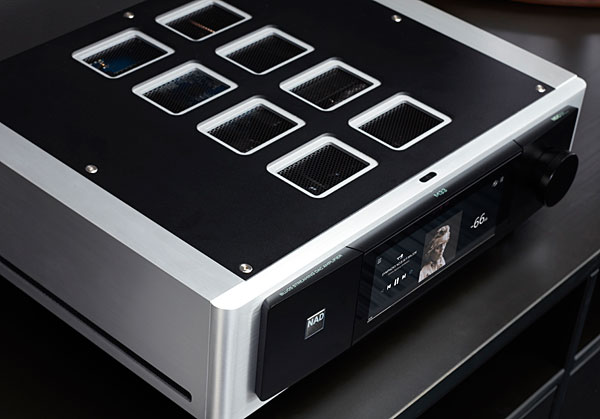 Most of us have had someone ask us how they might manage to produce and enjoy, in their home, the sound they hear in ours. Usually, their interest fades. It is never because of the cost (well, hardly ever); it's because of the required commitment—the complexity. They fret about the space it takes up, the mess of installation. They anticipate dealing with its intricate operations, and they end up with nothing, or with a lifestyle-style musical appliance.
The next time someone asks, tell them about the NAD M33. They can add a pair of speakers, almost anything from in-walls to big floorstanders (including a wide selection of remote BluOS speakers), and they're done. The M33, in one well-integrated and handsome box, replaces all the traditional components and can be operated from a smartphone or a tablet.
But I don't want to leave you with the impression that the M33 is for newbies. It's good for that because of its simplicity. But I think anyone who wishes to make a change in their music system should consider the M33—especially those considering making the move into the world of internet streaming and file playback. Keep your beloved speakers and let the NAD M33 do everything else. It will do it all superbly.
Most of us have had someone ask us how they might manage to produce and enjoy, in their home, the sound they hear in ours. Usually, their interest fades. It is never because of the cost (well, hardly ever); it's because of the required commitment—the complexity. They fret about the space it takes up, the mess of installation. They anticipate dealing with its intricate operations, and they end up with nothing, or with a lifestyle-style musical appliance.
The next time someone asks, tell them about the NAD M33. They can add a pair of speakers, almost anything from in-walls to big floorstanders (including a wide selection of remote BluOS speakers), and they're done. The M33, in one well-integrated and handsome box, replaces all the traditional components and can be operated from a smartphone or a tablet.
But I don't want to leave you with the impression that the M33 is for newbies. It's good for that because of its simplicity. But I think anyone who wishes to make a change in their music system should consider the M33—especially those considering making the move into the world of internet streaming and file playback. Keep your beloved speakers and let the NAD M33 do everything else. It will do it all superbly.
Footnote 3: The AHB2 amps accept only balanced XLR input and required adapters to accept line-level output from the M33. I used a pair of Kubala-Sosna RCA-to-XLR adapters with pins 1 and 3 of the XLR connected to the shield of the RCA connector and pin 2 of the XLR to the center pin on the RCA. This is not a proper active or transformer conversion, but it is configured as specified by Benchmark.
Things got even better when I added the three JL subwoofers, connected as one to the M33 with an 80Hz crossover and adjusted with Dirac Live 3 LE. The opening track on Pipes Rhode Island, John Dunstable's "Agincourt Hymn" played by Patrick Aiken (Riago 101), is remarkably clean and tight, with some distinct pedal notes of great power and definition. The M33 with Dirac and the subs let me play it at realistic levels with no taint of room modes to muddy it. And now the deep, shuddering tones of the synth bass on the eponymous track in Bela Fleck's Flight of the Cosmic Hippo (Warner Bros. 9 26562-2) were delineated as pitched, clear, musical notes. With "Jazz Variants," from the O-Zone Percussion Group's La Bamba (CD, Klavier KD 77017), it was as if my system had no dynamic limit at all. I annoyed my wife and neighbors for an entire afternoon, seeking the system's dynamic limits, only to find it was my own tolerance for loudness.
The improvements were even greater after I upgraded to the full version of Dirac Live, which can be unlocked in the M33 for $99.
What about Purifi?As impressive as the M33 is for a single component of modest dimensions, the inclusion of the Purifi Eigentakt modules is an indication of NAD's aim to compete with traditional multicomponent systems. This is what spurred my interest in the M33, and in all my auditions, I never felt limited by the amps. Still, I am obligated to compare them with other power amps.
Over the course of a week or so, I would start the day with one of the amps and, after a break for real-life events, switch to the other. I listened to many recordings in these sighted comparisons and, although there were no jarring differences, one recording helped me encapsulate best what I heard: The Americus Brass Band pays tribute to James Reese Europe's Harlem Hell Fighter's Band (Cambria Master Recordings CD-1263, CD). This is a stirring recreation of the Pathé recordings made 100 years ago (May 1919) after the WWI brass band returned from Europe, where they "filled all France with jazz." It swings and struts and didn't wear out its welcome even when I played it repeatedly for these tests.
The only clear conclusion is that the M33's Purifi technology is fully competitive that used in more expensive, separate power amps. Class-D without any ifs or buts.
Most of us have had someone ask us how they might manage to produce and enjoy, in their home, the sound they hear in ours. Usually, their interest fades. It is never because of the cost (well, hardly ever); it's because of the required commitment—the complexity. They fret about the space it takes up, the mess of installation. They anticipate dealing with its intricate operations, and they end up with nothing, or with a lifestyle-style musical appliance.
Footnote 3: The AHB2 amps accept only balanced XLR input and required adapters to accept line-level output from the M33. I used a pair of Kubala-Sosna RCA-to-XLR adapters with pins 1 and 3 of the XLR connected to the shield of the RCA connector and pin 2 of the XLR to the center pin on the RCA. This is not a proper active or transformer conversion, but it is configured as specified by Benchmark.