How these individual responses sum across a horizontal 30 degrees window on the tweeter axis is shown in fig.4. The speaker's overall balance is flat though the top octave is still a little high, something on which I commented in my auditioning. The mid-to-upper-bass region is also lifted. This will be due in part to the nearfield measurement technique, but this LF generosity was also something I noted about the speaker's sonic character. 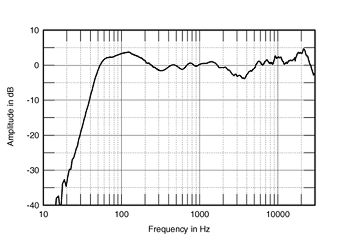 Fig.4 Mirage MRM-1, anechoic response on-axis at 50", averaged across 30 degrees horizontal window and corrected for microphone response, with the complex sum of the nearfield woofer and port responses plotted below 300Hz. The lack of presence-region energy can still be seen in this graph; whether or not it affects the MRM-1's balance will depend on how it persists off-axis. As can be seen in figs.5 and 6, which show the lateral dispersion, the on-axis depression does fill in to the speaker's sides, which means that the room sound will be better-balanced in the mid-treble than the on-axis response. Nevertheless, in my room at least, I couldn't escape the MRM-1's laid-back nature. In the vertical plane (fig.7), the MRM-1 maintains its balance over a wide window, the inevitable crossover suckouts appearing well above and below the tweeter axis.
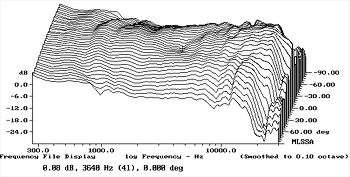 Fig.5 Mirage MRM-1, lateral response family at 50", from back to front: responses 90 degrees-5 degrees off-axis, response on HF axis, responses 5 degrees-90 degrees off-axis.
 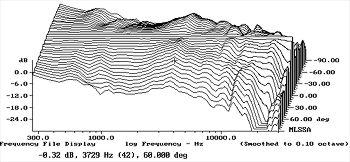 Fig.6 Mirage MRM-1, lateral response family at 50", normalized to response on tweeter axis, from back to front: differences in response 90 degrees-5 degrees off-axis, reference response, differences in response 5 degrees-90 degrees off-axis.
 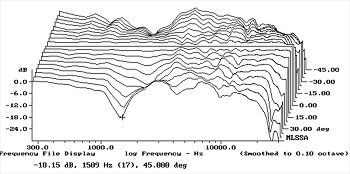 Fig.7 Mirage MRM-1, vertical response family at 50", from back to front: differences in response 45 degrees-5 degrees above axis, reference response, differences in response 5 degrees-45 degrees below axis.
Fig.4 Mirage MRM-1, anechoic response on-axis at 50", averaged across 30 degrees horizontal window and corrected for microphone response, with the complex sum of the nearfield woofer and port responses plotted below 300Hz. The lack of presence-region energy can still be seen in this graph; whether or not it affects the MRM-1's balance will depend on how it persists off-axis. As can be seen in figs.5 and 6, which show the lateral dispersion, the on-axis depression does fill in to the speaker's sides, which means that the room sound will be better-balanced in the mid-treble than the on-axis response. Nevertheless, in my room at least, I couldn't escape the MRM-1's laid-back nature. In the vertical plane (fig.7), the MRM-1 maintains its balance over a wide window, the inevitable crossover suckouts appearing well above and below the tweeter axis. Fig.5 Mirage MRM-1, lateral response family at 50", from back to front: responses 90 degrees-5 degrees off-axis, response on HF axis, responses 5 degrees-90 degrees off-axis. Fig.6 Mirage MRM-1, lateral response family at 50", normalized to response on tweeter axis, from back to front: differences in response 90 degrees-5 degrees off-axis, reference response, differences in response 5 degrees-90 degrees off-axis. Fig.7 Mirage MRM-1, vertical response family at 50", from back to front: differences in response 45 degrees-5 degrees above axis, reference response, differences in response 5 degrees-45 degrees below axis.