Figs.8, 9, and 10 show the monster McIntosh's THD+noise percentage plotted against output power for the 8, 4, and 2 ohm taps, respectively. (The discontinuities in the curves are due, I imagine, to the Power Guard circuit.) Again it can be seen that the MC1201 performs best when the load is approximately the same as the Autoformer tap, in which case the McIntosh easily exceeds its specified output power (footnote 1). 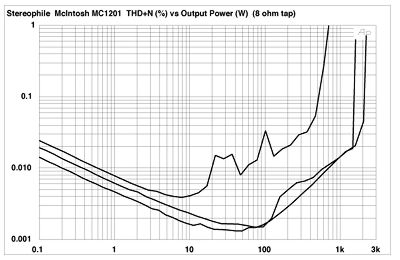 Fig.8 McIntosh MC1201, 8 ohm tap, distortion (%) vs continuous output power into (from bottom to top at 10W): 8 ohms, 4 ohms, and 2 ohms.
  Fig.9 McIntosh MC1201, 4 ohm tap, distortion (%) vs continuous output power into (from bottom to top at 10W): 8 ohms, 4 ohms, and 2 ohms.
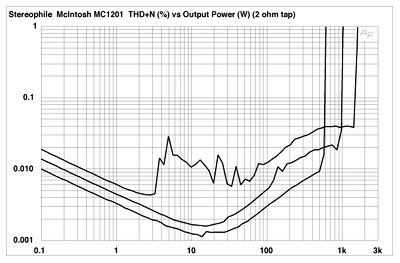 Fig.10 McIntosh MC1201, 2 ohm tap, distortion (%) vs continuous output power into (from bottom to top at 10W): 8 ohms, 4 ohms, and 2 ohms. From the 8 ohm tap, for example, more than 1500W are available into 8 ohms, with well over 2kW delivered into 4 ohms at the usual 1% THD clipping point. But "only" 700W can be delivered into 2 ohms from this tap. The power level indicated on the giant meter, by the way, was correct when the output tap matched the load. I couldn't perform my usual pulse testing with the MC1201; its fully differential output is incompatible with the single-ended Miller Amplifier Profiler. However, given the humongous gobs of low-distortion power it can deliver, McIntosh's MC1201 should be capable of driving all real-world loudspeakers to very high levels with music program (rather than continuous tones) without breaking a sweat.—John Atkinson
Footnote 1: The premature truncation of the 2 ohm trace in fig.9 is due to the MC1201 shutting itself down due to thermal overload at that point.
Fig.8 McIntosh MC1201, 8 ohm tap, distortion (%) vs continuous output power into (from bottom to top at 10W): 8 ohms, 4 ohms, and 2 ohms. Fig.9 McIntosh MC1201, 4 ohm tap, distortion (%) vs continuous output power into (from bottom to top at 10W): 8 ohms, 4 ohms, and 2 ohms. Fig.10 McIntosh MC1201, 2 ohm tap, distortion (%) vs continuous output power into (from bottom to top at 10W): 8 ohms, 4 ohms, and 2 ohms. From the 8 ohm tap, for example, more than 1500W are available into 8 ohms, with well over 2kW delivered into 4 ohms at the usual 1% THD clipping point. But "only" 700W can be delivered into 2 ohms from this tap. The power level indicated on the giant meter, by the way, was correct when the output tap matched the load. I couldn't perform my usual pulse testing with the MC1201; its fully differential output is incompatible with the single-ended Miller Amplifier Profiler. However, given the humongous gobs of low-distortion power it can deliver, McIntosh's MC1201 should be capable of driving all real-world loudspeakers to very high levels with music program (rather than continuous tones) without breaking a sweat.—John Atkinson Footnote 1: The premature truncation of the 2 ohm trace in fig.9 is due to the MC1201 shutting itself down due to thermal overload at that point.