The 1kHz, THD+noise percentage vs continuous output power curves are shown in fig.9. The output is essentially the same at all load impedances, provided the matching output tap is used. The MC2000's discrete clipping levels at 1% THD+noise are shown in Table 1. 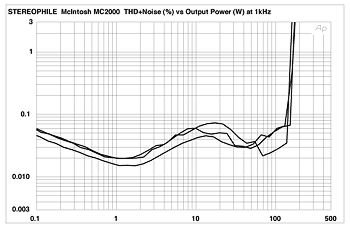 Fig.9 McIntosh MC2000, distortion (%) vs continuous output power into (from bottom to top at 2kHz) 4 ohms, 8 ohms, and 2 ohms (matched impedance taps). Table 1 McIntosh MC2000 Clipping(1% THD+noise at 1kHz)
Using the Miller Audio Research Amplifier Profiler to examine the McIntosh's power capabilities using a low-duty-cycle 1kHz toneburst with one channel driven, John Atkinson found it be a powerhouse. Matching the tap to the load gave around 200W at 1% THD+N. But almost the same power was available into lower impedances. Fig.10, for example, shows that while the 4 ohm tap will deliver 139W into 8 ohms and 205W into 4 ohms, it will still output 199W into 2 ohms and even 107W into 1 ohm, the latter equivalent to an RMS output current of 10.35A! If you're looking for a tube amplifier to drive your old Apogee ribbons, the McIntosh from its 4 ohm or 2 ohm taps will be the perfect choice. 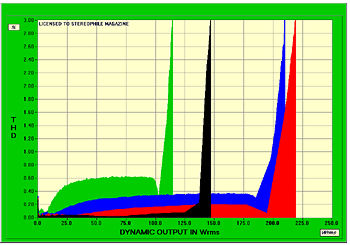 Fig.10 McIntosh MC2000, distortion (%) vs 1kHz burst output power into 8 ohms (black trace), 4 ohms (red), 2 ohms (blue), and 1 ohm (green). While not remarkable, the MC2000's test-bench results are more than respectable for a modern tube amplifier, and certainly better than most of the breed, particularly regarding output current capability.—Thomas J. Norton
Fig.9 McIntosh MC2000, distortion (%) vs continuous output power into (from bottom to top at 2kHz) 4 ohms, 8 ohms, and 2 ohms (matched impedance taps). Table 1 McIntosh MC2000 Clipping(1% THD+noise at 1kHz) | Both Channels Driven | One Channel Driven | ||
| W (dBW) | W (dBW) | ||
| Load ohms | (L) | (R) | (L) |
| 8 | 162 (22.1) | 164.3 (22.16) | 172.2 (22.36) |
| (line) | 114V | 115V | 116V |
| 4 | 165.5 (19.19) | 164.9 (19.17) | 176.8 (19.47) |
| (line) | 114V | 114V | 115V |
| 2 | 164.4 (16.16) | ||
| (line) | 116V | ||
Fig.10 McIntosh MC2000, distortion (%) vs 1kHz burst output power into 8 ohms (black trace), 4 ohms (red), 2 ohms (blue), and 1 ohm (green). While not remarkable, the MC2000's test-bench results are more than respectable for a modern tube amplifier, and certainly better than most of the breed, particularly regarding output current capability.—Thomas J. Norton