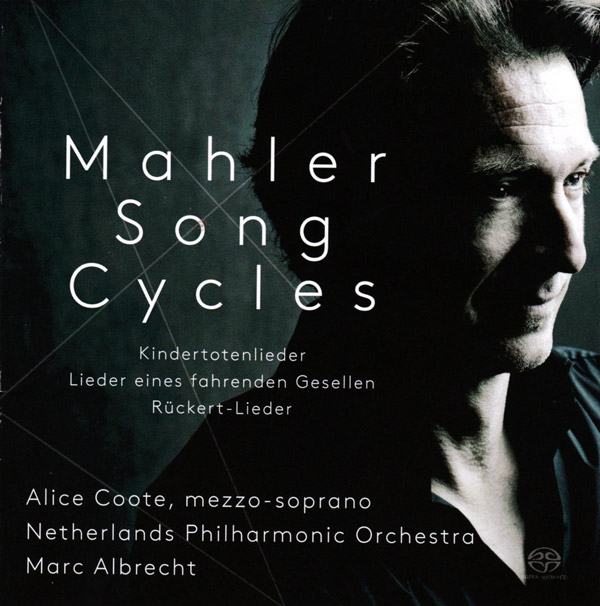
With so many great studio and live recordings of Mahler's three song cycles for solo voice readily available, any new contender has to offer something very special. On their new Pentatone hybrid SACD, Mahler Song Cycles, which is also available as a hi-rez PCM or DSD download in both stereo and surround here and here, mezzo-soprano Alice Coote and the Netherlands Philharmonic Orchestra under Marc Albrecht present interpretations of Lieder eines fahrenden Gesellen (Songs of a Wayfarer), the five Rückert-Lieder (settings of poems by Friedrich Rückert), and Kindertotenlieder (Songs to Dead Children) that can stand up against those of, to mention only a few leading mezzo-sopranos/contraltos of the last 70 years, Kathleen Ferrier, Janet Baker, Christa Ludwig, Brigitte Fassbaender, Anne Sofie Von Otter, and Frederica von Stade.
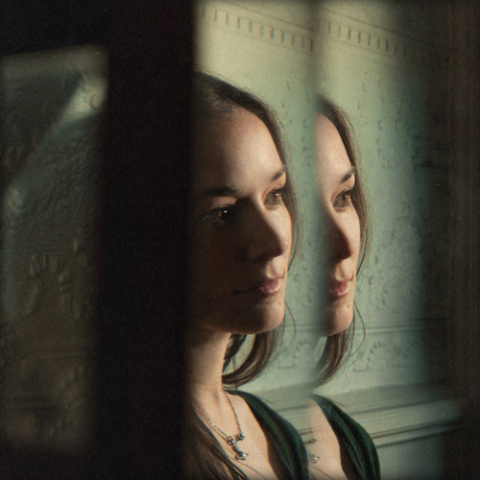
For those who are not familiar with the soloist, Coote, who was in her late 40s when she made these recordings, was named a BBC Radio 3 New Generation Artist in 2001. Earlier this year, she reprised the role of Sextus in the Metropolitan Opera's production of Handel's Giulio Cesare. Bold and outspoken on issues of importance, she is also the most intimate of artists. When I reviewed her 2010 San Francisco Performances debut recital, I was so moved by the depth of her singing that I ran backstage, encountered her with her equally gifted accompanist, Julius Drake at her side, and said, "Ordinarily, I'd never consider meeting someone I'm reviewing right after a concert. But I simply had to come backstage, because I must touch the hand of a great artist."
Coote certainly lives up to her reputation in this recital. First and foremost, she lavishes an extraordinary amount of care on these songs. In Rückert's "Blicke mir nicht in die Lieder!" (Don't try to find me out through my songs!), the level of intimacy is so intense that she almost seems to be whispering secret confidences to us. The naked intimacy continues in the wonderful "Liebst du um Schönheit" (If you love for beauty's sake,) where, once again, the intensity of her performance reflects just how much she has internalized words and music. If anyone questions whether songs written in 1901-1902, at the same time as the Fifth Symphony, can be considered representative of a living, breathing art, one need only listen to this recording.
In direct comparison, Janet Baker's 50-year old recording with Sir John Barbirolli finds her soft, high singing incomparably lovely. Baker's emptiness and spiritual devotion in "Um Mitternacht" (At Midnight) are unsurpassable, and her sincerity beyond question. The closing of "Liebst du um Schönheit," which is the final song in her ordering of a collection that is not a literal cycle, breaks your heart open with its beauty. The comparison is truly a case of "This is my very personal response to this melding of music and words" (Coote) vs "I have given myself over completely to music and words" (Baker). Coote may come across as a bit more self-conscious, but her response is no less genuine. I would not be without either version.
Nor would I be without the three Rückert songs that contralto Kathleen Ferrier recorded with Bruno Walter. The diagnosis of breast cancer that was to take her life was already known when she entered the studio in 1952, and her pain would be unbearable were it not voiced with such dignity and grace. Her conclusion of the final song of her chosen three is unequalled.
The other major difference between Coote's recording and the many others, besides the fact that Pentatone's full-price offering inexplicably lacks German texts and English translations (and offers no link to them online), lies in the recording and accompaniment. I'm not sure who recorded the disc—only executive producer (Job Maarse), producers (Wolfram Nehls and Erdo Groot), and balance engineers (Groot, Lauran Jurrius, and Jean Marie Geijsen) are listed—but the manner in which they've placed Coote in the acoustic of NedPhO-Koepel, Amsterdam, and wrapped the orchestra around her, is unique in my experience. Sound may not have such a pearly sheen in most of the venues I've visited, and the orchestra may not cast its net around the voice as it does on this recording (even in two-channel), but the engineering makes Albrecht's carefully considered orchestral commentary, and the beautiful playing of the Netherlands forces, equal partners in the recording's success. The interplay between voice and instruments is revelatory.
Coote's performance of the other two cycles (which really are cycles) is equally special. Listen to how convincingly she chirps "Zikuth! Zikuth!" in "Wenn mein Schatz Hochzeit macht" (When my darling has her wedding day), and then transitions to deep sorrow. True, she occasionally sounds just a mite shrill when she opens up full on high, but almost every time she does so, the emotional content of the music warrants such a sound. The soft highs in "Ging heut' morgen über's Feld" (I walked across the fields this morning" are truly special, as is the way Coote speaks her first "alles" (all). The Netherlands forces play with touching beauty at song's end.
From chirping, we discover an "O weh!" (O woe!) moan in "Ich hab' ein glühend Messer" (I have a red-hot knife) that is extremely real. The song's end is chilling, and the orchestral poetry perfect. In the last song, Coote almost seems to be singing to herself, so deep is the intimacy. Albrecht's funeral march is as profound as Coote's high singing is amazingly controlled. Even the fussiest amongst us will have to admit that this Songs of a Wayfarer is one of the special ones.
As for the Kindertotenlieder, I simply did not wish to listen to another version once I heard this one. Forcing myself to do so, I was surprised to discover that the great Ferrier's studio recording with Walter, set down in 1949, seemed far less overwrought in places. Much better, in this respect, is the noisy off-the-air capture of Ferrier with Klemperer, from 1951. The very different Ludwig, recorded live with Böhm and the Dresden Staaatskapelle at Salzburg in 1972, sounds resplendent beyond belief, and her intensity equals Coote's. Mezzo Brigitte Fassbaender is equally intense with Horenstein and the NDR Sinfonieorchester in 1980. In such exalted company does Coote belong. (I have extremely fond memories of Von Stade and Von Otter as well in some of this music, as well as Fischer-Dieskau, although I did not have time to listen to them this time around.)
In just a few months, John Atkinson will be asking a host of Stereophile contributors to submit our 2017 "Records to Die For." You now know what one of mine will be. After three Mahler recording reviews in a short period of time, I will likely refrain from more for a while. But I will just as likely carry Coote and Albrecht's Mahler Song Cycles with me to shows, and listen to parts of it over and over. It is an artistic and sonic showcase worthy of repeated listening.