Sidebar 3: Measurements
The Linn Klimax Solo 500 was preconditioned for 20 minutes with approximately 60W IEC 60268-1 shaped noise. At the end of that time, the temperature at the top exhaust vents had plateaued at 99°F, in a room with adequate ventilation held to 68°F. For a class-AB amplifier, this is on the cooler side, even with the power-saving settings disabled for the duration of the test. According to the manufacturer's published literature, the Solo 500 has active cooling; however, the fans were never audible.
The RCA input impedance measured 29.8k ohms at 1kHz, dropping just below 20k ohms at 20kHz, with gain sitting at 28.6dB. The balanced input impedance measured 14.5k ohms across both legs, dropping to 10.1k ohms at 20kHz, while providing a gain of 22.6dB. Pin 2 on the XLR is hot (compliant with the AES standard), and both the balanced and unbalanced inputs were noninverting, preserving absolute polarity.
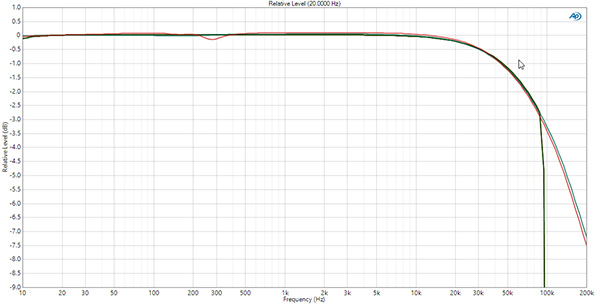
The Klimax Solo 500 supports passthrough for both XLR and RCA inputs, enabling biamplification of a speaker with minimal increase in loop area and system noise. For users who intend to use the Solo 500 this way, I recommend connecting the amplifier closest to the preamplifier to the highest-frequency inputs of the crossover network, since the passthrough outputs for both XLR and RCA show a modest 0.5dB rolloff from 10kHz, attributable to input filtering via the internal active termination intended to reduce system noise.
The Klimax Solo 500 slightly exceeds its rated power into both 8 and 4 ohms, with a vanishingly low output impedance and a noisefloor that places it among the quietest amplifiers I have measured. Linn's conservative approach to feedback brings with it a modest rise in THD+N at high frequencies and a small asymmetry between the balanced and unbalanced input performance, but the absolute levels involved are so low that I cannot imagine these departures from textbook-ideal behavior having audible consequences. This is superb measured performance.—James Grinalds
Fig.1 Linn Klimax Solo 500, balanced input, frequency response at 2.83V into 8 ohms , 4 ohms, and 2 ohms, and unbalanced input into 8 ohms—all graphs overlapping identically (1dB/vertical div.).
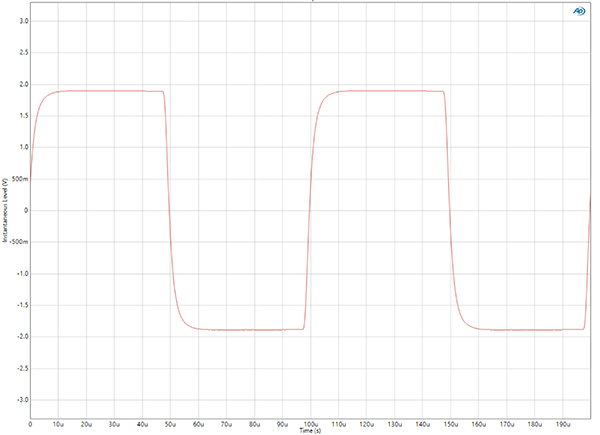
Fig.2 Linn Klimax Solo 500, balanced input, small-signal 10kHz squarewave into 8 ohms.
The amplifier's output impedance was consistent with the manufacturer's specified 0.01 ohms, with an increase of less than 0.002 ohms approaching 20kHz; this is close to the resolution limit of the APx555. Consequently, modulation of the Klimax Solo 500's frequency response due to load was below the resolution of the APx555 (fig.1). The frequency response rolloff at 100kHz is visible on the leading edge of a 10kHz squarewave, but there is no ringing or overshoot. The squarewave response was identical for the balanced and unbalanced inputs (fig.2).
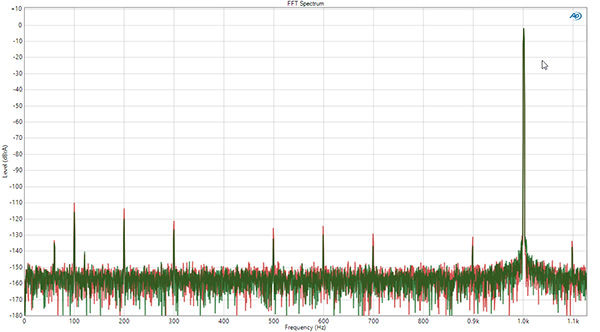
Fig.3 Linn Klimax Solo 500, balanced input (green) and unbalanced input (red), spectrum of 1kHz sinewave, DC–1kHz, at 1W into 8 ohms (linear frequency scale).
With the input terminals shorted, the unweighted, wideband signal/noise ratio of the Klimax Solo 500 monoblock measured an excellent 93.4dB (ref. 1W into 4 ohms), equivalent to an unweighted wideband S/N ratio better than 120.4dB referenced to the rated 500W into 4 ohms, which is outstanding. Measured at 1kHz with 1W into 8 ohms, the noisefloor was exemplary via both inputs. AC-related spuriae were present but irrelevant—indeed, barely measurable—at 132dB for the 60Hz fundamental and –139dB for the 120Hz second harmonic (fig.3).
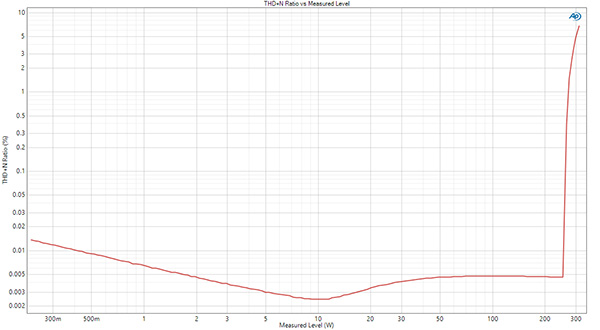
Fig.4 Linn Klimax Solo 500, distortion (%) vs 1kHz continuous output power into 8 ohms.
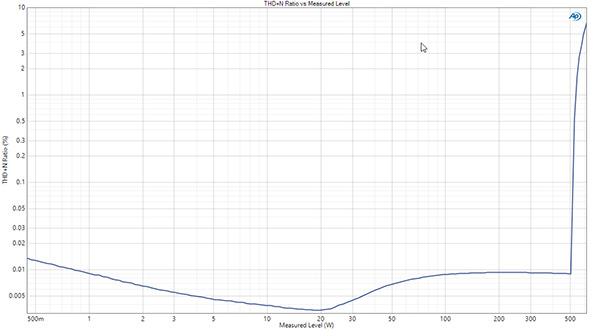
Fig.5 Linn Klimax Solo 500, distortion (%) vs 1kHz continuous output power into 4 ohms.
The Klimax Solo 500 is specified to deliver 250W into 8 ohms and 500W into 4 ohms, both equivalent to 24dBW. Using the conventional 1% THD threshold for clipping, the Klimax Solo 500 exceeded the rated power, clipping at 265W into 8 ohms and 525W into 4 ohms, both equivalent to 24.2dBW (figs.4 and 5).
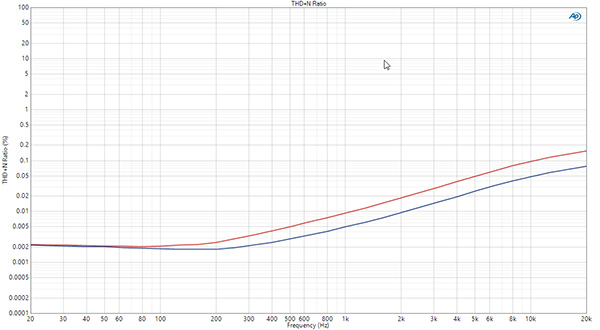
Fig.6 Linn Klimax Solo 500, THD+N (%) vs frequency at 20V into: 8 ohms (gold) and 4 ohms (red).
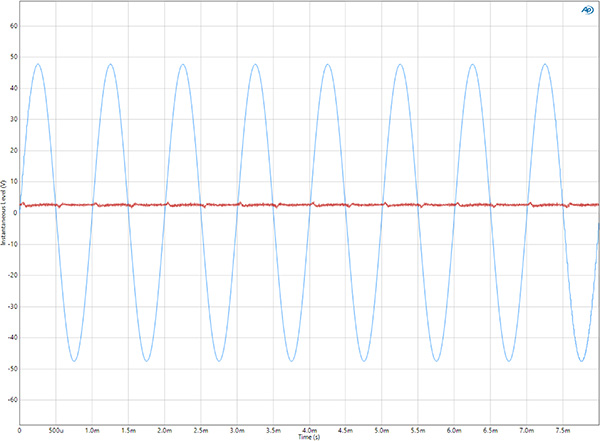
Fig.7 Linn Klimax Solo 500, 1kHz waveform at 150W into 8 ohms (blue); distortion and noise waveform with fundamental notched out (red, scaled 100× for visibility).
A rise in THD+N with frequency is visible at 20V into 8 ohms (blue) and 4 ohms (red) in fig.6. This is the usual signature of an amplifier with loop gain that falls with frequency. Crossover distortion is barely visible even at 100× magnification (fig.7).
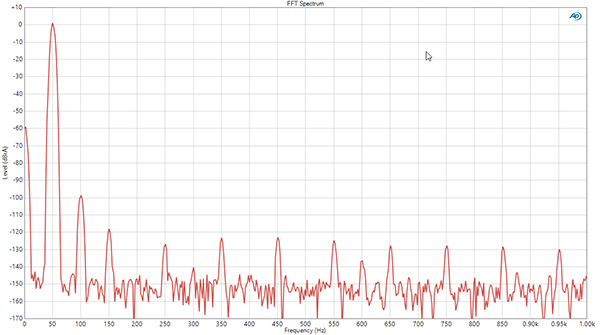
Fig.8 Linn Klimax Solo 500, spectrum of 50Hz sinewave, DC–1kHz, at 150W into 8 ohms (linear frequency scale).
Spectral analysis of a 50Hz tone at 150W into 8 ohms (fig.8) reveals that the second harmonic lies at a very low –100dB (0.001%), the third harmonic at –119dB, and no visible contamination from the 60Hz AC mains.
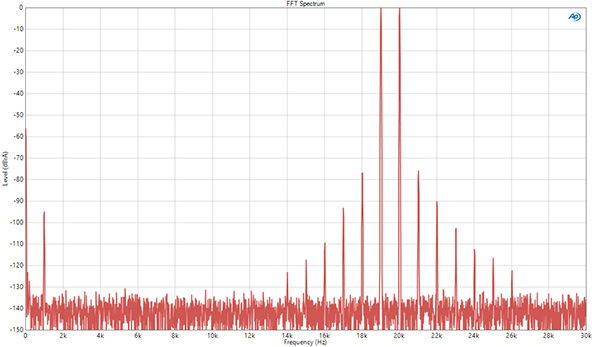
Fig.9 Linn Klimax Solo 500, HF intermodulation spectrum, DC–30kHz, 19+20kHz at 150W peak into 8 ohms (linear frequency scale).
With the increased distortion at high frequencies, more intermodulation products were present on the equal mix of 19kHz and 20kHz tones than is usually encountered, measured at 150W peak into 8 ohms (fig.9). Nevertheless, the difference product at 1kHz lay at –95dB ref. the level of each of the two tones (0.0018%), with higher-order products remaining well-controlled and none rising above –85dB.