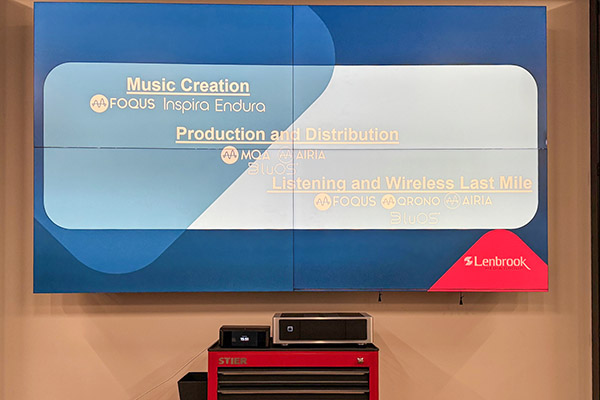
As someone who has repeatedly reaped the sonic benefits of MQA, I found the MQA Labs press release tantalizing. "MQA Labs Debuts FOQUS ADC Design with First Ever Demonstration, Showcases Full Technology Suite," it declared, then continued, "Highlights will include a first listen to audio captured with a FOQUS ADC chip, showcasing the enhanced clarity made possible by a reimagined decimation process." The press release promised further surprises, including "a walk-through of our new and upcoming studio plug-ins, offering creators powerful tools for managing impulse response and noise shaping," and "a showcase of QRONO d2a, our playback solution that delivers unmatched transparency and time performance across all audio formats."
The company claims that these technologies improve sound quality from creation through playback, all in pursuit of "digital audio with an analogue soul."
MQA Labs was acquired by Toronto-based Lenbrook in the fall of 2023. Lenbrook is the same company that brings us NAD, PSB, and Bluesound. As for MQA, the technology turned 10 years old during this year's High End Munich; it was introduced at the show in 2015.
I was unable to attend a full presentation, so I engaged in before and after-session discussion with Mike Jbara, Lenbrook Media Group's VP and general manager, and Pål Bråtelund, a Lenbrook consultant. Here’s what I learned:
First, many MQA Labs technologies are now embedded in plug-ins for studio workstations. Sound engineers can apply MQA dithering and time correction to their master before it goes to the record label. The Lenbrook Media Group, which is responsible for both BluOS and MQA, believes that these plug-ins give engineers the ability to resolve all timing issues in their recordings. Jbara said, "Engineers can now convey an analog sense of timing and space without the need to record at 192kHz or DXD sampling rates."
Lenbrook's MQA team also announced a new ESS ADC chip, which Peter Craven, Al Wood, and Bob Stuart helped create. Jbara says that the chip bypasses timing issues caused by traditional decimation filters. The chip will make its debut in Lenbrook's forthcoming NAD M33 V2 BluOS streaming DAC/amplifier.
Also coming in the near future, though with no confirmed launch date, is a new streaming service serving up MQA-encoded music. Several major labels are expected to sign on, and the plan is for the new streaming service to be available via several platforms, including Roon. This is welcome news for those who were dismayed when Tidal dropped MQA streaming.
For more on FOQUS technology, MQA studio plug-ins, and QRONO d2a playback, see mqalabs.com