Sidebar 4: Measurements
 Before beginning any measurements, I connected the Kii Control unit to one of the loudspeakers and installed the Kii Home app—v.1.1.27 (build 60)—on my iPhone. When I powered up the speaker, the app found it via Bluetooth, and it allowed me to connect the speaker to my Wi-Fi network. I then connected my MacBook Pro's USB port to the Control unit. Apple's AudioMIDI utility revealed that its USB port accepted 32-bit integer data sampled at all rates from 32kHz to 384kHz. The USB Prober app identified the Kii as "Kii Control" from "Kii Audio GmbH" with the serial number "415-001" and indicated that the USB port operated in the isochronous asynchronous mode.
I reset the loudspeaker's settings by pressing the appropriate button on its rear panel for more than 15 seconds, which disabled any equalization settings, set the LF Adjust and HF Adjust to 0dB, and set the Latency to Exact Phase. I then connected the analog output of my DRA Labs' MLSSA system to the appropriate XLR jack on the speaker's rear panel, selected that input, and set its sensitivity to –10dBV. This input's impedance was 17.6k ohms across the audioband. I performed a complete set of measurements with this input, using a calibrated DPA 4006 microphone with an Earthworks microphone preamplifier for the farfield behavior and an Earthworks QTC-40 mike for the nearfield responses. I then repeated some of the tests using the AES3 input with the speaker set to Left. (This input locked to data with sample rates up to 192kHz and, like the analog input, preserved absolute polarity, ie, was noninverting.)
The Kii Home app indicated that the speaker's volume control was set to "50." Sending the speaker a pseudorandom noise signal with a 20kHz bandwidth and an amplitude of 100mV peak–peak gave an SPL of 72.5dB(C)/slow ballistics at 1m, measured with the Studio Six SPL Meter app on my iPhone. Setting the analog input's sensitivity to +4dBu increased the SPL by 14dB. Digital pseudorandom noise data at –20dBFS gave an SPL of 94dB(C).
Before beginning any measurements, I connected the Kii Control unit to one of the loudspeakers and installed the Kii Home app—v.1.1.27 (build 60)—on my iPhone. When I powered up the speaker, the app found it via Bluetooth, and it allowed me to connect the speaker to my Wi-Fi network. I then connected my MacBook Pro's USB port to the Control unit. Apple's AudioMIDI utility revealed that its USB port accepted 32-bit integer data sampled at all rates from 32kHz to 384kHz. The USB Prober app identified the Kii as "Kii Control" from "Kii Audio GmbH" with the serial number "415-001" and indicated that the USB port operated in the isochronous asynchronous mode.
I reset the loudspeaker's settings by pressing the appropriate button on its rear panel for more than 15 seconds, which disabled any equalization settings, set the LF Adjust and HF Adjust to 0dB, and set the Latency to Exact Phase. I then connected the analog output of my DRA Labs' MLSSA system to the appropriate XLR jack on the speaker's rear panel, selected that input, and set its sensitivity to –10dBV. This input's impedance was 17.6k ohms across the audioband. I performed a complete set of measurements with this input, using a calibrated DPA 4006 microphone with an Earthworks microphone preamplifier for the farfield behavior and an Earthworks QTC-40 mike for the nearfield responses. I then repeated some of the tests using the AES3 input with the speaker set to Left. (This input locked to data with sample rates up to 192kHz and, like the analog input, preserved absolute polarity, ie, was noninverting.)
The Kii Home app indicated that the speaker's volume control was set to "50." Sending the speaker a pseudorandom noise signal with a 20kHz bandwidth and an amplitude of 100mV peak–peak gave an SPL of 72.5dB(C)/slow ballistics at 1m, measured with the Studio Six SPL Meter app on my iPhone. Setting the analog input's sensitivity to +4dBu increased the SPL by 14dB. Digital pseudorandom noise data at –20dBFS gave an SPL of 94dB(C).
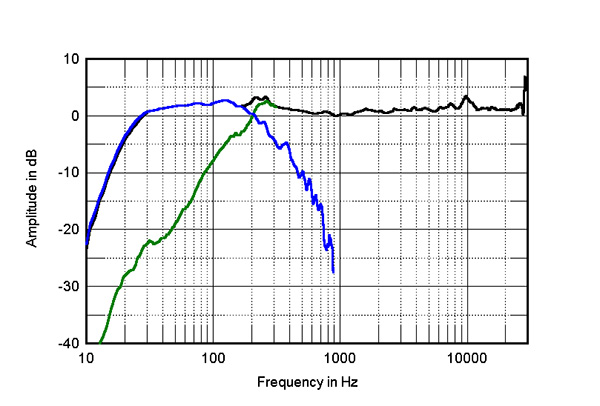
The black trace below 310Hz in fig.2 shows the summed nearfield response of the woofers and midrange unit. (The slight bump in the crossover region will disappear at the lower LF Adjust setting.) The black trace above 310Hz shows the Kii SEVEN's quasi-anechoic farfield response at a 50" microphone distance, averaged across a 30° horizontal window centered on the tweeter axis. Though there is a 1dB lack of energy in the upper midrange and a small peak centered on 10kHz, the response is otherwise extraordinarily even, falling within ±1dB limits.
Footnote 1: This means that the loudspeaker is firing into hemispherical space rather than a full sphere. A speaker that has a truly flat response in the usual "4pi" space will therefore appear to have a boosted upper-bass output with a nearfield measurement, the center frequency of that boost depending on the physical dimensions of the speaker and the woofer alignment. See this explanation.
Before beginning any measurements, I connected the Kii Control unit to one of the loudspeakers and installed the Kii Home app—v.1.1.27 (build 60)—on my iPhone. When I powered up the speaker, the app found it via Bluetooth, and it allowed me to connect the speaker to my Wi-Fi network. I then connected my MacBook Pro's USB port to the Control unit. Apple's AudioMIDI utility revealed that its USB port accepted 32-bit integer data sampled at all rates from 32kHz to 384kHz. The USB Prober app identified the Kii as "Kii Control" from "Kii Audio GmbH" with the serial number "415-001" and indicated that the USB port operated in the isochronous asynchronous mode.
I reset the loudspeaker's settings by pressing the appropriate button on its rear panel for more than 15 seconds, which disabled any equalization settings, set the LF Adjust and HF Adjust to 0dB, and set the Latency to Exact Phase. I then connected the analog output of my DRA Labs' MLSSA system to the appropriate XLR jack on the speaker's rear panel, selected that input, and set its sensitivity to –10dBV. This input's impedance was 17.6k ohms across the audioband. I performed a complete set of measurements with this input, using a calibrated DPA 4006 microphone with an Earthworks microphone preamplifier for the farfield behavior and an Earthworks QTC-40 mike for the nearfield responses. I then repeated some of the tests using the AES3 input with the speaker set to Left. (This input locked to data with sample rates up to 192kHz and, like the analog input, preserved absolute polarity, ie, was noninverting.)
The Kii Home app indicated that the speaker's volume control was set to "50." Sending the speaker a pseudorandom noise signal with a 20kHz bandwidth and an amplitude of 100mV peak–peak gave an SPL of 72.5dB(C)/slow ballistics at 1m, measured with the Studio Six SPL Meter app on my iPhone. Setting the analog input's sensitivity to +4dBu increased the SPL by 14dB. Digital pseudorandom noise data at –20dBFS gave an SPL of 94dB(C).
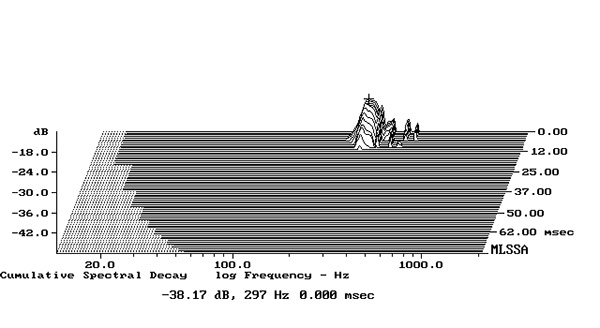
Fig.1 Kii SEVEN, cumulative spectral-decay plot calculated from output of accelerometer fastened to center of the top panel. (1V p–p input signal; measurement bandwidth, 2kHz).
The Kii's enclosure seemed inert when I rapped it with my knuckles. When I investigated the panels' vibrational behavior with a plastic-tape accelerometer, the only resonant modes I found were at 328Hz on the side panels behind the woofers and at 293Hz on the top panel (fig.1). These modes were all extremely low in level.
The blue trace in fig.2 shows the summed nearfield response of the SEVEN's two side-firing woofers, which behaved identically. The 3dB rise in the mid- and upper-bass regions will be due to the nearfield measurement technique, which assumes that the drive units are mounted in a true infinite baffle (footnote 1). The Kii's low frequencies are impressively extended for a relatively small loudspeaker, lying 6dB down at a low 20Hz, at moderate sound pressure levels. (A limiter operates at very high SPLs to protect the woofers.)
Fig.2 Kii SEVEN, anechoic response on tweeter axis at 50", averaged across 30° horizontal window and corrected for microphone response, with the nearfield responses of the woofers (set to free space), the midrange unit, and the complex sum of those responses plotted below 900Hz, 310Hz, and 310Hz.
The woofers cross over to the midrange unit (fig.2, green trace) at 200Hz, which is a considerably higher frequency than the 125Hz that designer Bruno Putzeys mentioned in an email to Kalman Rubinson. However, while Putzeys said in that email that the free space/(0dB) setting is needed when doing standard loudspeaker measurements, which is why I set the LF Adjust to 0dB, he emphasized that the SEVEN is intended to be placed with its back very close to the wall behind it. In that case, he wrote, "the energy that is radiated towards the wall comes back in phase, effectively boosting the frontal bass output by 6dB." The LF Adjust should therefore be set to –6dB for the wall placement, and if you visualize the blue trace in fig.2 lying 6dB lower in level, the crossover frequency will be exactly 125Hz.
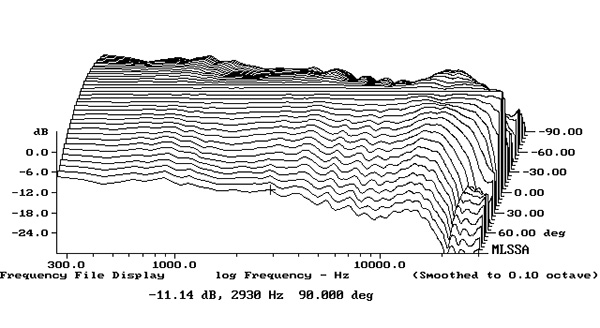
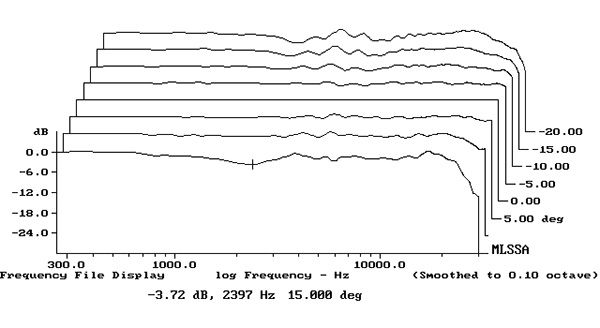
Fig.3 Kii SEVEN, lateral response family at 50", normalized to the response on the tweeter axis, from back to front: differences in response 90–5° off axis, reference response, differences in response 5–90° off axis.
Fig.4 Kii SEVEN, vertical response family at 50", normalized to the response on the tweeter axis, from back to front: differences in response 20–5° above axis, reference response, differences in response 5–15° below axis.
Fig.3 shows the Kii SEVEN's horizontal dispersion, normalized to the response on the tweeter axis, which thus appears as a straight line. The radiation pattern is superbly even and well controlled, which correlates with accurate and stable stereo imaging. The Kii speaker's radiation pattern in the vertical plane, again normalized to the response on the tweeter axis, is shown in fig.4. The even response is maintained over a wide window, though a hint of a suckout at 2.4kHz appears 15° below the tweeter axis, which implies that the midrange unit crosses over to the tweeter in this region.
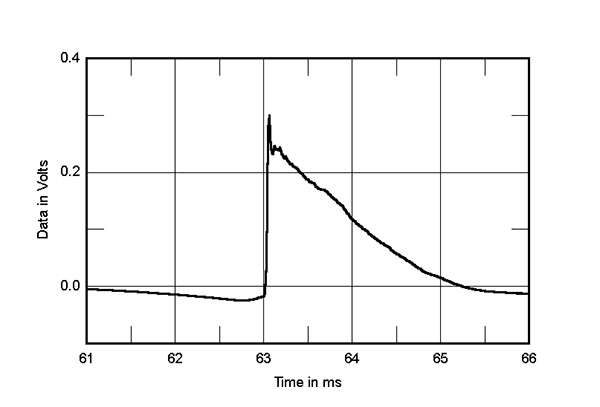
Fig.5 Kii SEVEN, latency set to Exact Phase, step response on tweeter axis at 50" (5ms time window, 30kHz bandwidth).
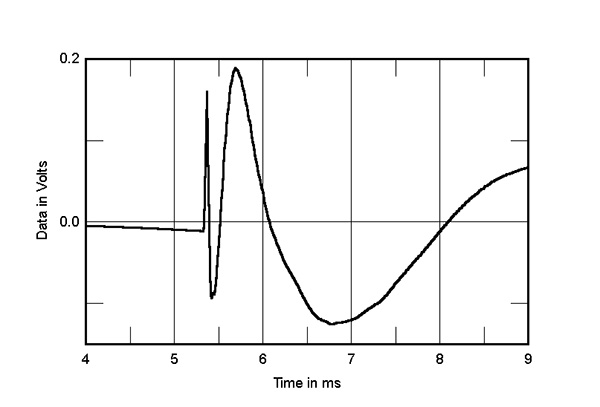
Fig.6 Kii SEVEN, latency set to Minimum, step response on tweeter axis at 50" (5ms time window, 30kHz bandwidth).
Turning to the time domain, fig.5 shows the Kii SEVEN's step response on the tweeter axis, with the Latency set to Exact Phase. While the step is delayed by almost 60 milliseconds, the speaker's DSP adjusts the timing of the drive units so that their outputs arrive at the microphone simultaneously. The step response is therefore a perfect time-coincident right triangle. I repeated this measurement with the Latency set to Minimum, which the manual recommends when using a TV or set-top box that is not able to synchronize the video and audio. The resultant step response is shown in fig.6. While the tweeter's output now arrives first at the microphone, followed by that of the midrange unit, then that of the woofers, it arrives at 5.3ms rather than the usual 3.7ms that corresponds with a 50" microphone distance. The latency is therefore just 1.6ms in this condition, achieved by sacrificing the time-coincident behavior with the Exact Phase setting. However, the SEVEN's output is still time coherent in that the decay of each driver's step smoothly blends with the start of that of the next lower in frequency. (The Kii's frequency response on the HF axis with Minimum latency was identical to that with the time-coincident Exact Phase latency.)
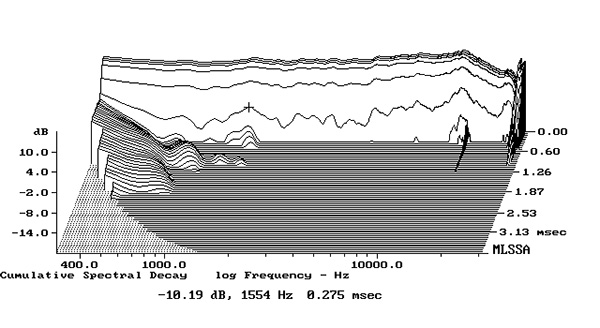
Fig.7 Kii SEVEN, cumulative spectral-decay plot on tweeter axis at 50" (0.15ms risetime).
The Kii SEVEN's cumulative spectral-decay, or waterfall, plot (fig.7), taken with the Latency set to Exact Phase, is extraordinarily clean, with virtually zero delayed energy. (As always with my cumulative spectral-decay plots, ignore the ridge of delayed energy close to 16kHz, which is due to interference from the MLSSA host PC's video circuitry.)
Overall, the Kii SEVEN offers extraordinarily good measured performance in both frequency and time domains.—John Atkinson
Footnote 1: This means that the loudspeaker is firing into hemispherical space rather than a full sphere. A speaker that has a truly flat response in the usual "4pi" space will therefore appear to have a boosted upper-bass output with a nearfield measurement, the center frequency of that boost depending on the physical dimensions of the speaker and the woofer alignment. See this explanation.