Sidebar 1: Bruno Putzeys on Directivity and Room Integration in the Kii Seven
"The mid-frequency portion is reproduced both by the midrange and side woofers, but with a precise phase-amplitude relationship that causes output behind the speaker to be minimized. The low- and high-frequency bands are reproduced normally, by the side woofers and tweeter, respectively.
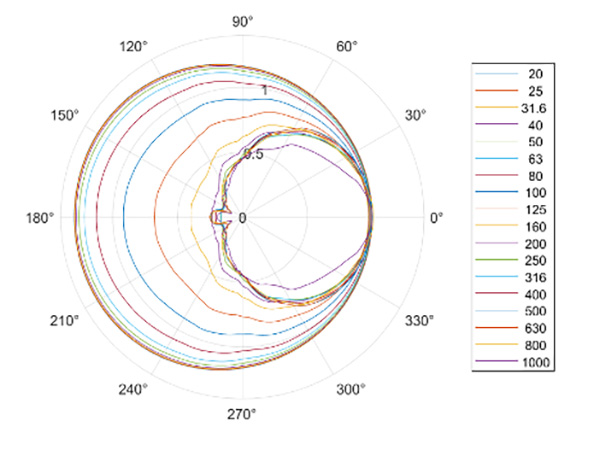 "This is a polar plot of the mid and low bands combined. Note that these plots are made with the center of rotation directly in front of the midrange driver, hence the apparent rearward shift in the bass.
"Because the low-frequency band is simply reproduced by the side woofers, the speaker is omnidirectional in this range. In the midband, the speaker is cardioid. At the crossover point (125Hz), you can see that the directivity is precisely between omni and cardioid. Now to some degree, any box speaker will transition between omni to (more or less) half-space radiation at some frequency. This is called the baffle-step frequency, and in conventional designs, this is determined by the width of the cabinet. What we've done here is to move that transition frequency down significantly. 125Hz corresponds to something like a 3' wide cabinet.
"We make quite a big deal about the fact that you can place the speaker with its back directly against the wall. This is in fact the preferred placement, and it's possible because the omni–half space transition happens at a wavelength that's long compared to the size of the speaker. The energy radiated toward the wall comes back in phase, effectively boosting the frontal bass output by 6dB. So all we need to do to complete the picture is to cut the low-frequency band by 6dB. Once you back the speaker against the wall, the rearward output (left of the graph) flips over to the right and adds up, so you have an even bass response again.
"This is a polar plot of the mid and low bands combined. Note that these plots are made with the center of rotation directly in front of the midrange driver, hence the apparent rearward shift in the bass.
"Because the low-frequency band is simply reproduced by the side woofers, the speaker is omnidirectional in this range. In the midband, the speaker is cardioid. At the crossover point (125Hz), you can see that the directivity is precisely between omni and cardioid. Now to some degree, any box speaker will transition between omni to (more or less) half-space radiation at some frequency. This is called the baffle-step frequency, and in conventional designs, this is determined by the width of the cabinet. What we've done here is to move that transition frequency down significantly. 125Hz corresponds to something like a 3' wide cabinet.
"We make quite a big deal about the fact that you can place the speaker with its back directly against the wall. This is in fact the preferred placement, and it's possible because the omni–half space transition happens at a wavelength that's long compared to the size of the speaker. The energy radiated toward the wall comes back in phase, effectively boosting the frontal bass output by 6dB. So all we need to do to complete the picture is to cut the low-frequency band by 6dB. Once you back the speaker against the wall, the rearward output (left of the graph) flips over to the right and adds up, so you have an even bass response again.
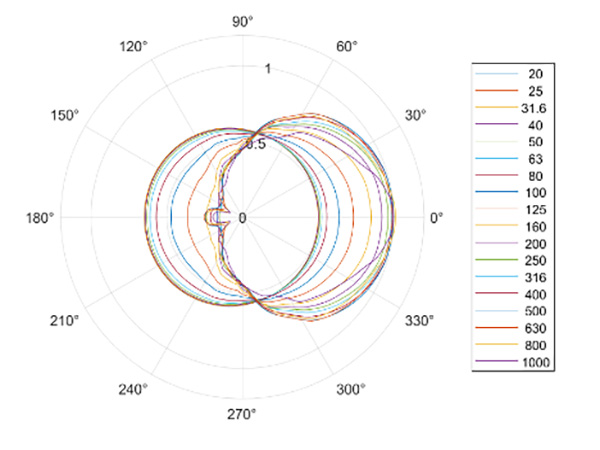 "Measured in free space, the polar plot looks like this diagram: It's hard to overstate how different this is from traditional speaker design practice. Traditional speakers are flat when measured in free space (ie, anechoically) but radiate bass in all directions. The consumer is then expected to get rid of the unwanted energy behind the speaker. This is usually not possible, so the band-aid solution is moving the speaker into the room and hoping that enough destructive interference occurs so that at the listening position you don't suffer from an enormous low-frequency boost. The damage this does to the in-room transient response is incalculable. But again, the free-space setting is not recommended.
"In short, the idea behind Kii speakers is to avoid putting unnecessary bass energy into the room. This means that room reverb in the bass is cut in half, and you get much drier bass."
"Measured in free space, the polar plot looks like this diagram: It's hard to overstate how different this is from traditional speaker design practice. Traditional speakers are flat when measured in free space (ie, anechoically) but radiate bass in all directions. The consumer is then expected to get rid of the unwanted energy behind the speaker. This is usually not possible, so the band-aid solution is moving the speaker into the room and hoping that enough destructive interference occurs so that at the listening position you don't suffer from an enormous low-frequency boost. The damage this does to the in-room transient response is incalculable. But again, the free-space setting is not recommended.
"In short, the idea behind Kii speakers is to avoid putting unnecessary bass energy into the room. This means that room reverb in the bass is cut in half, and you get much drier bass."
"This is a polar plot of the mid and low bands combined. Note that these plots are made with the center of rotation directly in front of the midrange driver, hence the apparent rearward shift in the bass.
"Because the low-frequency band is simply reproduced by the side woofers, the speaker is omnidirectional in this range. In the midband, the speaker is cardioid. At the crossover point (125Hz), you can see that the directivity is precisely between omni and cardioid. Now to some degree, any box speaker will transition between omni to (more or less) half-space radiation at some frequency. This is called the baffle-step frequency, and in conventional designs, this is determined by the width of the cabinet. What we've done here is to move that transition frequency down significantly. 125Hz corresponds to something like a 3' wide cabinet.
"Measured in free space, the polar plot looks like this diagram: It's hard to overstate how different this is from traditional speaker design practice. Traditional speakers are flat when measured in free space (ie, anechoically) but radiate bass in all directions. The consumer is then expected to get rid of the unwanted energy behind the speaker. This is usually not possible, so the band-aid solution is moving the speaker into the room and hoping that enough destructive interference occurs so that at the listening position you don't suffer from an enormous low-frequency boost. The damage this does to the in-room transient response is incalculable. But again, the free-space setting is not recommended.
"In short, the idea behind Kii speakers is to avoid putting unnecessary bass energy into the room. This means that room reverb in the bass is cut in half, and you get much drier bass."