Setup
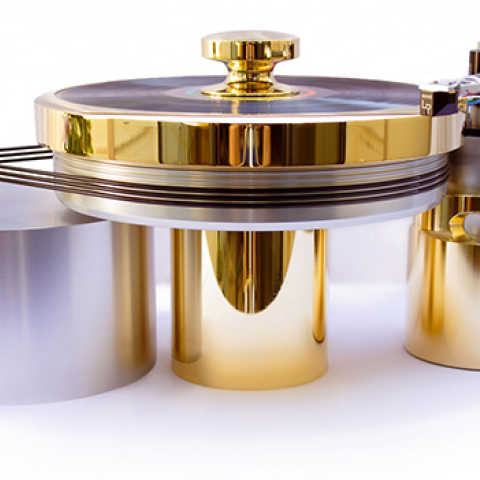
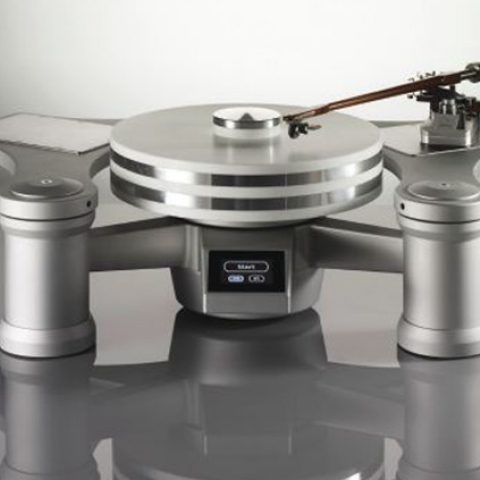
SetupI wasn't required to set up the SMS, as Sikora and Fox enlisted a three-man crew to bring the turntable's four wooden crates up the stairs and into my apartment. Notable Audio's Jessie Bentley did the setup work. This was not a reviewer perk. "All J.Sikora dealers are required to set up the 'table and tonearm for the customer," Jeff Fox explained. "If a dealer gets permission to ship a 'table to a location where there is no dealer, then the dealer must do the installation there." Supplied accessories include a pair of J.Sikora–branded interconnects, an umbilical cable to connect the power supply, and a quartet of snazzy leather pads to place the record weight on when it's not in use. (I preferred the sound of the SMS without the weight.) Along with a very clear user's manual, a tool kit is provided. It includes a set of Allen wrenches, a bubble level, a vial of oil for the main bearing, a jig for positioning the motors, cotton gloves to keep your fingerprints off the shiny metal parts, and some lint-free wipes to remove your fingerprints after you forget to wear the white gloves.
I began listening with an EMT JSD Pure Black MC cartridge mounted on the KV9 tonearm. This setup didn't gel. Music sounded hard and analytical. A MoFi Electronics UltraGold MC cart was a better fit, with excellent synergy. With the J.Sikora/MoFi duo, each record I played took me places previously unexplored. My attention shifted away from even the most important details—tone, texture, separation—and toward the delicate spaces between notes, the interplay of musicians, the palpable air pressure in the recording space, the distances between performers in the studio. The presentation was expansive and three-dimensional. Each record unveiled nuance, subtlety, and pleasure. The J.Sikora/MoFi collaboration provided a fresh experience, taking me places in familiar music that I had not previously been to.
 The inner life of records
Once carefully mounted, the Aidas Tru-Stone Gold Web MC cartridge (provided by Jeff Fox of Notable Audio) significantly enhanced soundstage depth and the sense of scale and yielded a notable increase in resolution and harmonic richness, deepening engagement. Transient speed improved. That enhanced soundstage was more stable, and images were better defined and more robust—more embodied and more human. The ultralow noisefloor of the SMS/Aidas pairing made for an eerily silent backdrop, allowing me to experience the inner life of each record I played. This combo extracted from the grooves not just the music but also, seemingly, the life force of the musicians. Micro changes in the pressure exerted by musicians on their instruments were audible, as was the big surge of energy emanating from an ensemble when they come together to play as one. This kinetic flow—the palpable connection between master musicians in sync—was captured vividly. If the record included atmospheric or ambient details, the SMS presented them fully realized, with the impact of a real event. The SMS/Aidas pairing delivered the tightest bass I've heard from LPs, with exceptional depth, body, and tension. A fine example is Walter Booker's masterful plucking on Sonny Rollins's Alfie (Impulse! AS-9111). Another example is Kraftwerk's Tour de France (Kling Klang 50999 96610916), which was a symphony of layered basslines and swooping synth tones. Assorted upright bass sounds tracked by Rudy Van Gelder on various Prestige, Impulse!, and Blue Note recordings brought fresh details in the bass allied to palpable warmth, human tone, and impressive extension. This grip on bass fundamentals was complemented by exceptional transparency and swift transient response, resulting in the realistic reproduction of all instruments.
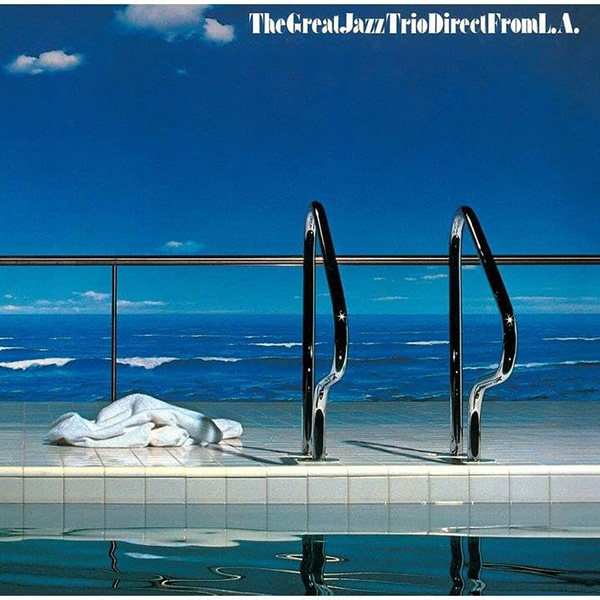 The Standard Max Supreme proved one of the most rhythmically adept players I have encountered. It precisely communicated nuances of time, tempo, groove, and swing. The subtle variations in Tony Williams's thunder-surfing drum solo in "Night in Tunisia," from The Great Jazz Trio's Direct From L.A. (1978, East Wind EW 1005), were on vivid display. The SMS effortlessly swung (though "charged" is a better verb) through the sassy ensemble riffing of Count Basie's "Blues in Hoss' Flat," from 1959's Chairmen of the Board (Roulette R 52032). The treacherous blues-rock weight of The Allman Brothers Band's "Black Hearted Woman," from their self-titled 1969 debut (Atco Records SD 33-308), was powerfully rendered, capturing the dense physicality of their dual drummers and dual guitars. In stark contrast, the SMS effortlessly glided through the supple yet insistent bossa nova rhythms of The Wonderful World of Antonio Carlos Jobim (Warner Bros. Records W1611), conveying breathy phrasing and wavelike rhythmic fluidity. The SMS's remarkable detail retrieval allowed it to convey rhythmic subtleties as it excavated ambient detail. The result was profoundly musical.
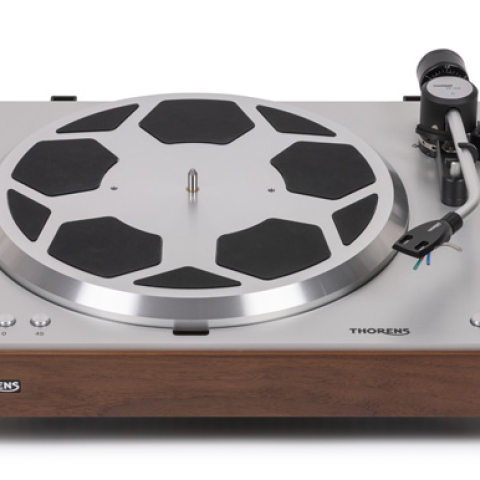
 The SMS exhibited rhythmic agility similar to my Thorens TD 124, and resolution superior to it. That extra clarity unveiled higher levels of sensory experience: the sensuous undulation of massed strings, the resonant vibrations emanating from a cymbal, the lingering decay of a guitar note, the reverberating shiver of a trumpet blast. The SMS also delivered a broad dynamic range within an immersive soundstage of notable scale, as exemplified by Karajan Conducts Ravel (EMI ASD 2766).
The SMS gave me more insight into the musicians and music I love, from the world-weary slide guitar solos of Duane Allman and dumbfounding technique of drummer Vinnie Colaiuta to the mysterious trumpet of Miles Davis and the winsome beauty of The Beatles. It cut across genres, reproducing music as a whole-cloth simulacrum with a ceaseless ability to delight. I suspect our records harbor a wealth of information that typically remains latent—esoteric, intangible qualities more deeply sensed or intuited than explicitly heard. The Standard Max Supreme faithfully conveys such subtleties, in a deep soundstage of exceptional scale, rich tonality, "touch it" texture, and PRaT-endowed speed and liveliness.