 I've never written a love story before, but then, there's always a first time. This romance concerns the stunningly anthropomorphic Jadis Eurythmie II (mostly) horn speakers and the petite, jewel-like and vivacious Jadis SE300B amps—a 10W single-ended triode design with paralleled output tubes.
Kathleen and I, having flung ourselves into single-ended's embrace, have become, to some fashion, quite experienced. I've described the purity of presentation available with the Wavelength Audio Cardinal XS monoblocks when coupled with the Swiss-made Reference 3A Royal Master Controls in these pages (January '96). Using the Eurythmie speakers, which supplanted the 3As in our system, we've listened to Gordon Rankin's Wavelength Cardinal XS monos, the Kondo-san Audio Note Kasai parallel 300B stereo amplifier (next SE review to come), the ebullient and eager-to-please Cary 301SE 300B stereo unit, and the Jadis single-ended triodes, as well as our reference Jadis JA200s (yes, Jadis also does push-pull).
And we evaluated a cornucopia of 300B tubes which were slipped into the waiting sockets of these amps: the VAIC VV30B and the less-costly VV300B; the long-anticipated and very suave Western Electric 300B (see my interview with Westrex's Charles Whitener elsewhere in this issue); Chinese Golden Dragon 300B Supers; the not-quite-ready-for-prime-time ESTi 4300BLX; Audio Note-branded 300Bs (carbon-plate ESTi, I'm told). (For the hoopy-scoopy on these tubes, see my "Brace of Bs" sidebar). At this point, even Jimi Hendrix would consider us experienced—if not quite in a Purple Haze. Most of the time.
The Jadis SE300B: the Long View
I've never written a love story before, but then, there's always a first time. This romance concerns the stunningly anthropomorphic Jadis Eurythmie II (mostly) horn speakers and the petite, jewel-like and vivacious Jadis SE300B amps—a 10W single-ended triode design with paralleled output tubes.
Kathleen and I, having flung ourselves into single-ended's embrace, have become, to some fashion, quite experienced. I've described the purity of presentation available with the Wavelength Audio Cardinal XS monoblocks when coupled with the Swiss-made Reference 3A Royal Master Controls in these pages (January '96). Using the Eurythmie speakers, which supplanted the 3As in our system, we've listened to Gordon Rankin's Wavelength Cardinal XS monos, the Kondo-san Audio Note Kasai parallel 300B stereo amplifier (next SE review to come), the ebullient and eager-to-please Cary 301SE 300B stereo unit, and the Jadis single-ended triodes, as well as our reference Jadis JA200s (yes, Jadis also does push-pull).
And we evaluated a cornucopia of 300B tubes which were slipped into the waiting sockets of these amps: the VAIC VV30B and the less-costly VV300B; the long-anticipated and very suave Western Electric 300B (see my interview with Westrex's Charles Whitener elsewhere in this issue); Chinese Golden Dragon 300B Supers; the not-quite-ready-for-prime-time ESTi 4300BLX; Audio Note-branded 300Bs (carbon-plate ESTi, I'm told). (For the hoopy-scoopy on these tubes, see my "Brace of Bs" sidebar). At this point, even Jimi Hendrix would consider us experienced—if not quite in a Purple Haze. Most of the time.
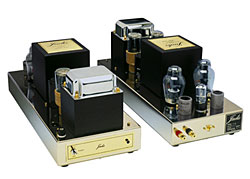
The Jadis SE300B: the Long ViewThis amplifier is drop-dead gorgeous. Working front to back on the elegant nonmagnetic highly polished stainless-steel chassis, you'll find an On/Off switch on the front apron with a green LED signaling "power on." There's no provision for warmup/standby mode as with Jadis's larger amps. Topside, there's an oozing-with-casual-quality power transformer, somewhat more diminutive in size than the lump of a hand-wound thing that crouches darkly on the chassis of the JA200s. That's followed by a pair of 5R4 rectifier tubes, a pair of caps, and the elegant Jadis signature square black potted output transformer with its elegant gold top-plate. Behind are "ignited" the two 300Bs, and a single 6SN7 at center chassis rear, flanked by another pair of caps. On the rear apron, there's an IEC power cord socket, an input RCA jack, and a single pair of binding posts.
I'll quote from a spec sheet on the Jadis parallel single-ended triode amplifiers prepared by Jean-Paul Caffi. I haven't paraphrased his words very much, as I found the charm and humor inherent in his Technical Franglais to be without peer in communicating the concepts behind them. "The SE300B supplies a power of 10W RMS and functions in pure class-A with single-ended mounting (the two tubes are in parallel) with an automatic bias [(footnote 1)]. The two high voltages, driver and power, have vacuum-tube power supplies. The bandwidth (at –3dB) is from 20Hz to 20kHz, without any feedback. The driver stage, powered at 400V, is built around a double-triode 6SN7. The two elements of the tube are mounted in cascade. The output stage is powered at 320V, which allows the tubes to work in the best conditions. The filament voltage is very finely regulated. Like other Jadis units, the output transformers are handcrafted without any gap in the magnetic circuits, and are used well below their full possibilities (they can be employed on 250W amplifiers.) It is important to have a large output transformer because a direct current crosses the primary in this construction, while in a push-pull construction, the direct current in the transformer primary cancels itself out." I couldn't have said it myself, isn't it so? And before I cancel myself out, how about let's getting to the sound!
The Jadis amplifiers were delivered with a quartet of matched ESTi 4300BLX tubes (evidently from the same Chinese factory that churns out the Golden Dragon BLX.) In addition, there were a quartet of JAN 5R4WGY rectifier tubes from Chatham Electronics, made in the ol' U.S. of A. (These were egg-cup style 5R4s, with a large solid base that extended up part of the way around the glass envelope.) JAN stands for Joint Army Navy, by the way. In addition, there were two input 6SN7s not marked for origin or brand name. A surprise package arrived soon after from what must be the nicest guy in audio, Wavelength's Gordon Rankin. "I thought I'd send you input and rectifier tubes that'll work well in the Jadis," he explained. Now I smell teen spirit! A public merci, Gordon. (As J-P Caffi seemed quite willing for me to try other tubes in his amps, I felt it very apropos to do so.) Gordon had sent a pair of his favored Sylvania 6SN7s, along with Tung-Sols, NOS (New Old Stock) red-base GEs, Golden Dragon 6SN7GTs, and very unusual looking 6SN7GTYs from the British Valve Electronic Company, whose glass-bottle interiors were coated in black. I tried all the input tubes with some interesting results. Gordon pointed out to me that the relationship between the input tube, the capacitors used in a particular design, and the output tube affects the sound in significant ways. Keep that in mind—the following description reveals the sound of these tubes in the Jadis' circuit.
We tried many different speaker cables with these little beauties, and eventually settled upon one that was perfect matched in every way—the Alpha-Core Goertz MI Ag silver ribbon cables. In conjunction with XLO throughout the rest of the system, these cables sounded above all ultra-clean and delightfully fast. You'd think a flat ribbon would be an invitation to the RFI Heebie-Jeebies, but this was absolutely not the case. Quiet, full-bodied, apparent DC-to-light extension, extreme high resolution, wonderful spatial qualities, these cables let the Jadis amplifiers be all they might. No editorializing whatsoever, aside from a certain lightness to the deep bass than could be corrected with the crossover adjustment.
Footnote 1: We're talking self-bias here, with a resistor, rather than an auto-bias circuit that requires a negative supply.