Sidebar 3: Measurements
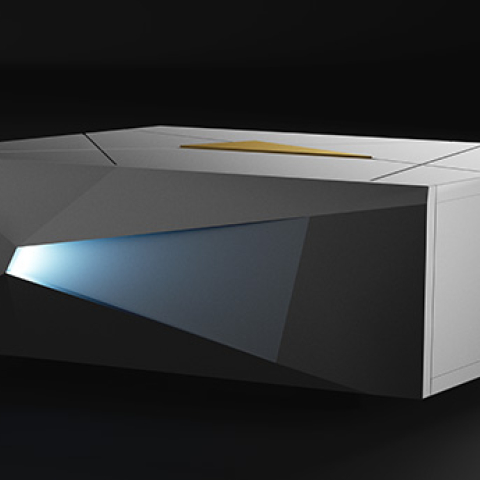
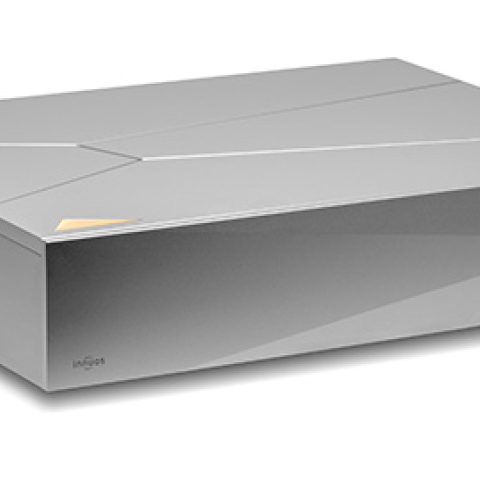
As with the Roon Nucleus+ that I reviewed in the August 2018 issue, it's difficult to determine what measurements would be meaningful with a product like the Innuos Statement. However, when I examined the analog output of an Ayre Acoustics QX-5 Twenty D/A processor with the Roon server, I did find that sourcing J-Test data via USB from the Nucleus+ gave a slightly cleaner spectrum than when the same data was sourced from my MacBook Pro laptop. The Ayre DAC has long since been returned to the manufacturer, but I did have three D/A processors with USB inputs that I could use to investigate what the effect was of sourcing data from the Innuos server rather than the laptop: an original Mytek Brooklyn, an AudioQuest DragonFly Red, and an AudioQuest DragonFly Cobalt (footnote 1).
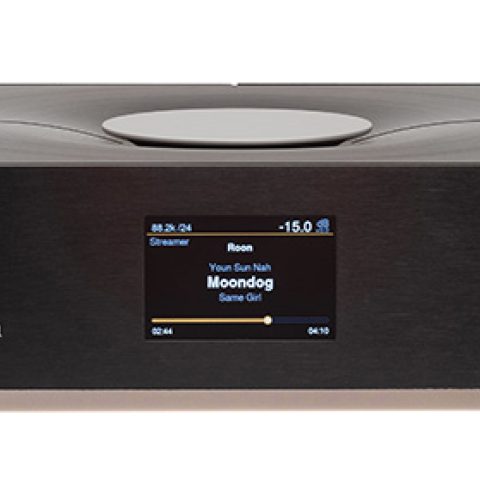
Using my Audio Precision SYS2722, I therefore compared the analog output spectrum of each of the three DACs fed USB J-Test data sampled at 44.1kHz, first from my MacBook Pro and then from the Statement's USB output. As the Innuos can be configured to work with Roon, I selected "Roon as Player Only" with the Settings menu at myinnuos.com and used the Roon app on my iPad mini to send the Statement audio data from my router via 50' of generic CAT-5 cable.
I looked first at the Mytek Brooklyn but found no differences in its jitter rejection when it was fed 16- or 24-bit J-Test data via USB from my MacBook Pro or from the Statement. I wasn't surprised. As I wrote in the measurements for the original reviews, "Even in the worst case, the optical S/PDIF input, the Brooklyn featured superb rejection of word-clock jitter."
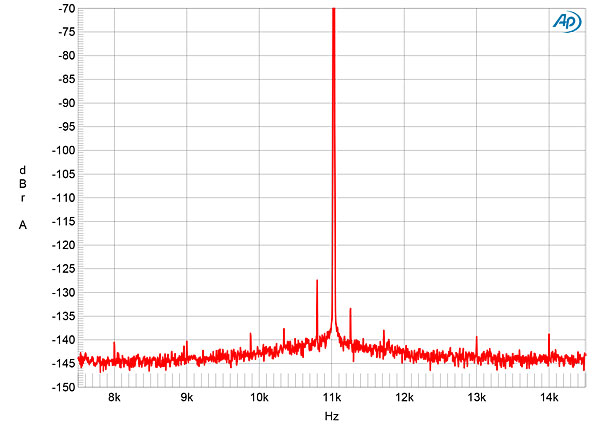
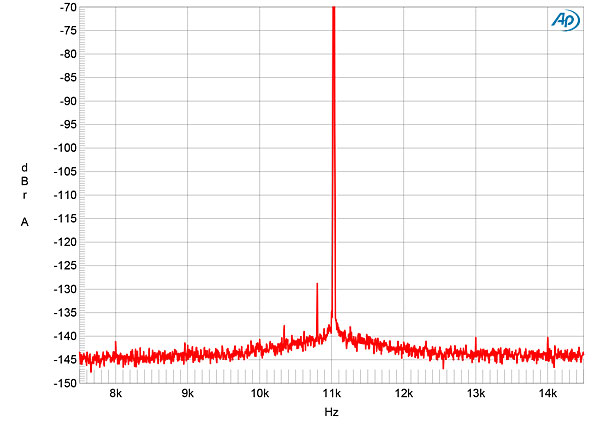
I then repeated the tests with the AudioQuest DragonFly Red, with its volume control set to the maximum. Fig.1 shows the spectrum of its output when fed 24-bit J-Test data sourced from the laptop. (I had to use the Audio Precision's AES17 low-pass filter to obtain this spectrum, because the ultrasonic noise in the DragonFly's output would otherwise interfere with the SYS2722's input circuitry.) Other than a pair of sidebands at ±229.6875Hz (44,100/192), lower-level sidebands at higher frequencies, and a slight rise in the noise floor to the sides of the spike that represents the high-level tone at 11.205kHz, the spectrum is clean.
Footnote 1: Jim Austin reviewed the Mytek in November 2016; Art Dudley reviewed the DragonFly Red in September 2016; and I reviewed the DragonFly Cobalt in December 2019.
Fig.1 AudioQuest DragonFly Red, high-resolution jitter spectrum of analog output signal, 11.025kHz at –6dBFS, sampled at 44.1kHz with LSB toggled at 229Hz: 24-bit USB data sourced from MacBook Pro (left channel blue, right red). Center frequency of trace, 11.025kHz; frequency range, ±3.5kHz.
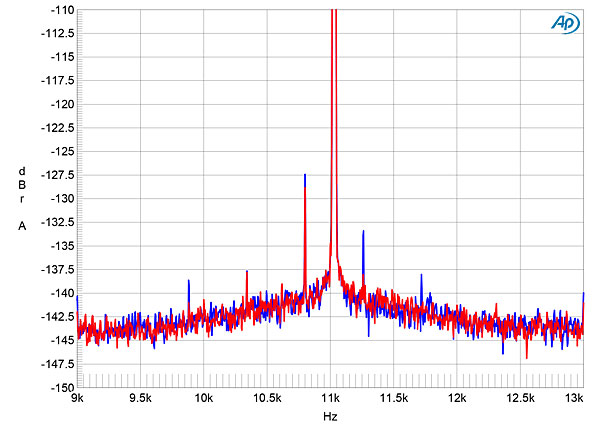
Fig.2 shows the spectrum when I fed the DragonFly data sourced from the network via the Statement. It looks very similar to the spectrum in fig.1, but there are small differences. I therefore replotted the data from figs.1 and 2 with expanded vertical and horizontal scales. Sourcing the data from the Innuos (fig.3, red trace) has eliminated the upper sideband from the laptop-sourced spectrum (blue trace), as well as reducing the level of the lower sideband. In addition, the expanded scale makes it easier to see that the Statement has virtually eliminated the lower-level sidebands at ±459.375Hz and ±689.0625Hz. Repeating this comparison with the AudioQuest DragonFly Cobalt gave the same result as it did using the higher-resolution Audio Precision APx555 analyzer that I have on loan (not shown).
Fig.2 AudioQuest DragonFly Red, high-resolution jitter spectrum of analog output signal, 11.025kHz at –6dBFS, sampled at 44.1kHz with LSB toggled at 229Hz: 24-bit USB data sourced from Innuos Statement fed network data from Roon (left channel blue, right red). Center frequency of trace, 11.025kHz; frequency range, ±3.5kHz.
Fig.3 AudioQuest DragonFly Red, high-resolution jitter spectrum of analog output signal, 11.025kHz at –6dBFS, sampled at 44.1kHz with LSB toggled at 229Hz: 24-bit USB data sourced from MacBook Pro (blue) and from Innuos Statement fed network data from Roon (red). Center frequency of trace, 11.025kHz; frequency range, ±2kHz.
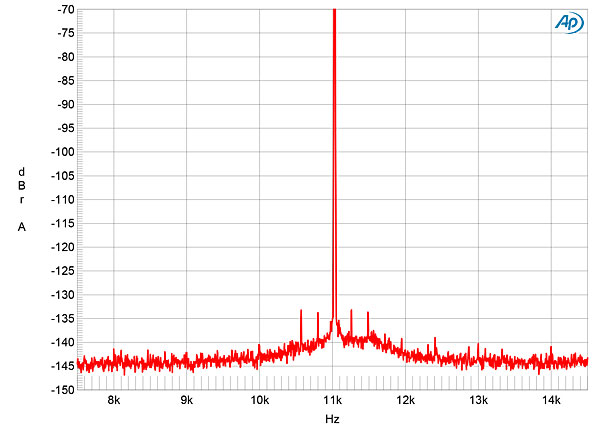
Following the testing using data sent to the Statement by Roon via the network, I disabled the Roon integration and copied the J-Test files to a USB stick. I then loaded the files onto the Statement's internal storage with the Import command at myinnuos. com. Innuos recommends using the iPeng 9 app to play files from the Statement's storage, so I installed the app on my iPad and used it to play the J-Test files to DACs connected to the Statement's USB output. Again, there were no measureable differences with the Mytek Brooklyn. With the AudioQuest DragonFly Red, however (fig.4), the sidebands at +229.6875Hz and ±459.375Hz were higher in level than they had been with network data (fig.2) and that at –229.6875Hz lower.
Fig.4 AudioQuest DragonFly Red, high-resolution jitter spectrum of analog output signal, 11.025kHz at –6dBFS, sampled at 44.1kHz with LSB toggled at 229Hz: 24-bit USB data sourced from the Innuos Statement's internal storage (left channel blue, right red).
It is difficult to decide what these measurements of the DragonFly Red or Cobalt mean. Yes, there are differences in the output spectra when comparing the DAC's analog output fed data from the Statement, either via the network or from its internal storage, compared to when it was fed data from the MacBook Pro. But these changes are very small in absolute terms, and it is impossible to correlate what I measured with any potential differences in sonic character. What I can conclude from these measurements, however, is that the Innuos Statement is a well-engineered server.—John Atkinson
Footnote 1: Jim Austin reviewed the Mytek in November 2016; Art Dudley reviewed the DragonFly Red in September 2016; and I reviewed the DragonFly Cobalt in December 2019.